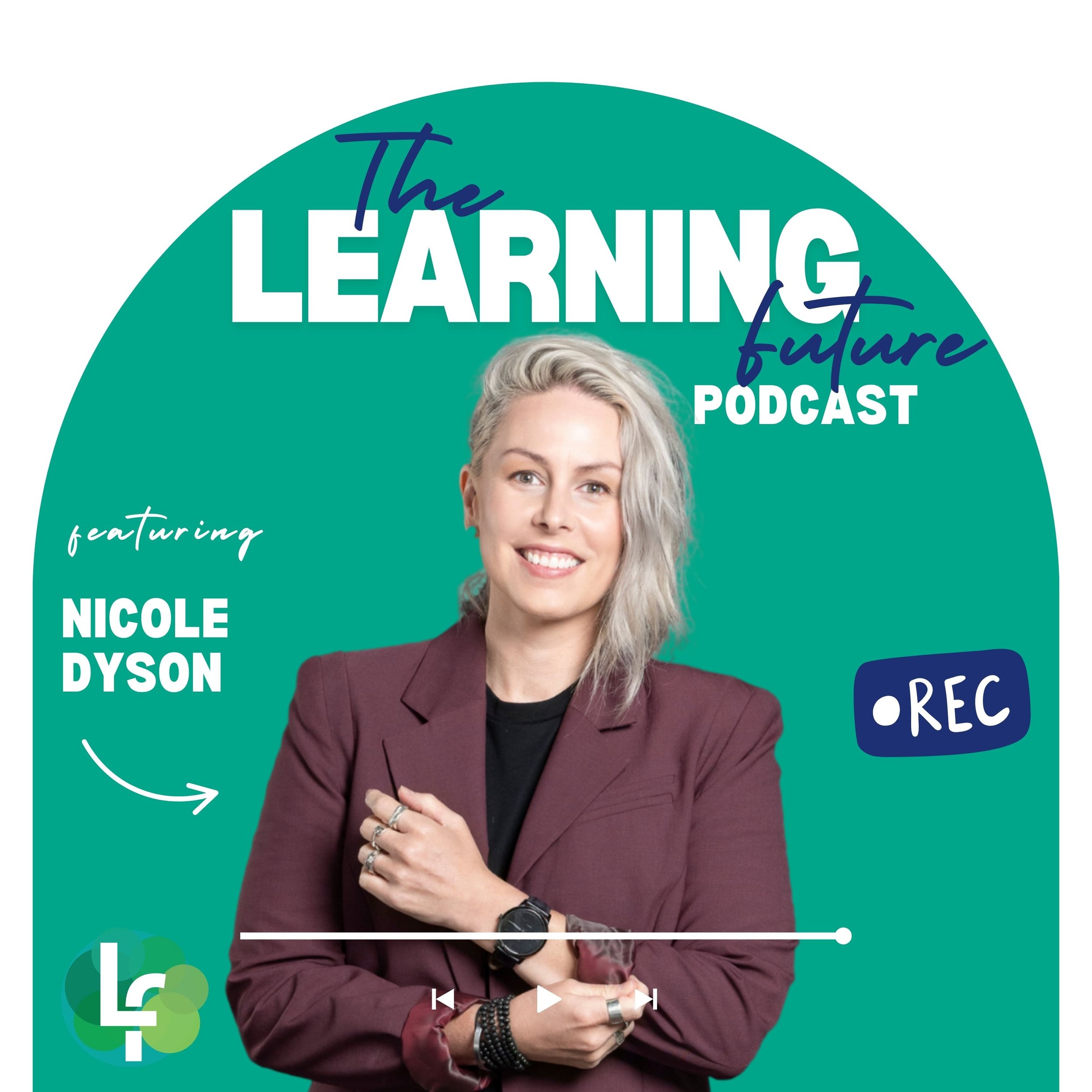
The Importance of Connection with Nicole Dyson S11E8 (147)
🌳 If AI can increasingly do the thinking we currently reward in schools, what kinds of thinking should young people be practising instead?
🌳 If we want young people to take risks, embrace uncertainty and learn at their growth edge, are we creating the same conditions for their teachers?
🎙️ Episode Summary
In this episode of The Learning Future Podcast, Louka Parry is joined by educator, entrepreneur and Future Anything founder Nicole Dyson to explore what learning needs to become in a world being rapidly reshaped by AI. Together, they challenge the false divide between knowledge and capabilities, arguing instead for capability rich learning, where young people build strong foundations of knowledge and then learn how to apply what they know in complex, unpredictable and unfamiliar contexts.
Nicole discusses why engagement matters, how AI is changing the skills young people will need beyond school, and why capabilities such as agility, communication, collaboration and agency cannot be developed through linear learning experiences alone.
The conversation also turns the lens back on educators. If we want young people to become explorers, risk-takers and adaptive thinkers, teachers and schools need the confidence to experiment too, loosening control, staying intellectually curious and creating learning environments where both educators and students can operate at their growth edge.
👤 About Nicole Dyson
Nicole Dyson is a multi-award-winning educator and entrepreneur, and a global authority on project-based learning, entrepreneurial pedagogy and school transformation. A former school leader in Australia’s public system, Nicole is the founder and CEO of Future Anything, a national education provider that has worked with 140 000 young people and teachers to impact the education of more than 1 million students in Australia and New Zealand. Nicole has received significant personal recognition, including being recognised as an Australian of the Year nominee for QLD in 2026, and included in The Educator’s Most Influential list four years running (2023 - 2026). Passionate about the power of youth-led ideas to bend the future, Nicole works with educators, schools, and systems to design and deliver learning that unlocks young people’s creativity, passion, and potential.
🔗 Connect with Nicole Dyson
🔗 Stay Connected with Louka Parry
For the latest learning innovation follow Louka on LinkedIn
Share your thoughts by visitingwww.thelearningfuture.com
🎧 Tune in to be inspired, challenged, and reminded why love truly is at the heart of learning.
[Transcript Automated]
Louka Parry (00:08)
Hello team and welcome back to the Learning Future Podcast. I'm here with actually a dear friend of mine, Nicole Dyson. She's a multi-award-winning educator, entrepreneur, a global authority entrepreneurial pedagogy, and whole school transformation of learning and teaching. She's a former school leader, hailing from Queensland. She's solar-powered. Although that's not in your bio, Nic, but I know it to be true. and she's very much a bibliophile, a turbulent enthusiast and a proud Queenslander who struggles to function when the temperature drops below twenty two degrees. Nic, it's been great to see you over the last few years really step into that global space as an Obama Fellow, as you know, a nomination for Queensland Australian of the Year. Thank you for joining the Learning Future Podcast.
Nic Dyson (00:52)
Thanks for having me, L P. What a lovely way to kick off a morning.
Louka Parry (00:56)
So far I find myself like torn between the kind of very formal host and just having a chat to you. So we'll see how we go on this one. I'm gonna start the first question though and let's see where we go. But the first question to you is what is something you're learning right now?
Nic Dyson (01:15)
I feel like I'm always learning. You know, I'm a prolific reader. So I'm constantly escaping the real world with a book. But the rabbit hole that I'm down at the moment, which I I really I kind of hate myself a little bit for buying into what is like a continuing narrative in education, but I'm really deep in the Claude Code hole at the moment and teaching myself to and again I hate myself a little bit for using this, but I'm vibe coding
I'm vibe coding Louka like I'm I'm that person.
Louka Parry (01:46)
Nicole Dyson the vibe coder. For people that
Nic Dyson (01:48)
Yeah. I knew.
Louka Parry (01:49)
who don't know what vibe coding is, Nick, maybe just give us a bit of a sense of what you're doing and then of course take us into where you think this is taking productivity, etc.
Nic Dyson (01:58)
Yeah. It's so
curious, right? Like I think the AI space is changing so rapidly. And I don't claim to be an AI expert by any stretch of the imagination, but I was connecting with a whole bunch of really smart tech entrepreneurs recently who are leveraging things like open claw or clawed code, which are more agentic forms of AI. they can drive your machine, they can Google search for you, they can pull together like
Complex processes into a single stream of a project. And I wanted to play with it, I guess. I wouldn't say I'm a tech head by any stretch of the imagination, but my team went away for a week. So I found myself with a week of time and I just downloaded Claude Code, did some rudimentary research on what not to do, because when you're working with these more agentic AI systems.
There's obviously more security risk attached, which is why the Mac minis are like sold out at the moment because everybody's like building these agentic AI on Mac minis. And then just kind of dove into this world. And so they call it vibe coding, which is basically, I think you have no technical skills at all and you are just fumbling your way through some attempt at coding.
I
Louka Parry (03:15)
Okay.
Nic Dyson (03:17)
think this is the technical definition. I'm sure if you look it up, that's exactly what it says.
Louka Parry (03:20)
It it is, right?
Yeah.
Nic Dyson (03:22)
People who have no
idea what they're doing, pretending that they do. And it would be a picture of me next to the definition of vibe coding. So I don't know. I actually started by having both my chat GPT, which is called Sage, and Claude Code open. And then I used the AI to kind of spot check each other as I was working in it. But I would say, unlike say cowork or chat GPT or co-pilot, which are these language models that converse with you.
Claude Code has the ability to string together quite complex tasks across multiple different spaces and bring it together into a project and then can convert that into say like something that will live, like an agent that will live in the internet and basically complete these tasks autonomously for you and continuously.
Louka Parry (04:15)
so interesting isn't it, this moment. And you know, it's wild that we're only t you know, well over three and a half years into the kind of public awareness around the the AI wave. where do you sit? Let tell us about Future Anything first for those that haven't heard of it, but then also take us into a bit of the learning space where where I would say you are an expert and you know you've dedicated your twenty years in education really trying, you know, think about what kind of learning matters today.
Nic Dyson (04:43)
The learning conversation is an engagement conversation. so the reason why we need to talk about learning and what learning looks like in schools is because we know when young people are engaged in school, then we get all of those really pretty metrics that schools love to report on. and I would say at the moment we have a real achievement focus in education, and it's it's the wrong conversation. We need to be talking about.
The engagement thread and how we build learning that young people want to turn up for. And I think the other side of this is you know, building learning that teachers want to turn up for. Because if we've got an educator standing in the front of the room who's excited to be there and feels genuine joy about the lesson, you know, that that anticipation of I'm excited about this lesson, that feeling is so contagious for young people and not like in a COVID way, but the in this like really beautiful.
culture of learning that you cultivate in classrooms. And so if we can build learning that teachers are excited about, we can build learning that young people want to turn up for. And so when I talk about what we do at Future Anything, I would say we support schools to build that kind of culture of learning where teachers want to be at the front of the room and and students want to be sitting in the room.
Louka Parry (05:56)
Hmm. Do what's the connection between engagement and achievement? You know, 'cause I I think of sometimes we go like we're achievement focused or no,
we're
Nic Dyson (06:05)
Yeah.
Louka Parry (06:06)
capability focused. And I again I I I can't remember who I'm quoting here, but you know, the the road to hell is paved with good educational intentions. You know, it's like this idea. I think it's so Michael Barber actually, but you know, this idea that we just think or false it's false dichotomies, you know? What what is the
Well what's the connection to you in terms of what you've learned through your work?
Nic Dyson (06:30)
I think we're dealing with a generation of young people that are starkly different to the generation of learners that we were when we were going through school, who were also living in a world that's markedly different to the world that we grew up in. and so I think we've got to consider that the ways that this new generation of learners are motivated are different to the ways that our generation were motivated. I would say I was very much just a compliance learner. I didn't really need
a reason for being there. I just understood that I needed to and I would sit in the classroom and do as I was told and regurgitate the content back and and follow that routine quite consistently without actually ever questioning whether I should or could or would or any of those things. comparatively, we've got a generation of young people who love to question. And that might be frustrating for the adults that are in their lives, but the world that they're inheriting requires that capability more than anything else because there is so much to question.
about the world that we're living in now. And so I think w if we take that kind of melting pot of like young people's dispositions and characteristics within a world that's constantly changing and is in flux. we have to then look at the way that learning needs to shift in order to meet the needs of the learners that are in the classroom in order for them to cope in a world that's so different to the one that existed when education was created. And
I think the conduit between that is pedagogy. Like I think that's how you build that bridge. and so when we talk about whether this should be an achievement conversation or engagement conversation, I think the reality is that we've moved into a space now where we don't need more compliant learners. We need engaged learners. We need learners who are who are going to raise their hand and ask difficult questions, who are going to fact check their teachers and the information that they get, who are
Who are going to get the assessment task sheet and then kind of re-pitch back the task. And like I I always say to teachers that engage learners are the learners that, you know, you finished explaining something and then you see a hand go up at the back of the classroom and there's a little part inside of you that dies. because you know that the question that's going to be asked is going to derail your entire lesson. And so we need to cultivate those kinds of questionnaires and challenges. And so
Louka Parry (08:54)
Yeah.
Nic Dyson (08:55)
In order to do that, and and to get that genuine curiosity and that I don't know, that that genuine engagement in what learning looks like, we need to focus on a different style of pedagogy to cultivate that for this generation.
Louka Parry (09:11)
Tell me then about your view on, you know, an educator listening to this, like, you know, and the role of a teacher. Like where what do you think is shifting in terms of how a teacher you know, like so I'll put a proposition to you, you know, we're not in a knowledge game anymore.
Nic Dyson (09:29)
No.
Louka Parry (09:30)
We're in an experience game or an applied transfer game, right?
Nic Dyson (09:34)
Yeah.
Louka Parry (09:35)
So and that's tri tricky for us as teachers because we're like, well, actually I I am
you know, we want expertise, especially because expertise has judgment and discernment in it and a lot of AI models, like language models don't. So
Nic Dyson (09:48)
Yeah.
Louka Parry (09:48)
where's the model of the teacher? What are you seeing in terms of the work that you do across, you know, these hundreds of schools?
Nic Dyson (09:54)
I d look, I think for this generation of learners, it won't be what they know, it'll be what they can do with what they know. And so the language that we talk about is that at the moment we've got this pedagogical warfare between content and capabilities. And I really think that we need to be using the language of capability rich curriculum. and so how do we like infuse this content with a focus on cultivating the critical capabilities that young people need to navigate life after school?
And so I'm really anti-the polarization of pedagogy because I think that pedagogy is like this really like sweet toolkit that a teacher walks into in the classroom. and the magic of a classroom is the the way a teacher can wield different pedagogies with expertise to meet the needs of the learners that are in front of them at that moment in time. So when I think about the role of a teacher though, I think we're kidding ourselves if we don't think that
the way that tech is transforming every other industry is not going to increasingly affect the role of the educator in the classroom. And you know, if you if you are if you know of an educator who approaches the classroom by using the same PowerPoint that they built five years ago to stand in front of the classroom and deliver the same content that they did five years ago.
There will probably be some sort of humanoid robot that will do that for us within the next five years. but I think that we can all agree that the magic of the classroom isn't in the content dissemination, it's in the connection that you build in the classroom. And so if as a teacher and a facilitator and an educator, you're fostering connection and a culture of learning and these capabilities within the content that you're delivering, then I don't think you're replaceable within that space.
Louka Parry (11:38)
So I I I think then with the this role of the teacher or this shift between like you hear people talk about knowledge rich curriculum all the time, you know and you know what Guy Claxon calls kind of direct instruction knowledge rich kind of group, right, over here. And then of course the progressives, laissez faire you don't need
Nic Dyson (11:57)
Hippies.
Louka Parry (11:58)
to know any the hippies, you don't need know anything. You know, all you need is skills. And so this idea that you know, and I think sometimes the
with respect to tech entrepreneurs, you know, that are all coming to transform education through new school models. I think they they miss that bit around the learning sciences. You need to know something to ask the right question or to apply knowledge meaningfully. So I'm totally with you in terms of the false dichotomy. I guess the question then is, how do you see this actually operating in a school? Like how does a school that might, you know,
might think it's a bit too content heavy and hasn't got embedded capabilities. Like how do you move into that space? What are the steps that you need to take?
Nic Dyson (12:42)
I think we've got understand that part of the reason why we don't maybe have more diverse pedagogies applied within a classroom environment comes back to the confidence of the educator at the front of the room. And so if as an educator you've been educated within that more prescriptive pedagogy and then you've moved into university, that's also privileged that pedagogy. And then perhaps you've moved into a school where that pedagogy is delivered on great outcomes, you've probably never stretched at that
Edge of what you're comfortable with around applying pedagogies that are maybe a little bit more unfamiliar, a little bit trickier, a little bit more open-ended, and might I also say you have a little bit less control of in the classroom because these explicit direct instructions, don't get me wrong, they're so critical. You can't do great inquiry or great project-based learning without the foundations that are built through explicit and direct instruction. So you can't do that without the other. But that particular
model of explicit direct instruction, the teacher is in complete control of that learning environment. And my gosh, isn't that comfortable, right? You know exactly what you're doing at the front of the room, you know exactly what you're going to get at the end, and you get through your lesson plan within the 55 minutes that you have. So there is a lot to love about that. When we start to open up a learning environment where young people are applying what they know in increasingly more complex, ambiguous
environments, then what the teacher has to do is relinquish control. And so in order for a teacher to be comfortable relinquishing control, we need to build their capacity and confidence to navigate that ambiguity in the classroom. And so, you know, part of the reason why teachers don't do this is because they're worried about breaking their students. No teacher's not playing with pedagogy because they're a bad teacher who doesn't want great things for young people. There's a little part inside of us that gets into teaching because we're deeply passionate about doing the right thing by young people.
And we're scared of experimenting with our pedagogy when we take our job so seriously. And so, you know, if a school wants teachers to play at the growth edge of these different pedagogies, then we have to provide the confidence and the capability building and the safety for teachers to start to be playful with their pedagogy without fearing that they're gonna break young people or break the classroom or break the school or break the ATAR post in December.
talking about how great the school is. Like it's all of this complexity that actually inhibits teachers' experimentation.
Louka Parry (15:09)
You brought up the kind of ATAR piece there. I'd love for you to talk a little bit about credentials, right? Because the I am of the view, like others, that the credential kind of corrupts the system top down, right? or it defines what matters top down, right? And you know, you'd be well aware globally of all the work that's going on around mastery transcripts or big picture or Melbourne metrics, your own capability work, you know.
What do you what do you think is emerging into that space into the next five years, knowing how quickly some of these technological things are getting at synthesizing or supporting knowledge?
Nic Dyson (15:48)
Yeah, it's really tricky, right? Like our current ATAR system is convenient. It's like easy to assess, easy to give a number, easy for tertiary systems to then give places to for university. And so we have like a a system of attainment that's built on efficiency and convenience. And so when we start to talk about like mastery transcripts or like capability profiles or portfolios, like gosh, that's a lot of work for the people that have to assess it. And so now
The system is no longer convenient and efficient. and so we don't do it, right? R despite maybe our philosophical viewpoint that it's probably better for the young person to to have that kind of measure of what they've achieved and where they're going. So I don't know, it's difficult because I think any vision that I have of what might be a better system for us to operate on requires a lot of people to to be less efficient.
and actually do the heavy lifting of what this might look like. So I don't know. I think w I I do believe that we'll start to see more of a portfolio entry into tertiary institutions where tertiary will look for and you know, let that US model of entry into university, I think we'll start to see more of that portfolio assessment into university. I think that's
Something that we'll see. I think in the upper school like upper secondary space, I'll I think we're going to start to see schools complement the more traditional report card with a learner profile that captures some of these critical capabilities that we know young people need. I think we're going to see an increasingly a larger conversation from industry about looking for portfolios of evidence of those 21st century skills for young people to step into entry-level jobs because
One of the challenges that we have with AI is it's removing a lot of those entry-level jobs because if it's a predictable input and a predictable output, the technology can do that. So increasingly, what industry's looking for is young people and people that can increasingly navigate more unpredictable contexts and do transformational knowledge work. Take what I know over here and apply it in increasingly unpredictable context in another space entirely.
Now that can't be measured by content. It can be measured by capability. And so what we need to do is start cultivating those capabilities deliberately within curriculum. Start providing these transparent measures so young people can see their capability and and take ownership of growing them meaningfully, and then start to translate that into those post-secondary pathways. but it's tricky because we've got this like secondary end that really privileges this.
ATAR measure. And I would say in the last five years I've seen that press further and further down. You know, it only used to affect significantly the curriculum in year 10 to 12, but now it's like playing in that junior secondary space. And I'm also walking into primary schools that are almost modeling their assessment and their assessment structures around that secondary context. They've got timetables now, they've got you know, exams and and even that model is starting to press further and further down.
into the education system.
Louka Parry (19:10)
I'm I'm really interested in two things that you sp spoke about then. One is the efficiency. Like if you build a system on efficiency, like show me the incentives, I'll show you the outcome, said Charlie Munger. Right? So it's the you know, so the incentives drive the outcome. I don't that's just logical s system understanding. so I think that's the first I'm I'm really interested in that that piece. And the other piece you said talked about technology and kind of employability. And 'cause I really want to
pack talk about that as well, right? So I'm just flagging those two. On the second point, you know, there's this anthropic thing that they released recently looking at what is the real in terms of the different industries and different spaces of work, where is the theoretical impact of artificial intelligence and where's the real impact right now? And I don't know if if I showed you this graph, but it it basically shows that white collar, all the white collar, routine cognition, is
you know, theoretically enormously disrupted and displaced because of this. You know, it's it's like having like the another way of understanding is the price of intelligence of a particular kind of intelligence is plummeting, you know, like gone through the floor. If you wanted to pay a copywriter to write you some copy, it was fifty cents a word or whatever. For a okay, so 10,000 words, well that's five thousand dollars. Now it costs you however many tokens, you know, three cents to get the same thing done.
So that's just like mind blowing to show like I don't think we can f fully understood that kind of shift. So take us into that kind of employability 'cause you you do you're kind of across industry and entrepreneurship as well as schooling. What do you think's what do you think's playing out?
Nic Dyson (20:54)
It's so interesting, right? Like there's two things that you're two things that come up for me as you're talking then. One of them is is the purpose of school for young people to reach their peak in school, or is the purpose of school for young people to leave us and reach their peak? And I think that's a really curious thing for us to unravel in the way that we structure learning and assessment. because I would sometimes argue that we
drive 13 years of schooling for young people to achieve a really great ATAR. And so that therefore becomes the peak of their achievement, rather than driving learning so that they're building thirteen years of confidence and capability so that they can step outside of school and then lead this life of like purpose and intention and success in whatever that whatever form that looks like for that young person. So I think that's one thing. The second thing with the the way that AI is
radically changing the skills profile. I I'm not I'm I promise I'm not going to stay in the Claude Code space, but we obvious we we obviously have this capability framework that we work with, which are these six capabilities that we believe sit at the intersection of of building agency. So so my belief is that agency is the product of confidence in these capabilities. So if you can cultivate these capabilities in young people, the product of that is agency.
And this is why agency is so context specific, right? Because I might have these capabilities in one context and have agency, but I might not have the confidence in these capabilities in another context and not have agency. So agency is not something you can suddenly just, you know, parachute in and expect that somebody's gonna have forever. But when we look at so I would say and I would say schools at the moment are very literate across the need for some sort of capability work in schools. Like I don't think
you know, five years ago where I was convincing principals that capabilities mattered as much as content. I think most leaders acknowledge that capabilities are critical now. And they're starting to have some sort of capability framework within their school, whether it's the general capabilities or some other capability framework that signposts these in curriculum. So so we have come some direction here. But what I'm really curious about is those capabilities only breathe when they're lived within a context that allows them
To come up against friction. So it's all good
Nic Dyson (23:15)
and well to talk about how critical communication is, how critical, you know, we talk about action, which is like collaboration and project management, or agility, which I would say is like the new resilience. These capabilities are all great, but if the only place that a young person practices those capabilities is within a linear learning experience where they don't come up against productive friction.
Then they're not building that capability within a context that's transferable in the real world, which is highly unpredictable. And so the challenge that we've got at the moment is we've got a capability literate education community who are unwilling to explore the curriculum context that young people apply these capabilities in. So we're still doing this explicit direct instruction model with like references to these capabilities and expecting the highly applied.
model of capabilities to live within a very linear learning journey. And again, don't get me wrong for any of the science of learning like advocates out there, I'm not against explicit and direct instruction. My challenge is if learning ends at explicit and direct instruction, I believe it should move forward from there, take what they know and then apply it within an open-ended context. So and the best demonstration I have of this is Reeve is going to kill me for telling this story on a podcast when we're doing it anyway. So Reef is 18.
in my house and he's studying computer science in his first year of university and I would say he's way more comp tech techie than me. Like he's just invested in this computer that does way more interesting things than I'll ever be capable of. And I had him apply Claude Code to build an agent for our company because I really wanted to him to experiment with the AI. And I know I knew that if I gave him a project I would he would then experiment with this. Now the project was really simple. I wanted him to build an agent that would scan the internet every Monday across these five categories of like education research, conferences, you know, this stuff that was really relevant to our work at Feature Anything, and then produce this digest of what's happening in the world in the last week and then deliver it to Slack every Monday morning. So instead of me having to go scouring through my favorite outlets to kind of find what's new in the zoo, it would be delivered to my inbox. Pretty simple task. Reef like did it in a few hours, delivered the agent to me. It's called Atlas. They all have names. and it did what it needed to do. It searched the internet. it produced a digest that was then delivered to Slack every Monday. and it operated autonomously, hosted in GitHub, you know, a cron that runs it. Everything was fine.
Louka Parry (25:52)
Mm.
Nic Dyson (25:52)
Problem being, I then went and it just it it didn't function. So I I would
We've all had that young person who said to us, you know, when they hand something in and we're it's not finished, and they're like, No, it's done. Like it does you it does what you said. It it's finished. And you're
Louka Parry (26:08)
But
Nic Dyson (26:08)
like, but it's not finished. So I went back through and had to stretch at the edges of a whole bunch of the things that the agent did and how it functioned. But then what I went back and did was map all of the decisions in building Atlas. So there were ninety three different decisions that went into building Atlas from sc from the beginning from
through to it functioning and operating within our company. So anybody says that AI is just like for simple thinking is not true. Like when I built the web of these 93 decisions, some of them were retrospective. You had to go back and rebuild again. Some of them moved forward and we redid things. There was complex thinking that went into those net 93 decisions that went to build what is a a fairly simple agent. Where it got
Louka Parry (26:50)
Yeah.
Nic Dyson (26:51)
really interesting is I mapped all of those decisions across Bloom's taxonomy because I was interested in how
surface level or deep or complex across the taxonomy these these decisions were. And they went the whole way up. So Reef's decisions, he they went the whole way up Bloom's taxonomy to the more sophisticated. But where it got super interesting is I then mapped it across first order, second order, and third order thinking. And so if you're familiar with Howard Marks, who's written a book around first order thinking and second order thinking, it's kind of this idea of first order thinking is like,
That base level of getting something to when it's complete. But second order thinking is almost consequence thinking, like if this, then that. And then you go to third order thinking, and we're talking about like systems and futurist perspectives, which is like once it's playing in the world, like what else does it affect? And like how does it interact with the world around us, both positively and negatively? And how can you minimize unintended negative consequences or or have it work, operate efficiently within a system from those systems and futurist perspectives?
When I mapped Reef's decision making, he only ever stayed in first-order thinking. He went the whole way up Bloom's taxonomy, but only in first order thinking. And so what I think is super interesting when we talk about the intersection of tech and capabilities is the technology can navigate the more complex taxonomy of thinking routines. What it can't do is that consequence thinking and system and futurist thinking. And so the challenge for our young people today is if
If
all they're capable of doing is Bloom's taxonomy and first order thinking, the technology will replace them. And the only way to practice second and third order thinking is to put them in a curriculum context where there is no single right answer. And they have to wrestle with the consequence and the futurist perspective. And so this is the value of an applied learning context is cultivating this second and third order thinking, which the technology can't replace.
Louka Parry (28:49)
Mm. Yeah, it's it's a really it's a fascinating one, Nick. I it reminds me of the performance learning paradox a little bit too, right? Which is and maybe we can talk a little bit about this as well, the kind of the cognitive debt, cognitive offloading, cognitive uploading. Do you know however we wanna you know, the different kind of ways the tech is being used. because, you know, I I'm I'm this is my current view that
AI in learning spaces has been net negative up to this point in time. I mean, that's the Brookings Institution report from Rebecca Winthrop and the team. That's their view, which I hold, for a whole range of reasons. Because basically, if you have an efficiency performance-based system, well, and you've got this now, this general-purpose tool that effectively can speed you up so you can, quote, perform better, but not learn anything, it turns turns out, right? That's the c the
accumulation of cognitive debt or offloading cognition too much. you end up in a space where people are producing things but they don't they haven't developed the deep thinking skills you're talking about to be able to see not just cause and effect, but cause effect, effect, effect. Or, you know, looking at retrospective or backwards design, futures modellings of scenario planning, some of the stuff that we talk about. So you know what what's your kind of you know, you're using this tech all the time, but you've got a capability already as an adult.
What's your view on this tech in schools at this point?
Nic Dyson (30:24)
It's
really tricky, right? Because I I feel like we've we're kind of out in the ocean at the moment, like a little bit like the Titanic's gone down and every educator's like floating on a board in the middle of the ocean. Except the board the board that we're clinging to is AI because we feel like this is the solution to all of the problems that the system has delivered for us now. but we're not unpicking what the root cause is of
the challenges we're facing. And so all AI is doing is accelerating the slop that we're currently experiencing. It's not actually solving any of the challenges that we've got. So there's a few different layers to this. Like I think if maybe one of the one of the challenges that I see is AI both in ed tech and also consultants who are kind of standing in front of educators and telling them that AI is going to
solve the planning problem that they have with curriculum and resources. But if you are not a pedagogue with a really strong understanding of both the discipline and the subject, as well as your learners and what's going to work for your learning context, then all you're going to get is kind of slop content that's not going to land in your classroom. And so you're going to spend, and I know teachers, you spend just as much time then calibrating the lesson
or lessons that the AI has given to you because it doesn't actually work for your curriculum context. Where I think it gets really interesting is when schools have really well developed approaches to pedagogy or teaching and learning frameworks that capture the essence
Louka Parry (32:04)
Mm-hmm.
Nic Dyson (32:05)
of where their where their learning sits, what intersection of which pedagogies define the signature of what makes learning great within their school context. And so if you can then apply that framework
with AI as a as a strong pedagogue, then you can drive the AI to deliver learning experiences or learning content that that mirrors the framework that you're providing it. But if you're just jumping into ChatGPT and saying, Macbeth, year 11, it's it's gonna give you slop. And so I
Louka Parry (32:37)
Yeah.
Nic Dyson (32:39)
don't know, I f I feel like we need to be investing more time and building the confidence and the capability of our educators to be really strong pedagogues.
And then they'll be able to leverage AI to build really strong learning content. But if all we're doing is bolting the AI prompt on what is weak pedagogical practice in classrooms, then we're accelerating slop. We're not accelerating anything that's going to benefit young people or teachers.
Louka Parry (33:07)
Mm. Yeah, I hear that. Yeah, just take me into that into that kind of, you know, where we put our attention. You know, like what is being taught versus how it's being taught versus who owns the learning, like the agency pieces. It just it really often comes back to me around the agency piece. Yeah, it's just an interesting question.
So a bit random, right? But you know, like have you heard of the the valedictorian research? You know, someone that succeeds within basically wins the game of school and then wins the game of higher education. And, you know, when you look longitudinally at how those people do across life, they do they do well. They often become expert they most of them become professionals, forty percent get to top of their field. But there's no vis there is actually is n in the evidence no real visionary. There's certainly not an entrepreneurialism.
often. They they they know how to play the compliance game because they're an achievement
Nic Dyson (34:09)
Yeah.
Louka Parry (34:10)
mindset. And I think, you know, quoting from the disengaged team, you know, the get the explorer mindset is the the kind of one for the future.
Nic Dyson (34:18)
Yeah. Yep.
Louka Parry (34:20)
Because if we're just achievers, well kind of you're just playing within the lines. Well what happens when there are no lines or the lines are moving so quickly? It's your adaptive capability, not just being able to follow the script, because there is no script.
Comments? Reflections? I mean what's just like a bit of tangent. I just I just really think about that, you know, like it's like who are we becoming through the process of education? Not just what do
Nic Dyson (34:46)
Mm.
Louka Parry (34:46)
we know with what we know, but who are we becoming? And you know, this kind of I
Nic Dyson (34:52)
I love that Brookings
report like on engagement. Like I think that notion of the achiever and the explorer, I think it's such a powerful vehicle to for teachers to reflect on what the makeup of learner is in their classroom. But maybe the lens I'd love to introduce here is what if we applied the same that same lens over our staff room. And so what percentage of our teachers would be explorers, what percentage of our teachers would be achievers?
What percentage? I forget the other two now. I'd have like pull the graphic. Yeah. The passengers
Louka Parry (35:23)
Yes, yeah. How many resistance after
Nic Dyson (35:26)
and the resistors. Yes. So I this is where I think it's really curious because when we do within the work that we do in capabilities, we have a set of like tools that help young people reflect on their confidence in these capabilities. But we have the same tools that ask teachers to reflect on their confidence in their ability to teach these capabilities. Now, it should be no surprise that the teachers and the students mirror each other.
Okay,
I don't know which one's the chicken and which one's the egg. I've got some assumptions I've got some theories, but effectively, whatever the teachers feel most confident in teaching, the young people end up feeling most confident doing. I mean, this isn't rocket science, right? And so when we think about engagement or these models in the classroom, if you've got, say, the explorer, the achiever, the passenger, the resistor, I would hazard that whatever the percentage mix is that sits across your classroom for your learners.
Will be the exact same mix that will sit across your staff makeup. And so it comes back to the origin. If you want to change the culture of learning in your classroom, you have to change the culture of learning in your staff room. And so you have to build the confidence of these educators to be explorers and to not be so achievement focused. Because if they can't let go of their own achiever identity.
How can they coach a young person to let go of their achiever identity and take healthy risks in exploring?
Louka Parry (36:51)
like you're talking about me here, Nick, as well. The achievement Yeah, thank you. Yeah, this is great.
Nic Dyson (36:55)
Welcome to our session.
Louka Parry (37:00)
I to follow up question. I 'cause I remember when you first when you first started, you know, Future Anything and this idea of, you know, a future ready it kind of it was entrepreneurship. You know, similar
Nic Dyson (37:10)
Yeah.
Louka Parry (37:10)
when we had in Aust in Australian education, you know, many places, you know, it's all about coding. But it's kinda
Nic Dyson (37:16)
Yes.
Louka Parry (37:16)
like I think what what I've what I've been interested in seeing over the last ten years is your evolution from
We're gonna teach kids to do X versus
Nic Dyson (37:23)
Mm.
Louka Parry (37:24)
we're gonna enable a learning system or a school to be able to build these kinds of things. Take us a little bit on that journey. Like what's the right framing in twenty twenty six that, you know, around
How how you know, that journey for a young person. Based on this, you know, explorer,
Nic Dyson (37:41)
Yeah.
Louka Parry (37:42)
achiever, kinda you're always stuck in one particular mode, it's it's hard to break out and kind of thrive within within s another context.
Nic Dyson (37:52)
Yeah, that's so interesting. I think when I left the classroom for start future anything, at the time I was playing with s sort of project-based learning in the classroom, particularly with entrepreneurship as a vehicle. And so young people were looking at problems that existed within the curriculum. So if as a science unit, they were looking at mm, I don't know, tectonic plates, for example. But instead of just doing the exam on tectonic plates, they would use what they knew about tectonic plates to
come up with some sort of device that would just reduce the impact from a natural disaster. So the curriculum is always a catalyst. but then I there would be this like problem solving scope that came off the side of it. Use what you know to give me something different. And so originally I I really felt like entrepreneurship was that vehicle that would unlock young people's agency. That if we provided an opportunity for them to to follow that journey, that the product of that would be this education that really future proofed young people.
But interestingly, as we scaled the program from a single school to five schools, from five schools to 12, from 12 to about 23 schools, it was at that point that I realized that I couldn't guarantee the final product just because we ran an entrepreneurship journey. There were all these anomalies that were coming up in the classroom, right? And so the young people that were really flourishing and thriving within that experience were not necessarily the young people that I expected. And the conditions that entrepreneurship delivered weren't.
eliciting the guarantee that it would deliver on the promise of what I thought. And so what I started then isolating was these this is where the capability thing came up for me. It it was less about the pedagogy and it was more about the confidence that these young people had at this intersection of critical capabilities. And so that's when I got really nerdy about well, what are the capabilities? Like can you measure them? Can you build them in any curriculum, not just entrepreneurship? And so
We still run lots of enterprise programs, but I would say that increasingly we've find ourselves further and further away from entrepreneurship education. Because to be honest, I have zero care whether the student develops a commercial product I'm interested in. Can they take something that they know and imply it in an apply it in an increasingly more complex, unpredictable way? Can they do something new with what they know? That's what I'm interested in. And so the conduit for that are these capabilities. But maybe what I'm most interested now is I think we've got this.
capability piece and I'm I'm really the work that we're doing in schools around building these capability frameworks and living these through all curriculum everywhere from like a year two teacher through to like year eleven physics is great. But there's this missing piece which I alluded to before which is the capability has to be tested within a context that has genuine friction in it. And so I would say, you know, nine years down the track I'm moving further along where I'm like, okay, capabilities are really important.
The curriculum context is really critical. So it has to be within an applied learning space. But the curriculum context has to provide the space for young people to sit at their growth edge within, you know, what I would call this productive friction, this space that really tests them under conditions that are unfamiliar and uncomfortable. But what's interesting about that is you have to have teachers that are willing to get uncomfortable in order to cultivate learning environments that enable young people to be uncomfortable.
Louka Parry (41:12)
brutal. It's like the hardest thing to honestly, I think don't think it's just an education aspect. I think it's a I think it's one of the deep truths about being human and living a life. Is, you know, and there's just so many wonderful sp even spiritual wisdom on this, Nick, you know, like hard choices, easy life. Easy choices, hard
Nic Dyson (41:32)
Yeah.
Louka Parry (41:32)
life. You know, like there's just so much that comes around that idea of I seek out friction.
And you know, like you would know, I'm just really interested in how you go beyond resilience, you know, into anti-fragility, which is through the friction I endure, I become stronger. Which is, again, another universal truth. that, you know, n Nicholasin Taleb has kind of written about. And so it's such an interesting one, right? The friction conversation, productive, unproductive friction, and where it sits. I'm curious when we have this conversation.
I mean we'll have many before then, but when we have this conversation in ten years time, you know, it's twenty thirty five, twenty thirty six, you know, we're approaching twenty forty. What do you what do you hope has happened for our our learning systems?
Nic Dyson (42:24)
you know what? I really hope we've learnt to let go.
Yeah, I really hope we've learnt to let go. I think the more we obsess over declining results, the tighter we hold on to control of curriculum, control of outcomes, control of environments, control of rules, like, you know, line up at the door, sit down, like open your notebook, rule a margin. Like we just we get tighter and tighter and tighter. And in doing so, I think we squeeze all the joy out of learning.
And we squeeze all the hope out of learning and we squeeze all the potential out of our learners. So I really hope we've learned to let go, to understand that young people will learn if we let go. And we provide them with an environment that allows them to explore who they are, what they're capable of and how they can show up in the world in a really meaningful way. Because if if we can let go, then young people can step up. And and I really feel like that's the purpose of education.
Louka Parry (43:31)
Of life. That's really powerful. Thank you. it's been wonderful to chat to you, my friend. I'd love across all the interesting work that you're doing in this capability space and future space. And what's one take home message beyond hopefully we learn to let go by you know in the next ten, fifteen years? What's a take home message you might want to leave us all with? Something to you know mull over?
Nic Dyson (43:58)
Hmm. Maybe I think, you know, in this world where we've got this real pedagogical warfare at the moment, you're either like team this or team that. maybe I would stretch our education community to stay intellectually curious about.
about the world and how our learners might learn and and what learning can look like in the classroom and stay open to experimenting with your pedagogy. Like try something. And and just because it doesn't work the first time doesn't mean it won't work later. If we want our young people to be risk takers and be agile and be confident with playing at their growth edge, then I'd really love for our educators to stay curious and then to play at their growth edge in classrooms too.
You know what? We stayed so professional for that entire conversation. I'm really proud of us. Yeah.
Louka Parry (45:02)
If you wanna you wanna find out more about Nicole's work and the great great work of Future Anything, go and check out their website, futureenything.com. and yeah. Until next time. Thanks, team.