Embracing the Messiness of Life with Ulcca Joshi Hansen S11Ep9 (148)
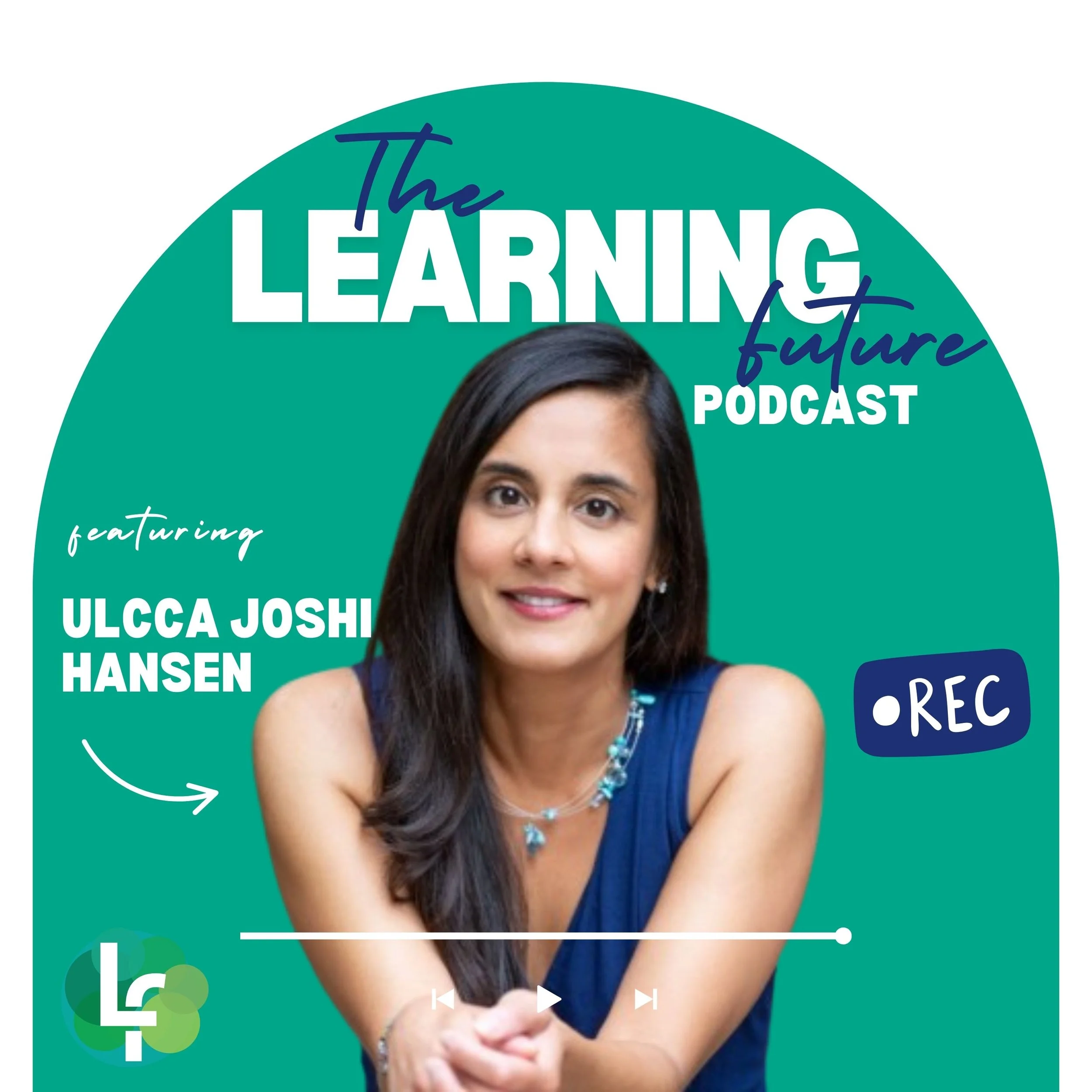
🌳 What if the messiness, uncertainty and imperfections of life aren't things to overcome, but essential parts of what makes us human?
🌳 In a world obsessed with speed, efficiency and achievement, what might become possible if we slowed down, let go of expectations and made space to simply be?
🎙️ Episode Summary
In this episode of The Learning Future Podcast, Louka Parry welcomes back Dr Ulcca Joshi Hansen, social and cultural futurist, author and education thought leader, for a deeply reflective conversation about embracing the complexity and messiness of being human.
Together, they explore the importance of slowing down, reconnecting with our emotions and bodies, and challenging society's obsession with productivity, achievement and certainty. Ulcca shares her personal journey of transformation, reflecting on how stepping away from expectations created space to rediscover her purpose and redefine success.
The conversation also examines the evolving role of education, the value of authentic human connection in an AI-driven world, and why cultivating trust, hope and imagination is essential for navigating an uncertain future.
Ultimately, this episode invites us to reconsider what truly matters, embrace our capacity for change and recognise that our humanity lies not in perfection or efficiency, but in our ability to feel, connect, grow and simply be.
👤 About Ulcca Joshi Hansen
Dr Ulcca Joshi Hansen is an author, education thought leader and social change advocate with over 20 years of experience transforming education systems in the US and internationally.
Beginning her career as an elementary school teacher, Ulcca has worked across education, policy and philanthropy to champion human-centred learning that nurtures the unique potential of every individual.
She is the author of The Future of Smart, which challenges traditional approaches to education and explores how learning systems can better support young people to thrive.
Ulcca holds a PhD in Education and Philosophy from Oxford University and a Juris Doctor from Harvard Law School. Her work focuses on reimagining education, human development and what it means to thrive in a rapidly changing world.
🔗 Connect with Ulcca Joshi Hansen
🔗 Stay Connected with Louka Parry
For the latest learning innovation follow Louka on LinkedIn
Share your thoughts by visitingwww.thelearningfuture.com
🎧 Tune in to be inspired, challenged, and reminded why love truly is at the heart of learning.
[Transcript Automated]
Louka Parry (00:01)
Hello, everybody, and welcome back to the Learning Future Podcast. I'm your host, Luca Parry. Today we've actually got a returning guest, Ulcca Joshi Hansen, PhD JD, an incredibly well-credentialed human being who is a social cultural futurist and author, and whose work explores what it means to be fully human during periods of rapid social and technological change. She has written an award-winning book, which I'm holding in my hand a few years ago, which we first spoke when we first spoke about it, called The Future of Smart: How our Education System Needs to Change to Help All People.
young people thrive. Ulcca it's so wonderful to be speaking to you again.
Ulcca (00:35)
It's so good to be back with you. We were just thinking how long ago it was and how quickly time flies. So yeah, as happens. Mm-hmm. That's all right.
Louka Parry (00:41)
And you know, the the relativity of time, of the construct of time, you know. it
feels you know, yes, like t time has a strange feature to it, it seems, at this moment. especially during COVID when we first recorded. I would love to I I know that you've evolved quite a lot in the last four years, six five years since we last recorded.
Ulcca (01:02)
Mm-hmm.
Louka Parry (01:03)
I would love to know what is something that is is kind of emergent in your mind around your own learning. because clearly
even in just your short bio, so much resonance with the way that I see the world and would like the world to be and your own work. So
Louka Parry (01:18)
what is something you're learning right now that's taking prescience for you?
Ulcca (01:23)
I I think well, it's funny I preface it with I think. I think it's fe it's feeling. It's really kind of sinking into and kind of allowing myself to fall into feeling and what that does for me and to me. I'm I've been working on a couple of projects that have had me thinking a lot about my childhood, about my family, about growing up, about how I've been as a parent and a mother.
and I think this idea of allowing myself to come down from my head into my body, into the kind of morass of things that I think I used my head to escape from, that has been a really big feature of the last four four years, probably two and a half in particular. And it shapes everything, you know, what I'm interested in reading, how I want to sit with people.
the conversations I want to have, the kind of desires I have for myself.
Louka Parry (02:28)
I love that. it reminds me of something I'm going to misquote, but it's, you know, it's the idea that the the longest journey you'll ever have is the six inches between your head and your heart. And as someone, I mean, you're you know, with a PhD from Oxford and Philosophy, Neuroscience, Human Development and K J D from Harvard Law, I mean you've kind of really spent a long time, it s feels like developing your intellect, you know what it means to be smart. And so this idea of like returning to the body to the what did you say, the morass, you know, the kind of the soil of human existence. I mean that feels pretty potent.
Ulcca (03:06)
It is.
Louka Parry (03:08)
Yeah. Tell 'cause again, I I see you as someone who really speaks into a future I would like to be a part of. And certainly in terms of the work you do in education systems. But I'm I I think it seems to me you're it's a very human journey that we need to foreground now, especially with converging tech and synthetic, you know, simulation, simulacra surrounding us. Where do you Yeah, like give us a bit more about this like w
A return to the heart, a return to the fully human experience.
Ulcca (03:43)
Yeah, for me, I think one of the one of the breaking points for me was I left a job. and I realized as I was leaving it that I hadn't really liked who I was when I was in some of the environments and spaces that I had been in for the last kind of decade or so. And so I kind of went into this chrysalis, right? for nine months or so. And I was just at a conference and and they were using this metaphor, but a a inside a chrysalis, an an entity is destroyed, right? There is this kind of releasing of stuff that breaks you down completely. And then inside the chrysalis, there is room for something new to sort of emerge. And I feel like I took, I gave myself permission to have about nine months, six to nine months of, you know, it involved binge watching a lot of stuff on Netflix some days and like sitting on my couch and sometimes, you know, just like weeping for no reason, like all that stuff. but I I let myself, which was a real gift, and not like me at all and inside of that time, it sort of felt like there was a different set of questions and curiosities that wanted to emerge. I think it was it was the same time that my own children were really entering this phase of adolescence, you know, high school.
These questions of who am I, who am I becoming? So even my identity as a mother was shifting. and so just just being able to sit in that, feel it, use some of the tools, some of the communities that I had been developing over the last kind of seven years to lean into, to be in that space. I mean, I'm giving you a lot of detail, but it it's sort of it was inside of that messiness that I think I allowed myself to hear.
Yeah, there was a slightly different shift in the direction of the work I wanted to take, the stories I wanted to tell, the things I wanted to explore. and so I took a couple of years, have been doing a lot more work in the international education space, which has been lovely, and that emerged out of the book and finding all these kind of global communities and networks that are interested in in exploring the ideas and moving in that direction. And for somebody who's a third culture kid who grew up in so many places.
I hadn't kind of been part of that international community in a really long time. And so even that kind of return to who I was was a really big part of it. And then, you know, we can talk about this, but I've definitely been shifting some of the ideas and conversations and content which I'm creating now because it feels like the world is ready for a different conversation, the kinds of conversations that I think you and I enjoy.
Louka Parry (06:35)
beautiful. Thank you for just being so I don't open about the the journey the human journey. You know, even on a podcast, you know, you can kind of self distance and watch yourself performing. It's such a like such an interesting thing to be about. I'm doing the thing, you know, kind of the switch into kind of you know, the news reader kind of idea. And I just feel like we kind of frankly lost the plot in some parts of our culture, you know, where we've optimized for the wrong thing. We have diminished the messiness that we are. I talk I I'm quite interested in this idea of I think we talked about this last time. but a kind of technomorphic desire that humanity has, which is to want to be immortal, consistent, certain. you know, the idea that you're PT says to you, you're a machine. You're such a machine. And you're like, Yes, I'm a machine. When of course it's the it's kind of the opposite of the reality of organic life is that we renew, that we die, you know, that we regenerate 300 million cells every day. You know, like this kind of idea, we're constantly in flux. And so I'm really interested in that the chrysalis metaphor you spoke to, and this idea of being, you know, in the goo or the liminal space, you know.
what were the questions you used to ask yourself and what are what you might say better questions for yourself now? And I imagine that's also true for the culture of the time, you know, it's your point where w culture's ready for a different conversation now. Maybe it's not how many followers or likes you have or something. Maybe it's something different, or what success is, it's what meaning is, you know. Take us into that world a little bit.
Ulcca (08:27)
So I think one of the things that I had to release, and this is funny because sometimes life tells us over and over and over again, and we have people who tell us, but it just takes kind of getting your butt kicked a couple of times. But I think one of the this idea that you have to go and become an executive director or be in charge of something, building an organization, an entity, a particular vision of education. And I think
I was I was doing that for the vast majority of my career. It's what the book was, a number of the organizations I was with. I think in part because of COVID and watching what happened at the end of that, where it felt like there was this opening, and then we sort of bounced right back into the old version of school, in some ways, even worse, at least in the US, where conversations immediately became about learning loss, right? And not at all about this collective trauma.
That we had just endured, where we, you know, so many people were grappling with their own mortality and other people's mortality, and you know, the reality that we're so small and in some ways had no control over this thing that happened. and so I think I, for me, I took one last job after the pandemic, and I think I just began to feel I have a model that I work with called the Two Loops model from the Bracana Institute, and it kind of talks about systems.
That are in decline. And there's nothing wrong with that, right? Systems can't just grow. That's a very mechanistic idea.
Ulcca (09:57)
Things grow, they mature, they decline, and they die. And then we compost the things that we need to. And I think what I was seeing after COVID was that that's where we were with a lot of our systems. And so in many ways, needing to step back. And instead of in my case, focusing only on education,
As the thing in the K 12 system, really, what education is about is about inviting people to think about who they are, what their gifts are, what their purpose is, who they want to be and to bring into the world. And that felt like something that all of us were being invited to grapple with in new ways. And then AI showed up. And and and this question of what is it to be human when you are face to face with this tool.
That appears to be doing so many of the things that we have thought of as the domain of of humanness. and so for me, I think the the questions I've I've started to ask are, you know, what are the capabilities that we uniquely bring as human beings who are embodied in time and space and place with other beings, other people? what does it mean to witness, right? To witness a world that's changing.
To witness other people in their changing, whether that's a you know, grief or despair or mourning or the kind of recreation. what does it mean to to imagine what's possible in a moment where we all recognize that the the assumptions and values and ways of operating in our current systems aren't sustainable? So
In this moment, can we actually start to have conversations about the world we actually want to build? And so, you know, one of my lines these days is kind of hope is a muscle. This you can't
Ulcca (11:50)
see it, you have no evidence for it, but you you're gonna articulate a vision of something that you wanna build and and we collectively wanna build. And what does it take to help people build those muscles? and and have different stories.
Louka Parry (12:06)
It's so it's so juicy. Yeah, it's this hope is a muscle. I'm just reflecting on that.
W how how close to the answers have you got, Aulka, with some of these these new questions? What does it mean to be human? You know, if you think even about the fourth industrial revolution of the cyber physical convergence and some of the World Economic Forum framings, etc. etc. You know, there's this you said it quite beautifully, you know, the domain of humanness. And now unf sadly, I think it's devastating actually, that we have conversational robotic systems, computer systems.
That can emulate humanness so well that it's not only that we can no longer tell that they've passed the Turing test, it's that we prefer them to an actual conversation that we have or chat that we might have with another human being. And I think that's because we are in some ways there's no need to balance the conversation. You become the focus of attention. You know, the sycophantic models. So I I wonder like w where where is the domain of humanness that
I mean, I have my theories, my thesis.
Ulcca (13:17)
Mm-hmm. Mm-hmm.
Louka Parry (13:19)
But for you, where should we be placing our attention right now in this moment? So we don't lose you lose kind of the essence
Ulcca (13:25)
Hmm. I wanna come back. Yeah.
Louka Parry (13:29)
of the meaning of life. Frankly, I don't want to be too existential. But you kind of the meaning of stuff, you know, what does this mean? It gotta has gotta be a key question today. Rather than this is cool.
Ulcca (13:37)
Yeah, no.
Louka Parry (13:39)
Should we Yeah, but what does it do for our experience of humanness, if anything?
Ulcca (13:44)
Hmm.
Yeah. All big questions. I won I won't say I have answers. If you do, I'd love to hear them. I mean, you're the host here.
Louka Parry (13:50)
No, I don't know about that.
Ulcca (13:54)
you know, i thinking about the the human relationship though, I I always wanted to go to summer camp, to sleep away camp when I was a kid because I heard all these stories of people who had gone and you're read teen novels and and my parents didn't send us to sleepaway camp. but when my kids were young, I found one for them.
And they've been going to one since they were basically the year after kindergarten or or I can't remember which reception year in the UK. So since
Louka Parry (14:21)
Well, yeah, nice.
Ulcca (14:22)
they were five, they've been going to the same camp. And in that time, this camp doesn't allow phones, it doesn't allow tech, it is not one of those camps where we get videotapes and you know, whatever of the kids. It is two weeks, four weeks of silence. And if we don't hear from them, we assume that everything is good.
And and I have watched over the years as they've come back, and one, they can tell the difference being in a place where they are just with other people and they have the experience of sitting and being bored or going off on adventures and climbing up to the top of you know the the chimney rock and sitting and just having in-depth conversations about life. And I'm really grateful for that because I feel like they understand the difference.
between a relationship with a chat bot and a and a deep relationship with another human being. You know, hopefully they have also gotten that inside of our family and other things. But I know, right, given the the depth of the relationships that they've built, that they understand that. And I I've often felt that if a chatbot can replace for somebody human conversation and company, it's a really low bar for what human company
and conversation are. And I I think that makes sense, right? We have we don't we haven't spent a lot of time in the last 10, 15, 20 years in schools or in youth development organizations or in you know the civic spaces, whether they're churches or service clubs, etc., allowing people to kind of keep alive that that artistry.
Of conversation, of just being with people, doing with people without the distractions of phones. And so I think it's an invitation for us because I will tell you, when I do have conversations with people, right, when I have those moments where we have great conversations, I can feel their relief, right? People are like, I love this, right? But we just don't get it very often. And in the absence of it, a chat bot feels good enough. But I think when given the opportunity,
most people right they might feel rusty, but I think, you know, they they they sort of they lean into it after a while. They're like, right, okay. And we feel it in our bodies. We feel it like in our hearts. Like I don't know if, you know, if qi and energy or, you know, your your projections that you kind of have, but we know it. We know that it feels different. So yeah, I've been thinking a lot about what it means for us to create more of those spaces and be in more of those spaces as a starting place.
To kind of remind people the distinction between I work with Claude a ton. I mean, I go back and forth with ideas. I have great generative kind of sessions. I am very clear that Claude is a tool that I use, right? And and sometimes I've I've worked through something difficult, like I have a hard conversation I have to have, or had a hard conversation and it's helpful. But I'm really clear it's different than when I call my girlfriends to talk about
Louka Parry (17:24)
Yeah.
Ulcca (17:25)
it, you know.
Louka Parry (17:26)
Yeah. That's such a great I I really like that response to Ulcca the what's the bar? Like what are we aspiring to in our human k in our human interactions? You know, if and if it's transactional, well yeah, you may as well use the tool. But if it's virtuous or even gen no, spirit like spiritually connected in some way, well, you know, I don't know if we will ever feel fully seen by some of these models versus
That moment when you're talking to your partner or your mother, your family member, dear friend. And it's just that moment where you get to choose if you reveal what's really going on. And you
Ulcca (18:04)
Mm-hmm.
Louka Parry (18:04)
can just kind of see the body go, you know, it's because
Ulcca (18:08)
Mm-hmm.
Louka Parry (18:08)
it's this moment of deep connection that I I think we are losing because incentives have driven models, products, services into a space where the attention
you the tension economy has taken us down this road of
Ulcca (18:25)
But you I I wanna sort of also name that it's not even
Louka Parry (18:26)
Keep you Yeah.
Ulcca (18:28)
always the deep interactions, right? It's when I go to Trader Joe's and I'm checking out and instead of being
Louka Parry (18:33)
Ha ha ha.
Ulcca (18:34)
on my phone, I just look at the person who's it and I'm like, How are you doing today? Like, are you at the beginning of your shift? Are you at the end of your shift? Like, what do you have planned? Like, you know, like you know, I I have I see you have this in your produce cart. Like, what are you making with it? And and people respond to that, right? They might at first sometimes they like look at you like, what are you doing? Cause they're not used to it.
But even there, and those are small interactions. It's not like we're discussing world peace or spirituality. And yet, right, their day might change. My day might change because I had a a sort of positive encounter with another human being, which I then take and pass on because I say hello to the next person I meet, or they say hello to the next person they meet and look them in the eye instead of looking down. So I think, you know, I don't want us to get carried away like it's that we have to.
you know, create these salons and these elaborate places. it's all those moments.
Louka Parry (19:29)
What's going what's going on, Ulka, in those moments? I I want us to Well actually I'll just talk about like I think we talked about this last time the a glimmer as the opposite of a trigger, which I just think is such a beautiful way to think about it. You know, a glimmer is a moment of connection and kind of a flood of endorphins or oxytocin into your body. When you have one of those meaningful even you know, it might be superficial or or brief, but it's still a connection. What I'm curious for you from from a human development perspective, and I'm thinking about children in particular here.
Louka Parry (20:00)
Often there's a kind of a social anxiety or there's a fear of getting something wrong or shame, shame-based. Because you obviously have enough self-concept or self-esteem to actually say, I'm going to risk myself and say, say something which could be deemed as stupid. You know, what's that muscle? Because hope is a muscle, as you would say. But what's the other muscle? It's almost like I don't know, social risk muscle or something. What's going on in that?
Ulcca (20:27)
Yeah, I've been writing a piece on trust. And you know, if hope, if if hope is the idea of believing in a future, let's say, or something that you can't yet see or doesn't exist, to me, trust is giving that to another person. So I have no reason, I have no evidence that you will not harm me. I have no reason to believe that you won't, you know, potentially kind of make fun of me. And yet I'm going to.
Trust myself and trust you enough to engage in that human moment. And I think, you know, that's a gift that you give to another person. And I think most people receive it as that, even if they're surprised, because it's you're showing them that actually you see them and you're willing to kind of give them something. And they didn't have to earn it. And and that that idea that you are are simply worthy of.
Dignity, attention, respect, curiosity, right? How powerful is that?
Louka Parry (21:34)
I I love I love that. I love that so much. I've seen on l we do a lot of strategic planning work with schools and systems and all this about and so and often we talk about trust and verify, which is what immediately triggered for me the idea to assume positive intent, but then also make sure that we're not being taken up, you know, up the creek a bit. I wonder about how with everything you've just stated, where what's your
What's your view on how organizations create cultures where that happens, you know, be they schools or systems? You know, 'cause I think there's when we operate in a comparative success oriented culture based on a certain narrow expression of the human experience, which is also phenomenal, which is usually the intellect or cognition, it feels like we're missing a lot. And so you end up in these spaces where everyone compares each other and may not may not really collaborate.
deep level or even develop that sense of I think you said worthiness, you know, and you said dignity, that these things aren't earned. And yet I think a lot of our systems say, well you need to earn this to be worthy of achievement. So
Louka Parry (22:49)
how do you how do you see it in terms of the nuances around the both and articulation perhaps of some of these things?
Ulcca (22:57)
Hmm. So, you know, in the future of smart, there's there's a framework that I kind of talk about where I I I talk about in McGill Christ's work and he talks a lot about these kind of attentional capacities that human beings have. We have this wide open attention that allows us to kind of be in the world with all of its complexity. It's not about efficiency, it's not about your output. It is simply the beingness, and that's the wide open attention.
And then there is this narrow focused attention that is about taking the complex and simplifying it and being efficient and getting outputs and really right. And those two types of attention both are sort of embedded in our brain and the human experience. And one way, you know, I would I would now describe some of the systems that I think are in decline is they are systems that have oriented us towards that consistently narrow, rigid.
kind of short-term attention where everything becomes a thing to achieve, a thing to maximize, a thing to right, kind of collect, etc., versus the wide open attention that just lets you be in the presence of something or the in the presence of an experience, in the presence of beauty, in the presence of someone else, without it feeling like you're forcing yourself or them into something else. And I think so we have a culture
That has overdeveloped our muscle and our t our narrow attention. And so part of what we need to do is kind of release back into this kind of wide open attention. And it can be as soft, you know, it can be as simple as I did this exercise of you know, softening your gaze. Like you're
Ulcca (24:42)
looking out at the world, and instead of looking to kind of find, you just look to kind of see. And it's maybe noticing big things and in your peripheral vision and
But I think in organizations that I've been in that feel like they have created that culture of people being together, that kind of attention is the foundation. People know how to get to it to that space and that way of being together. They know how to do the narrow attention and get stuff done, but then they revert back to this other state.
Ulcca (25:14)
And that's different from organizations where everything is about right, the meeting, the efficiency, we've got to get this output. You're doing it. It's all very transactional.
And when I I in the in the book, right, one of the things I said in the intro was I walked into a classroom and I felt it. And I to this day feel like I can walk into an organization or a school and get a pretty clear sense of whether they're more oriented towards that kind of human-centered kind of space and and way of being versus the kind of more rigid, you know, efficiency output version. And again, it's because our bodies
We think with and through our bodies in time and space and place with other people, picking up all of this. And that is a felt sense that I think most of us have forgotten. And when we, you know, we started this conversation with my my saying, I felt like I was going from here back into my body. And it's it's this process of becoming more intentional and more aware of that, both so that I can feel it and receive it, but also so that I can give it.
Louka Parry (26:23)
I'm sorry, I just I just get so like you speak so beautifully. I'm kind of like, you know, I just listening to you lay it all out.
Ulcca (26:30)
Thank you.
Louka Parry (26:31)
it's so it's so good. I I I do want I just want one more question on kind of school systems because it's something that perplexes me a little bit and I want to test this idea with you. I I think a little bit about the background context, which you as a cultural futurist were very, very, you know, tapped into. So the way technologies are being used, kind of the way it's impacting home life or work.
You know, and it's certainly the thing the idea of you know shortening attention spans, the reverse Flynn effect, some things that are slightly controversial in cognitive science, et cetera. but certainly the idea that technology isn't always an enhancer for the human experience. It can be an extractor if it's using an extractive business model. And so, you know, we're seeing 17 billion from big tech under the loyal, etc. etc. Right. So we're kind of having this reckoning, I think, on the one hand. In the foreground, what I'm noticing is that some school systems are in some ways tightening their control of the development experience. And I can fully understand their desire to do so. Because if you have young people, Jen Alpha, that have had these kind of developmental experiences that are somewhat fragmented with less potentially less development experiences because there's a screen based childhood now. I like Jonathan Hyatt and colleagues work. You know, I I wonder I I can see just why you would want to do that. You'd say we're gonna explicitly instruct and directly instructs young people and tell them exactly what they need to know. And we're going to tightly control that the intentional capacity of our students. But again, my I guess my question that I sit with is that also seems insufficient because of course it's a res an valid response. But we've forgotten about the imagination network completely. Or we've forgotten about some of those other just what you're talking about. The kind of sitting with the being cognition as and Maslow would call it. So it's just the deficit cognition of like cool, I have to do something, I haven't got enough yet, I'm not there yet. And so for me it has to be a both end. So there's there's kind of my piece. What's your what are you seeing through your work and through your vantage point?
Ulcca (28:36)
I think we are all muddling through this together. I think, right? I think I think there are very real questions about, you know, over the next three to five years, what is the purpose of education? I just met this woman who is a subtraction specialist, right? And her point was you have to take away in order to do the things that you want to do. And our intuition is always to add something more, right? Which is why we have
Young people who are drowning in sort of content and requirements, right? To the point that yes, we're sort of getting through it, but they haven't had an experience of it at all because they didn't have time. so I think there is going to be a question, and I'm curious whether we will let ourselves think about solutions in developmental ways where we kind of say, look, birth through eight, there are certain things, certain experiences, certain formative foundational pieces of information and knowledge and skills that young people need.
Right, that are pretty consistent because that those form the foundation for what comes later. But by the time they're in secondary school, actually we're gonna take away this expectation that they understand all of this content or take the same content kind of focus because we understand that actually it's about the bigger thinking, it's about giving them the opportunity to dive deep into things, to develop judgment, to develop taste.
To develop a sense of what things look like and are in the world. And I'm I'm happy to send you this link, but there's a gentleman who does a Substack, and you know, he kind of used this image of a fulcrum that AI and technology are the are the sticks, and you have a fulcrum, and your fulcrum is that judgment and being in the world and knowing, you know, what good taste is, what's not good. those are the things they need to develop. And so I think schools, and unfortunately, we know this, we can't stop.
And do a big reassessment. But I think the tightening is going to be counterproductive because it's actually not going to allow the things to fall away that in some ways probably would naturally fall away if in partnership with young people we're actually watching and observing to kind of say, What is it that you need? And I think young people should be part of the conversation about technology use. I think this is one of these moments where we have got to bridge.
this generational opinion of one another. Like young people are not scared of techno of this these technologies. Or if they're scared, they're scared about it because they kind of understand what it can do, but they are natives to it and and I think much more intelligent about some of it than the adults are. And the adults obviously hold a lot of understanding about what are the things you might be skipping over young people, right? If if you kind of
If you use these tools indiscriminately. But I think schools need to be working with young people to be making clear to them, right, what what is the outcome that we're trying to get you to? And how do we work together to try and iterate on the kinds of processes that are going to get you there? And we're going to make mistakes, right? It's going to be this kind of back and forth. And
So I don't have any easy answers, but I I don't think that the constrictive lock it all out and have these really broad, you know, what was it, New York City or LA? It was like 80 minutes of screen time, you know, a day or something. No more than that. No more, no less, regardless of what you're
Louka Parry (32:07)
Right.
Ulcca (32:07)
doing with it. So I don't know if I answered your question, but
I'm still thinking
Louka Parry (32:10)
No, no.
Ulcca (32:11)
through this just like you are. So
Louka Parry (32:14)
Well
yeah, and I think we'll continue to do that. I mean, I I wonder about speed, yeah, Uka, 'cause I think the whole thing, like, even we're racing through this, there's something about
The speed at which we move through a landscape. I I I don't know. This is just a bit raw, but y th you know, there's something that we lose we lose the essence of an experience if we're too focused on its outcome. I think that that's true. I think Campbell's law, you know, and Goodhart's law and other kind of organizational laws can show that quantitative metrics end up corrupting the whole process that we're trying to measure in the first place eventually. But I
Ulcca (32:50)
Mm-hmm.
Louka Parry (32:51)
so I I do wonder about the even the Caruman way, you know, thinking
fast and slow. People
Ulcca (32:56)
Mm.
Louka Parry (32:56)
are trying to keep up with stuff. And I I think that's amazing that people even attempt to do that. I don't even try to keep up. I just try to think about what should I pay attention to and then how do I respond. Because trying to
Ulcca (33:06)
Mm-hmm. Yeah.
Louka Parry (33:08)
keep up with a machine, it's back to that technomorphic idea again. I don't operate
Ulcca (33:12)
Mm-hmm.
Louka Parry (33:13)
like a machine. I gotta rest. I sometimes have bad days. I don't know about you. I have a body.
Ulcca (33:17)
Yeah. Yeah.
Louka Parry (33:18)
I have emotions. I have you know this idea that you're talking about.
I don't think we make and if we make that first category error, I don't think we can get it back from there. If we can make the first category determination as, well, I'm a human being. I'm not a machine. Because of that, these are the needs that I have. And those needs aren't just about not being ill, they're of course they're abundance oriented needs, you know, positive deviance. How how do we think about thriving rather than and I think that's one of the framings, one of the issues is we to protect children.
And I am a hundred percent on that bandwagon, by the way. Absolutely. We need to protect not children from accessing big tech, but big tech from accessing our children. that's true. But then the question is what what do they do with the time? Like with the depla this displacement, all of a sudden there's time.
Ulcca (34:07)
Mm-hmm.
Yeah. Yeah. I couldn't agree more though about this kind of need to slow down and not attempt to keep up with the pace of I kind of think about it as critical ignoring. But everyone continues to do critical thinking. And critical thinking, in some ways it's a I think it's not the right thing to be focusing on right now. I know I'll get pushback on that, but critical thinking was really important at a time when you had like small amounts of information.
And you had to use that information to extrapolate out and sort of like think, you know, beyond what you had. And right now we have so much information that actually critical ignoring is more important because if I am not intentional about what I am not attending to, I will get overwhelmed. And this is what we're seeing: mental health, self-reports, you know, the the number of adults and young people who are just saying they're overwhelmed.
Because the nervous systems of technology, even if they have them, right? Some people would say they don't, but let's assume they have nervous systems. They're nervous systems that are built to take incredible amounts of speed and change in ways that we're not. So and I think this idea of again, I go back to regulation. How do we learn to regulate ourselves back down and regulate down with other people? Right? Self-regulation is also a misnomer.
Because we always borrow other people's nervous systems from the time we're little. And I think in moments like this, it's even more important that we're borrowing people's nervous systems, right? To help us collectively all, yeah,
Louka Parry (35:41)
Mm. Co regulating. Yeah.
Ulcca (35:44)
kind of get back down to a place where we can actually ask ourselves, like, does this matter? because the tech companies aren't gonna do that for us, right? The those who stand to earn a profit, even our news organizations.
Right. I've like even some of the the best news organizations, the headlines they send me in their emails are designed to get my pulse up. right, and get me to click and be anxious.
Louka Parry (36:08)
Yes. Rage bait.
Ulcca (36:10)
And they're trying to do good stuff, but they need to make a profit. And so, yeah, but I th I think helping people really be thoughtful about what are you what are you taking off your plate? What are you ignoring to make room for the stuff that you need to actually keep and contained and
one of those things. I've been thinking a lot about this, you know, as we think about consciousness and does AI have consciousness? And like we are the stories that we tell about ourself and our experience. I've been reading up on sort of people as they get older, right? And they they tell stories over and over again. And in some ways that's because you are recounting and you are recreating yourself in the telling of those stories. And like
I I feel like that's a a deeply human skill, right? And a deeply human thing to do, which is we could call it sense making, but it is I am creating the composite of of who I am through the stories I tell, through the changes I tell in the stories I tell about myself, right? The shifts in frame. that losing my job eight years ago was devastating and it gave me one story about myself. I tell that same experience now, and I'm telling a different story about myself.
but yeah, we need time and space to to do those things.
Louka Parry (37:30)
Yeah,
to sit just to sit in. Just to sit in the story and maybe be able to look back at it. I I often 'cause a future I I love some of these things in my own life too, right? I use things like temporal therapy. It's where I go and talk to my future self. All right. One thing I do every year, which I think I got
Ulcca (37:48)
Mm. Yes. Uh-huh.
Louka Parry (37:51)
from a friend of mine, is I send on my birthday, I send a video to myself in one year's time.
Ulcca (37:57)
Hmm.
Louka Parry (37:58)
And I
just lay out what's going on for me. And it has been one of the most potent things I have experienced in my life. Because when you're watching your younger self, twelve months younger, talk to you, because that's the frame,
Ulcca (38:10)
Mm-hmm.
Louka Parry (38:11)
and they're vulnerable and they're k they're saying, I'm committing to this and I'm doing that. And you what you realize is the stories that were held at that moment in time. And I
Ulcca (38:20)
Mm-hmm.
Louka Parry (38:20)
think as you say, okay, I mean everything is a s everything is a story. It's like a a collective mythology that we believe. Nation states.
Theories, concepts. I mean, all you need to do is go
Ulcca (38:29)
Yeah. Yeah.
Louka Parry (38:31)
out to space, look back at Earth and and realize, well, the borders of these countries or trade, trade wars. These are all it's all just story. It doesn't mean it's not doesn't exist. It's just to note that in Alan Watts' words, which I love, you know, you're under no obligation to be the same person you were five minutes ago. And yet we
Ulcca (38:50)
Mm-hmm. Yeah.
Louka Parry (38:51)
will continue to tell the story because we can plin continue to re identify with that.
And certainly one thing I I I got from your book as well, and also from the Adaptation Advantage, which is another great book from the is this idea of the identity layer. And I think this is where I'm really in listening to what you're saying, we we get to be good at holding our identities lightly if we want to have a fully
Ulcca (39:16)
Mm.
Louka Parry (39:17)
human experience. If I calcify early and I'm I am this person throughout your whole life in a world of significant change.
Ulcca (39:26)
Mm.
Louka Parry (39:26)
I just
wonder what's missed in that. You know, the the rite of passage. You know, your two
Ulcca (39:31)
Mm.
Louka Parry (39:31)
your two children as they move out of high school, go into college, experience into their adult you know, our impending birth, you know, of our child you know, I the it's all these moments of change if we choose it.
Ulcca (39:42)
Yeah. Well,
well, you know, I just turned 50. And one of the things I've been doing and kind of playing with the last couple of years that I've loved at conferences is doing what started as a menopause workshop, but we invited men and women into it
Louka Parry (39:55)
Cool.
Ulcca (39:56)
so that men could hear from women who weren't their spouses and women could hear and talk to men who were not their partners. And and it's it's remarkable. I I think it's such a fun experience to kind of give people different frames, but one of the frames that I keep coming back to.
Is this idea of kind of, you know, we think of human development and we think, okay, great, you're 25, you stop developing. Well, of course you don't. And each of these kind of rites of passage, you become a parent or you build something in the world that matters to you. And then you you reach middle age at a point where you have this, you know, a lot of us have this transition of like, gosh, the time in front of me is less than the time behind me. And who do I want to be? What do I want to become? I did this video recently on sort of
You know, this middle midlife is kind of like adolescence, but on the back end of saying, Who am
Louka Parry (40:45)
Mm-hmm.
Ulcca (40:45)
I? Like I brought these, I I brought these things with me. When you're an adolescent, it's your family stuff you bring with you and you get to decide who you want to be. And now it's I brought all this stuff with me from the last 30 years of doing the things that society told me I was supposed to do, but actually I get to decide who I want to be next. And and I think, you know, all all of us, I love that idea of you hold your identity loosely enough.
So that when something comes at you, as is happening a lot in the world right now, that you know, feels like it's threatening that or it's gonna require you to change something, you can get through it without feeling like you are about to be destroyed. And so much of what we're seeing, you know, the otherness and belonging institute talks about in moments of of change, rapid change, people sort of go inward and they're like, I must keep
Louka Parry (41:36)
Yeah.
Ulcca (41:37)
myself safe.
And you begin to other and you, you know, that's where you get the vitriol and the anger, because literally it's existential dread. But if you can hold your identity lightly and say, Well, I get to retell this story and I get to recreate myself in the face of whatever it is that's coming, I think it's a much it's gonna be a much healthier way, both individually and collectively, for us to kind of enter this next phase where to your point, these are stories we tell. And the stories we tell
give us imagination about what's possible. And if we keep telling negative, constrictive stories
Louka Parry (42:15)
Mm.
Ulcca (42:15)
that are about our own destruction, right? That's probably not going to get us the same outcome as if we're able to tell different stories about, gosh, what are the possibilities we get to we get to engage in in this moment where, yeah, this thing, this technology is doing a lot of what we have focused on.
But human beings, like our brains and our capabilities are so wide ranging. And for reasons of survival, we've focused on what, 20%? Let's be generous of what we're actually capable of. So I'm really curious, like, what's the other 80%? Right? Sure. Let
Louka Parry (42:50)
Mm-hmm.
Ulcca (42:51)
Claude kind of do some of it. Like, what's the rest of it? like what do I what do I now get to take off my plate so that I can spend time doing the stuff I'm doing?
Louka Parry (43:00)
I
mean that's that's the hopeful future that I would like to believe in. You know, and I'm trying to create as well. Okay,
Ulcca (43:06)
Ha ha.
Louka Parry (43:07)
of course it is, you know, but I I do think that's that's right. And and one thing came to me as you were talking, the you know, the kind of I do wonder as artificial intelligence becomes ever more powerful and these frontier models continue to progress, regardless of them discussing a slowdown or otherwise, I don't think that's like likely. and I wonder if like ha
When you talk to people, sometimes people say, So where are you from? It's such a great question. And if I'm feeling a little provocative, I'll just say Earth. And it's kind of like just a bit of a weirdo because I'm a bit of a weirdo. But it's just like a it's just an interesting frame because I go and you know, I think of the Earthrise photo, which is one of my favorite photos of all time,
Ulcca (43:48)
Mm-hmm.
Louka Parry (43:49)
which is this when the ask the American astronauts saw for the first time Earth rise over the surface of the moon. And you know, what a thing to witness. And then realize that.
Blue sphere is every
Ulcca (44:02)
Mm.
Louka Parry (44:02)
is everything. It's every thought, every day, all the stuff has come very pale blue dot, right? from Carl Sagan. But I just think that's so interesting. It's like I wonder if in this moment in the coming years we will realize actually as a humanity, we're we're humans. And then there are these tech models that are ever more power, god-like technologies. And you wonder if there will be this moment where we create a bit more of an a collective in-group for humanness and humanity.
I just I mean, who knows? Maybe it's too optimistic. I certainly I don't mean.
Ulcca (44:34)
Hmm. Yeah, or AI
becomes the other, right? I mean, but potentially that is the yeah.
Louka Parry (44:38)
That's well that's that's kind of the way that's potentially
it. I was like, was this human generated or not? And that that kind of I'm already experiencing that. You know, when I look at LinkedIn
Ulcca (44:47)
Mm.
Louka Parry (44:47)
I'm like, that's I I like this person's thinking, but this is not their thinking. Or is it? You know, what's what's a simul what's simulation? What's authenticity? What's a photo in twenty twenty six? So anyway,
Ulcca (44:59)
Mm. Yeah.
Louka Parry (45:01)
these are just such fascinating ideas. but I love the idea of slowing down. Yeah.
Ulcca (45:05)
But you're I'm curious, right? Pay people who used
to paint portraits, do you think they were do you think they would have thought we were cheating when we got cameras? And they're like, I used to spend all this time with paint standing in front of it and kind of and they're Well, this is not your stuff, right? This is the thing
Louka Parry (45:14)
Yes, they would have they would have thought that.
Ulcca (45:21)
that the and I'm sort of like, Well, that's you know, it's kind of interesting. And I I like I do. I I use AI to help me kind of clarify my thoughts. Like there are times where because I think in layers and levels.
Sometimes I talk in circles and people are like, What the hell are you saying? And sometimes it's really helpful. This is what my human editor did with me in my book. He'd be like, Yeah, we're gonna like take some words out, right? but the thinking is all mine. And I I get actually
Louka Parry (45:46)
Yeah.
Ulcca (45:48)
really you know, I'm always worried because I do sometimes write in ways that people might think of as like, Well, that's an A. I'm like, no, actually, you haven't met me at a cocktail party because I do actually talk like this, you know? It's gonna like
Louka Parry (46:02)
I have a note. Yeah, fascinating.
Ulcca (46:04)
Yeah, exactly.
Like this idea is too cleanly stated. I'm like, or there are too many like blah blah blah. I'm like, I don't know. Yeah. But yeah.
Louka Parry (46:12)
Too many connections to it. Well, this is it
is clearly the th you know, AI in my view is the greatest theft in of human labor in history. And it also might be one of the most powerful
Ulcca (46:20)
Well, that is yeah.
Louka Parry (46:23)
tools that we can use to rehumanize, to cognitively outsource where we want to, to get ourselves doing higher order work. That I certainly see that scenario as possible. and it's a I guess it's the decisions that we make and how we use these tools and not
allow cognitive stunting to be the kind of play here. But yeah, I I agree with you. I okay I think people have always worried about the new tech. We need to be careful of temporal chauvinism, as I've heard it called, which is this idea that, well, it's this moment is unlike any other moment. I mean, that's a very human thing to imagine. Just because we have a
Ulcca (47:01)
Mm.
Louka Parry (47:02)
you know present time perspective. We're alive right now in this moment. Things have never been like this before, especially when we get somatic.
Ulcca (47:10)
Mm.
Louka Parry (47:10)
And into the body. I've in I've really enjoyed this guy.
Ulcca (47:13)
But did we did we talk
up did we talk about the telepathy tapes? Sorry, this is just a slight tangent. Did you have you listened to the telepathy tapes?
Louka Parry (47:17)
No, we haven't yet. But I
haven't and I've heard so much about them. Most of my friends are listening to them at the moment. I'm like, look at you need to get onto these things 'cause there's something going on.
Ulcca (47:29)
Yeah. Well, and and all
I will say is I think, you know, take it there are people who are incredibly skeptical, you know, and they they kind of rebut what the the what the podcast has chosen to include and not include, whose voices, et cetera. But there are individuals who have nonverbal autism who are interviewed in the podcast. And one of the takeaways for me, you know, they said, look, for those of you who are verbal, it's like you operate on a frequency.
And you access things on that frequency. Because we don't have words, we access things on a different frequency. And on that frequency, we actually have access to things in ways that you who are constrained by words, right? Written words, spoken
Louka Parry (48:15)
Mm.
Ulcca (48:15)
words, don't have access to. Because they talk about going to this place called the hill and communicating and having conversations. They talk about being able to access information as though it is kind of out there.
And they're able to simply access it and take it in. They don't need the medium of a book and reading the book to put it in their brain. And I I just, you know, there's something very interesting as you start to look at the quantum realm, as you start to think about, and I'm not gonna oversell, right? I think a lot of people are overselling what quantum physics kind of tells us, but there is so much we don't understand about who we are, about how we work, about how
everything beyond us works. And I think one of the things that's maybe a little scary right now is the the repet the the rapidness with which we are approaching right kind of new horizons that that have have just felt impossible. But they weren't impossible. They were just like out of our sight. And and and and it's it's both scary. It's like a roller coaster, right? As you get to the and you're like, my God, I'm both exhilarated and I wanna like jump off and I also want to do it at the same time.
So I don't know. I I would I would recommend it. I think it's really interesting and food and good food for thought.
Louka Parry (49:30)
brilliant.
I'll I'll put it that's back to the top of my list. Yeah.
Ulcca (49:33)
Well.
Louka Parry (49:34)
There's so that could be a whole other multi-hour conversation. Umka,
Ulcca (49:38)
Mm-hmm.
Louka Parry (49:39)
I would I I love speaking to you. I think you think s you have such an interesting view on the human experience, on organizations, on education. I just have a final question for you. F
Ulcca (49:49)
Thank you. Yeah.
Louka Parry (49:51)
for at least this podcast, which is what is your take-home message that someone that's taken the time to listen to this.
as they perhaps go about their busy day. Well what's something that you want to leave them with?
Ulcca (50:06)
So I'm reading this book right now called The Score by C.T. Wynne, who is a professor. And he talks about games. And he talks about how the rules of games determine what our experience is. And I think I've been thinking a lot about this idea of how do you stop playing somebody else's game by really asking yourself, what is the thing that is important?
to you and kind of leaning into that versus allowing external parties rules and outputs and metrics to determine to determine sort of your experience of your own life. So I would say, yeah, stop playing somebody else's game, slow down, soften your gaze, take a minute to kind of be like, what am I going to take off so that I can actually like listen to myself?
Louka Parry (51:06)
Beautiful.
Okay. Joshy Hansen, thank you so much for joining us for the Learning Future Podcast.
Ulcca (51:12)
Thank you for having me. It's a pleasure.
you wanna find out more about Nicole's work and the great great work of Future Anything, go and check out their website, futureenything.com. and yeah. Until next time. Thanks, team.