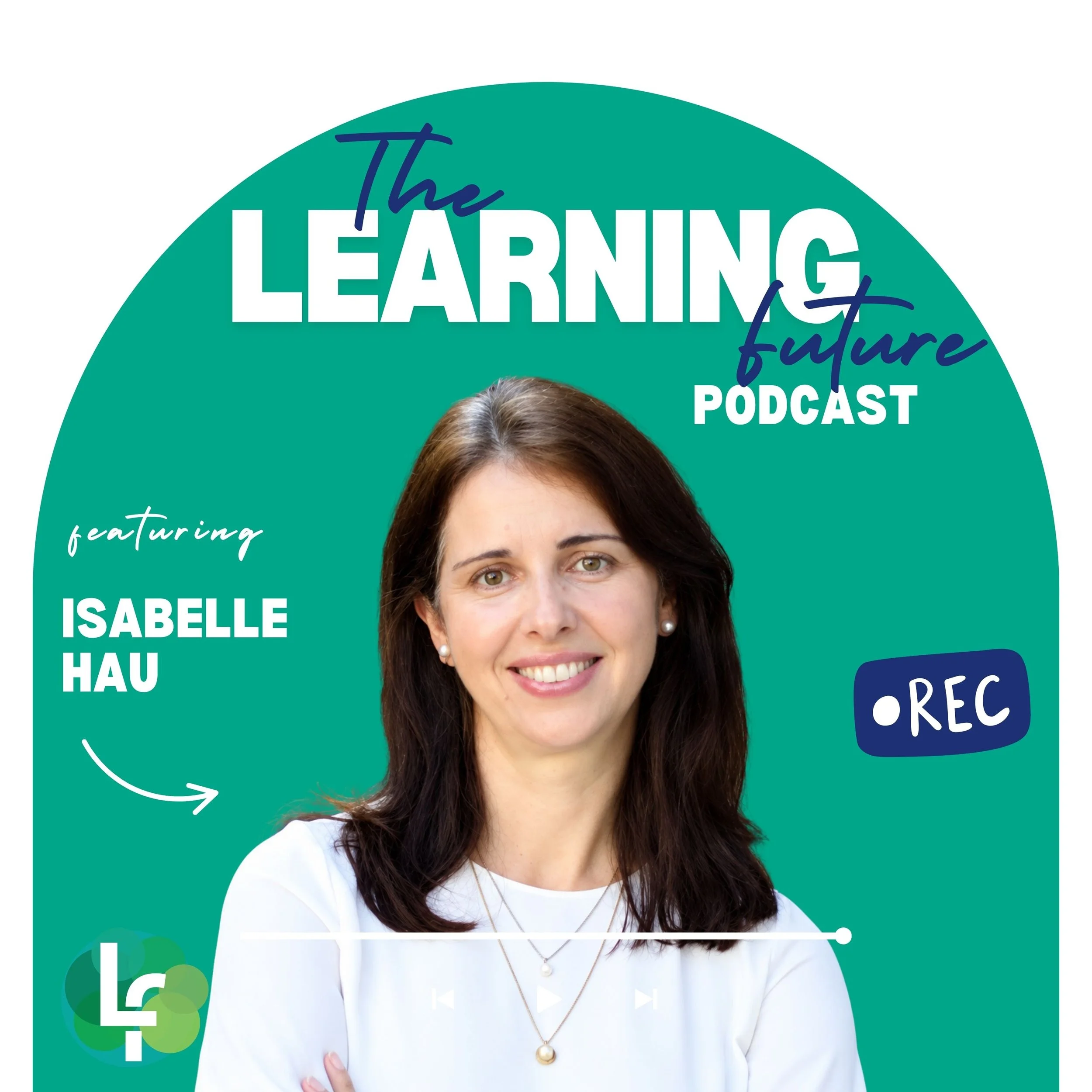
Redefining Intelligence with Isabelle Hau S11E7 (146)
🌳 If we’re teaching young people how to relate better to machines, are we giving equal attention to teaching them how to relate better to humans?
🌳 What happens when frictionless relationships with AI make real human relationships feel too difficult?
🎙️ Episode Summary
At The Learning Future, we’re interested in what learning needs to become in a rapidly changing world and this conversation goes straight to the heart of that question.
In this episode of The Learning Future Podcast, Louka Parry speaks with Isabelle Hau about why the rise of AI makes our human relationships more important, not less.
Isabelle introduces the idea of relational intelligence: our capacity to build trust, practise reciprocity, navigate conflict and repair, and create meaning with others. Rather than seeing intelligence only through an individual or cognitive lens, she argues that our ability to relate well may become one of the most important capabilities for the future of learning and work.
👤 About Isabelle Hau
Isabelle Hau is the executive director of the Stanford Accelerator for Learning, a Stanford-wide initiative to connect scholars and students across disciplines, and bridge research, practice, and policy, to bring quality, scalable and equitable learning experiences for all learners and throughout the lifespan.
Prior, she was a founding partner at Imaginable Futures, a venture of the Omidyar Group, the philanthropic investment firm of eBay founder Pierre Omidyar and his wife Pam. She led the U.S. education initiative, portfolio and team. Her work has directly impacted millions of learners and families.
Isabelle earned an MBA from Harvard Business School and graduated from ESSEC and Sciences Po Paris.
🔗 Connect with Isabelle Hau
🔗 Stay Connected with Louka Parry
For the latest learning innovation follow Louka on LinkedIn
Share your thoughts by visitingwww.thelearningfuture.com
🎧 Tune in to be inspired, challenged, and reminded why love truly is at the heart of learning.
[Transcript Automated]
Louka Parry (00:08)
Hello, everybody, and welcome to the Learning Future Podcast once more. I'm your host, Louka Parry. Gosh, it's a delight to have this guest on with us today. We are speaking with Isabelle Hau. She's an education leader, an impact investor, and an author who's focused on creating a more human and equitable future of learning. She is the executive director of the Stanford Accelerator for Learning, and she brings researchers, educators, technologists, communities together to turn learning science into practical solutions that really help elevate what it means to be human.
she's an author of this fabulous book, which I've actually spoken to her about on a previous podcast called Love to Learn: The Transformative Power of Care and Connection in Early Education. And I've been following her work closely because I think you're fantastic, Isabelle, obviously. about how you kind of navigate this the focus on AI and technology when really the purpose of these technologies is to elevate the human experience. And so you're
We're gonna discuss quite a lot around this this idea that you've been championing of relational intelligence. But thank you so much for joining the Learning Future Podcast again.
Isabelle Hau (01:06)
Louka thank you for having me and it's such an honor. this is this is my first time when I'm invited for a second time, so I'm like very special today.
Louka Parry (01:17)
That yeah, return. You'll be
Well, I just I just think it's it's just so wonderful to have someone that I think's at the you know, at the forefront at your work at the Stanford Accelerator. And you know, I think what we're I'd love you to talk us into the relational intelligence idea because I think we have a shiny object syndrome or one of the issues we have is that we centralize the technology, which is because we're kind of fascinated by it.
When what we need to be centering is the human and then wrapping the technology around to elevate, expand the human experience. So take us into what you've been learning recently and some of these ideas that you're exploring.
Isabelle Hau (01:57)
Yeah, so I could not agree more with everything that you just said, Luca. my my view is very simple is that when we experienced the the industrial revolution, we decided that the most important piece of human intelligence would be cognitive-based.
So as a result we anchored around IQ, which became a very important concept in our societies. And IQ is a form of human intelligence that looks at reasoning and essentially very cognitive-based.
That has as a concept influenced and shaped a lot of our education systems and more. That's why we have so much focus on academic success. And if we think
about
Louka Parry (02:53)
Mm.
Isabelle Hau (02:54)
how we look at successes, well, a lot of a lot of it is cognitive and individual based.
We have made some progress with EQ in some ways over the past 20-30 years, which was a different form of intelligence which is much more emotional based, looking at you know empathy and other things on the on the s and at an individual level.
Louka Parry (03:21)
Yeah.
Isabelle Hau (03:23)
amazing amazing work that has been done that started mostly from the workplace actually interestingly and then got infused into education settings
I think we are at a different point where we now have this AI revolution and I think we need to really ask ourselves what do we want humans to become and what is
Louka Parry (03:49)
Mm.
Isabelle Hau (03:50)
really truly human.
And I my thesis or my viewpoint is that what will make us truly human in this future is our ability to relate to one another, our ability to collaborate with each other to make meaning of this complex world together. So essentially the space in between people, diadic or network-based.
As opposed to an individual sense only of success.
And honestly this what is been fascinating is that a lot more and more economists are now writing on this and are saying, yeah, social skills, relational skills are rising. This is what is what's what employers increasingly want. They want team players, they want collaborative
Louka Parry (04:48)
Yeah.
Isabelle Hau (04:49)
people, they want human skills, they want people who can be interpersonal. Anyway, so and jobs also are increasingly
going to evolve toward more and more human skills anyway. So my my thesis is that we we need to start focusing a lot more on this aspect that has already been there which makes us profoundly human, which is our capacity to relate to one another.
Louka Parry (05:22)
It's such a great framing. I just it's you know, and I think we can look at any of the data around belonging and isolation and human connection, or even longevity research, which looks at, you know, our social connections as being in some ways the greatest protective factor that we have. And one of the paradoxes of the social media era is that it's in some ways you can argue it's made us less social in settings, which I think we're seeing now with some of the big tech.
You
know, the design of some of these platforms and the and the lawsuits in California, New Mexico and and other places now into the tens of billions, you know, for Meta and others. So g just break this down, like what does RQ or relational intelligence what are its components from your standpoint? Because I I love this frame. I use it too. The space in between people. It's so good to think about like, you know, that's what a a social network is, a community is. It's actually it's the space in between people that hold the place together.
You know, in that kind of a network theory perspective. So what's give us a bit of sense of like what's what's RQ? What's what's relational intelligence specifically?
Isabelle Hau (06:25)
Yeah, so Luca, you might have to invite me for a third time when I have a detailed construct established with researchers. So this is something that I'm actively working on at the moment. but essentially right now what my initial thinking is is that
There are f four areas that are critical in that space in between or that ability to relate. One is trust.
So second is reciprocity.
Third is ability to manage conflict and repair.
Very important, and I will give you an example if you allow me a personal example on that one. And then the fourth one is creating the ability to create meaning with others, and meaning could be value in a in a monetary sense, but it could also be when we speak to other people, our own capacity to understand better or make sense of what's happening in the world.
Yeah.
Louka Parry (07:35)
Love that. So I trust, reciprocity, kind of conflict resolution and creating meaning. And you know, there's this I I saw this sentiment recently, and I think it's from an anthropologist saying we have more and more information in the world, but less and less meaning. And you know, there's other theorists that talk about the collapse of meaning. You know, with the simulacra, everything simulated content everywhere. It becomes seemingly less meaningful if these you know, if AI chatbots or agents have
Created something. Does it have the same ph so yeah, I'm I'm really on on board with those four. Take us into that story. Tell us the story that you wanted to share. Yeah, you know, that's a that's a good example.
Isabelle Hau (08:12)
Yeah,
and I I I will be quite I will share a personal example here of I have two daughters, Luca, who you could describe as one is extrovert and the other one is more what you would call introvert. Okay. I they never I don't I don't think they've ever taken one of those tests, but
Yeah. So
Louka Parry (08:35)
yeah, sure. Like a ocean yeah, sure. Yeah.
Isabelle Hau (08:39)
So my one of my daughters is extremely social, like a social butterfly. She needs human connections around her all the time, okay?
So you could say, she has high relational intelligence, but in fact, she has a very hard time coping with conflicts. So literally, we also call her in my family like drama, you know, drama queen, because it's like there's always those stories about relationship issues that come up with friends and and romantic relationships all the time, okay?
Louka Parry (09:18)
Yes, right.
Isabelle Hau (09:19)
Where whereas my other daughter, which you could describe as introvert, so you could say maybe she's not very high on relational intelligence, but in fact she has a perfect
never any drama because she's able to cope with conflict in a beautiful ways and a tighter set of friends as a result. So it's very interesting how you know this the importance to me of this ability to repair
in relational intelligence. and just was with the this example. This very personal example I think is a is a good
Louka Parry (10:01)
Yeah.
Isabelle Hau (10:02)
one. Yeah. Yeah.
Louka Parry (10:03)
Thank you for sharing that. I can identify with both of your you know, in my own life either the the kind of extrovert, introvert. Do you know it it's fascinating, you know, the Gottman Institute, which are these researchers on relationships as well, and s particularly marital and romantic relationships, just say that repair is is almost the w number one predictor of relationship success. It's not that
Isabelle Hau (10:24)
Exactly.
Louka Parry (10:26)
you don't have issues, it's that the repair
generate some of this trust as well. And I've always found that fascinating as someone who also earlier in my life would avoid conflict and didn't really know how to navigate it. So it's just a fascinating reflection, I think. And and and I wonder too, Isabelle, this is you know if we talk about education systems, many of our listeners will be educators themselves. And you just wonder like when are we when do we teach? When do we develop the ability to deal with conflict in education systems?
You know, it's an interesting question. If we to your point earlier, the thesis, if if it's been a really about knowledge acquisition, well that's great. And I'm very much around I love knowledge acquisition, but really kind of what's the skill acquisition that comes alongside that? Or the dispositional acquisition to know actually I I can allow myself to feel discomfort as I have a discussion where there is some conflict, then I can repair. What's your what's your view on kind of the how education systems might be able to bring in some of these ideas?
Isabelle Hau (11:21)
yeah, so I I there is one thing that I'm working on right now that's highly relevant to this question. So let me speak about this because this may be of interest to to the community that's listening. I'm doing a pilot with a public charter school here in the Bay Area called Design Tech High.
Louka Parry (11:42)
well.
Isabelle Hau (11:43)
And the story is is quite interesting. Actually, the principal with a good friend of mine has been a friend for a while, who is actually a Stanford grad. Ken Montgomery had approached me earlier this summer with this question. and I I don't think he was necessarily thinking what I would think about that question, but anyway. He had asked, Isabelle, what do you think if we were to organize a workshop for my high schoolers on how to make friends?
Louka Parry (12:10)
Wow.
Isabelle Hau (12:11)
Yeah, so anyway, reflecting on this question and he and I were seeing each other several weeks later and I I I said, Well, I love the question that you had asked me several weeks ago. You may not remember what you had asked me that question, but I do. and
I would like to propose slightly different framing. I would like to suggest that instead of focusing only on friendships, we actually elevated to
relationships more broadly and start with a question about why does it matter to have a vibrant set of relationships? why does it matter for example for longevity on your point earlier, Luca, or why does it matter for health matters, for learning, for well-being and all these? Go through the science
Louka Parry (13:10)
Mm.
Isabelle Hau (13:11)
of relationships and the why. Okay.
And then go through different types of relationships. So absolutely friends but also romantic relationships which are keen interest to teenagers, also
work of course like how to establish a social network, social capital, what does that mean, and how to do it well. Also AI relationships, having
Louka Parry (13:45)
Interesting.
Isabelle Hau (13:46)
teenagers reflect on where do they use AI or not for establishing for for for relational AI and what are the implications of that. Anyway, so we we start co-designing this little so
and it's going to be launched in two weeks. kind of eight work, eight-part series. But here is where I'm what's going to be interesting relative to your question is initially I thought okay we will have one session on conflict management you know as part of this eight part series and the teacher
The phenomenal teacher named Joe Schneider. no, I want at least two sessions on conflict management. This is too important. we I will teach two of those eight sessions will be on conflict.
And I'm like, wow, this is amazing. I love, I love, I love, I love the bravery of teachers, but also the importance of as as you're saying, it's not something that we are being taught in life how to handle conflict.
Louka Parry (15:01)
It's
yeah.
Isabelle Hau (15:02)
And
so anyway, this teacher, this brilliant teacher is you know just expressing a need that he sees to have more of this training prevalent in in in that workshop that we will be launching. So it's exciting and also very much in line with what you're saying. So we need more of this. clearly this is what is you know, more on on relationships broadly speaking, but also on specifically visibility.
to repair and handle conflict.
Louka Parry (15:35)
It's it strikes if if we take a step back, Isabelle, like to the assistant you I this way like first principles thinking. And obviously as a designer myself, you know, I'm often thinking, Well, why are we doing it? This you know, if you if you ask a teacher and I've been working with you know, all all this week, been working with school principals and things around Australia and so it's very forefront of my mind, but you know, and there's just not there's very little space. You know, it's kinda like we are so content curriculum driven, especially because
Some systems we see a decline in academic results, you know, across a lot of the OECD countries, not all of them, but certainly here in Australia and the US and other places that's been the case across the last twenty five years. And you talk a bit about this relational recession, and I actually think it's part of the problem. and of course, you know, twenty ten and Professor Jonathan Haidt's work in this space about the anxious generation, which has been very globally impactful.
There is something about when we don't have relationships, it doesn't just impact our health, which it does, you know, the loneliness epidemic that the Surgeon General spoke to in the US a couple of years ago. It also impacts our learning. You know, like do we feel connected to our teacher? It's a great question. How does the teacher feel connected to the leader? Great question. You know, that kind of overall health of the system. Can you take can you just make the case that we are in a relational recession?
Because
I think some for some people there's still great work happening in schools and they are I think more important than ever before as we see kind of more horizontal digital connections sometimes replace analogue vertical connections of family and grandparents and other things. what's the case for the relational recession?
Isabelle Hau (17:13)
Yeah, case of for the real r relational recession is multifold actually. That starts with a decrease in fertility across this planet, maybe with the exception of China, but in a many areas you know certainly in the US, in
Europe, in many parts, non-China parts of Asia, we are seeing a decline in fertility. So what it means concretely is that we have more and more families with lesser siblings, so lesser ability to have connection within a family unit, smaller smaller households. for example the number of one only child households
in the US has doubled in the past I think 10 years. I would need to check exactly the stamp table in the past few years, meaningful increase in the number of single child households. So less of siblings in family units, that's one.
Louka Parry (18:22)
Mm.
Isabelle Hau (18:23)
Two is we have less friends. So it's well documented for both adults and children. Children are spending less have less number of close friends, and they are also spending less and less face-to-face time with friends. And same with adults, we also have lesser friends. so it's very very well documented, the number of
Of
you know, very sad, but the number of people with zero friends is increasing steadily. and also the the average number of friends that we all have is declining. So that's a number another big, big, big big part of this relational recession. And if you start thinking about the circles of around a child,
Louka Parry (19:14)
Mm.
Isabelle Hau (19:14)
family is smaller, number of friends is smaller, the
Other one is older adults.
So if you think anthropologically, we as a human species have thrived in tribes essentially where they were a lot of supports and especially from elders and especially grandmothers. So it's very well
Louka Parry (19:43)
Mm.
Isabelle Hau (19:43)
documented from anthropology, the role of grandmother in the human evolution is critical. we have a situation where, and I see it in my very own household.
Where we live, you know, further away from grandparents,
or
Louka Parry (19:59)
Yeah.
Isabelle Hau (20:00)
we have less connection with elders generally, because elders are in you know in separated homes from our household. So anyway, less and less of connection with with you know the traditional grandma, if you like, or traditional elder. and then the the the other factor, of course, is technology.
Technology is playing a big role in potentially connecting us better, but also in many instances isolating us. and certainly AI could be either, but right now on the margin, because of its format of being con conversational chatbot between a human and a machine, is also driving
you know more more isolation than than connecting us among humans. And
Louka Parry (21:02)
Mm.
Isabelle Hau (21:02)
I may add one other factor.
One other factor that's also very societal is and that impacts younger children, but I think it impacts actually all of us in some ways is our lives are there's less and less play.
Louka Parry (21:26)
Mm.
Isabelle Hau (21:26)
And through play, that's how we make friends.
So because there is less play and and those are actually neither technology nor societal, this is another factor that actually we have created as humans, which is these overachieving cultures of and I know I know it exists in many places in the world,
Of testing our kids for filtering toward a aspiration of whatever college or elite universities or whatever aspiration
Louka Parry (22:05)
Yeah.
Isabelle Hau (22:07)
the parents have, or the children themselves have for themselves, but that leads to this culture of overstructuring lives of our children.
between academics and extracurricular activities that leave very little time for what is this very natural element of play. And play drives human connections.
Louka Parry (22:33)
It's
so I mean it's so resonant with me, Isabelle, you know, and there's just so much research on this too, you know. Professor Peter Gray talks about, you know, the how play, you know, unsupervised play in particular, how important that is in child development. Even like famous quotes by Einstein, you know, you learn more about someone in a hour of play than in a year of conversation. There's something beautiful about the hum like it feels to me to be like a just a human disposition to play.
And it's what two things I wanna just put to you and get your reflection on. One is the on the AI piece. Zal Mark Sanders, who's a researcher in AI, you probably know his stuff. He just writes a h HBR article every year and the twenty twenty six how people are using AI from their research, right? Which is always a certain subset. But no the number one use case is com is therapy and companionship again, which it was in twenty twenty five.
And so it's just a fascinating thing. And I think your point on the design features of these, you know, conversational anthrop anthropomorphic, you know, to to imitate a human connection seems to be one of the design choices being made at the moment. And so that's the idea that we've moved from attention economy to attachment economy is a really is something that I I think is true. Actually, and it's, you know, it's it was it still is dopamine, but it's like also oxytocin now. Can we have a
You this makes these really philosophical questions. Can you actually have a real relationship with a machine? In my view, you cannot. But you know, other people might hold other views, including some of the technologists. So that's the kind of first point around. I'd love your your piece on how we might design that differently. Because narrow AI use cases can be fantastic for productivity and for other things, but it seems like it's a bit of a well the Wild West. The second thing is to your point about system incentives.
And I think what I'm noticing in in my work, especially in some kind of public education spaces globally, is a tightening of control. So what we're saying is we're gonna go to a quite a s like a scripted model, and you can understand the rationale for that, especially where you see results going downwards. But my sense is they're going downwards because of the background context and the impact of technology on cognition and social relationships, not necessarily because of the foreground issues within education systems themselves.
Teaching hasn't changed particularly much in twenty five years. So I know what are your two kind of reflections on on that one? The first around the kind of technological design bit. and the second around how systems kind of can respond to can can you get to the same destination using another path, you know, maybe even a better destination? What what do you think?
Isabelle Hau (25:06)
Yeah, so on the first one we are doing a lot of work on that question at Stanford. be and frank frankly, Luca, this is a the this is the the part of AI that I am personally the most concerned about.
So in education a lot of my colleagues are studying the impact of AI on cognitive outcomes and cognitive offloading and all these elements which are very important. But I actually think we can probably resolve those through better pedagogy, better better assessment. they are solvable in my mind. if you like.
The one that I'm very concerned about is what I call relational offloading, which is which is these essentially AI, what it called companions. I don't even like the word companion in that context because that actually is by itself an anthropomorphic manifestation of a machine. So but anyway.
Louka Parry (26:17)
Yeah.
Isabelle Hau (26:19)
So here is what we are showing from our research. We are showing that AI is extremely psychophantic. What it means is that it praises us humans all the time.
And we are all seeing this. Anyone who has is using some AI tools feels it. It's very, very praising, telling us how great we are all the time and our ideas are fabulous. So our research shows at Stanford that AI is praising adults 50% more than humans.
And then
Louka Parry (27:02)
Right.
Isabelle Hau (27:02)
we had done a research two years ago when AI was extremely sorry, even more psychophantic than it is today. that was showing that for children it was 14 times more praising.
so extremely psychophantic, okay? Why? Because psychophanty and being praised is something that we like as humans. So it's a very good technique to engage people essentially, from a psychological perspective.
Here is a problem that I'm very concerned about is that we now s have several tool which I'm happy to circulate for for for anyone, any any listener interested in digging more, but including one that was done with a very large sample of twenty thousand conversations. that shows that essentially people who are using psychophantica i are liking human relationships less.
why? Because we are getting used to having these beautiful,
Louka Parry (28:11)
Yes.
Isabelle Hau (28:11)
perfect, no friction messages. and so when we go back to in real life and we have to handle, you know, the what I think is beautiful but more complex human interactions, this is much more complicated and we actually like it less. So
Louka Parry (28:30)
Mm.
Isabelle Hau (28:32)
what essentially we the risk here is that
if we continue on this path is that we like more and more the machines unless and less human relationships so clearly very concerning. Very concerning because having human relationships drives a lot of benefits.
that have not been replicated in AI, including better learning, better cognitive outcomes, as well as greater well-being, longevity and all these other few things, better peak performance. I mean I could go on these on a long list of benefits of timing, strong human relationships.
Louka Parry (29:16)
Lover. Yeah, that's I share the same same concern. and I of cour relational offloading is a really great frame for to talk about that. the teachers that we've worked with recently will say kids are kids have changed, especially if they've been teaching for a number of decades. They say the demographic of Gen Alpha is different. And it's not just it's different because the in some ways the the technological backdrop
of their development has been different. IPads in prams, you know, screen based media, the you know, and at as you as, you know, for both of us interested in early childhood. Serve and return, you know, like brain development, strong relationships, attachment theory, the still face experiment. I mean, all of that gets implicated. And
Isabelle Hau (30:04)
Yeah. Yeah.
Louka Parry (30:05)
I just think it's there's gonna have to be some kind of
reckon like reckoning or recognition of what's really going on. I think that's slowly taking place. I like to be optimistic about it anyway. Yeah, thanks for that. what what do you think about the tightening, Isabelle, in terms of education systems
Isabelle Hau (30:19)
Exactly.
Louka Parry (30:21)
too? Like what do you think 'cause you can understand it's like, okay, we're gonna control this tightly because outside there's less developmental opportunity, there's less play. We've gone from play based to phone based. What's your view at this point?
Isabelle Hau (30:35)
Yeah, no, I think that's exactly the right question, Louka. So
I I'm I'm very optimistic and I'm seeing signals everywhere that there is a very strong appetite that's rising. And I think actually AI is helping on this matter because people are suddenly acknowledging that yeah we need those human relationships. So I'm seeing in education an early but early signals.
But very important ones of schools focusing more and more on social connections. And let me give you a few examples of this.
Louka Parry (31:21)
Love that.
Isabelle Hau (31:22)
One is very important for anyone with a listening strong read that I highly, highly recommend, which is the MIT
report that was just published two days ago called the watershed moment for MIT. So they call AI the watershed moment. And essentially the report is a a set of recommendations and ac actually it's called call for action.
for MIT to make extremely big changes on how they teach, how they grade, how they behave as a university. They have an entire section on the importance of social connections and the importance of residential life.
anyway, so fascinating
Louka Parry (32:16)
Mm.
Isabelle Hau (32:17)
read. So anyway, MIT report being one example in higher education of I mean a an organ an elite institution that has represented and continues to represent the best in class of
engineering and computer science education. So the fact that they are signaling to others that change is necessary in this time is very important. Just came out, strongly recommend reading it from beginning to end, best 15 minutes of anyone in education. then the second second type of signals are in K-12.
And I mentioned already design tech high and the work that you know this principal expressed, but another example recently that I I learned about is from another innovative high school called Valor in
in Nashville, Tennessee, here in the US, that is essentially restructuring the high school curriculum to have more academics concentrated in the morning and then in the afternoon they are now going to offer three labs one is connection lab two is purpose lab and three
Louka Parry (33:54)
wow.
Isabelle Hau (33:54)
Is Career Lab
Louka Parry (33:57)
Interesting.
Isabelle Hau (33:57)
its very interesting and so i'm i'm seeing you know and i could give you more examples than those but i'm i'm seeing those those examples of squ whether it's again higher ed and now k twelve of
innovative schools moving toward essentially thinking a lot more about the importance of human skills and in addition to academic you know traditional academic so it's not like they are ignoring academic skills they
Louka Parry (34:37)
Mm.
Isabelle Hau (34:38)
are now making it on par with human skills if you like
Louka Parry (34:43)
I think it's I those are wonderful case studies to look at. I just got up the website as well of of Valor. I like, Yeah, this is fantastic. There is this I think there is this I wonder about this as a thesis, Isabelle AI is a forcing function for us to finally perhaps realize what matters most. And I think
Isabelle Hau (35:03)
Exactly.
Louka Parry (35:04)
the argument where we say what and this is where we've been captured, I think, in education systems and
My my colleague Parsi Salberg, who used to run the Finnish system, you know, used to call this the global education reform movement, the germ. He used to call it right. Which is this idea that, you know, we just get some quantitative measures, put together a league table, and then that's success. And of course, what gets measured gets valued. And so rather than saying, Well, actually, it's why constructs like relational intelligence become important, because then we can start
To place our attention into that frame. You know, rather than saying how intelligent are you, it's how intelligently can you relate to others? Far more interesting question. You know, and I think that's that's the evolution of intelligence in some ways too, into this human, hopefully human era. Sometimes by AI taking us a bit making us a bit wobbly in terms of what really matters.
But this fascination with I you know, and you know I was talking before we started went to recording about the book that I've just finished writing, which will be published later this year. And it was a fascinating piece. And I think that one of the things I realized, you know, I call it a technomorphic desire, is this idea that we want to be like the machine, which I think is such a fascinating part of psychology. You know, this you know it was a p a personal trainer who used to say, You're a machine.
You know, when you're at the gym and you're like, you're such a machine, I'll be Yes, I'm a machine. And then you realize, hang on a second. Why why is there this desire to be like the machine, right? So it's not it's the opposite of anthropomorphism, right? It's the idea of technomorphism. yeah, because then we don't need to rest. We can be certain about our output. We can, you know, be high high achieving consistently. You know, it's just such an interesting piece that I really sat with for some time.
So I wonder if this is the moment you know, you call it a relational renaissance, I think. So I'd love you to talk to that.
Isabelle Hau (36:57)
Yeah, no, and let me let me also comment on one thing that relates to this technomorphism I actually really like this. so right now what I
what is happening in the US and in many parts of this planet is a big effort on there are different names for it but AI literacy, AI fluency, AI yeah. And if we step back and say essentially we are teaching us humans to relate better to machines.
That's what AI literacy or AI fluency is. And I
Louka Parry (37:44)
Fascinating.
Isabelle Hau (37:45)
I'm I'm not necessarily saying this is this doesn't need to happen. I think this is very helpful to know how to use those AI tools.
But I also think we need to reflect on if we teach ourselves humans how to use better machines, what about also teaching our children and maybe adult learners how to better relate with humans? Maybe equally often are not more important. So it's a maybe fine to have some form of AI literacy or AI fluency, but what if we also had humans human
fluency, human literacy or relational fluency, whatever you want to name it, yeah, in parallel.
Louka Parry (38:32)
I love that concept. Similarly, it's back to the shiny object piece, you know, and the FOMO and all that. no, like what's the latest? The question should always be, how might this enhance and deepen the human experience of being alive? Surely that's what life is for. This is how we recapture, reclaim purpose and meaning and even I don't know to be a bit bold, but our humanity itself, you know, in this in this moment.
you know, the many faces of the machine can be replaced by the many faces of the humans that we love around us. You know, your book, you know, love to you the whole idea of the transformative power of care and connection, you know? And I d I don't know, for me it seems to be as much remembering as invention. You know, I think I've I that's what I've learned from my work in First Nation communities as well and looking around at global cultures. This isn't we don't necessarily invent our way.
Isabelle, perhaps it's that we can remember and create. You know, like you know, what remember like what the wisdom of the grandmas. You spoke about the grandma bit, you know. And I I have a page there dedicated to the wisdom of my grandmas in the book, you know, which is just this like what's been passed through these beautiful human relationships. Gosh, we have to remember that, not just be fascinated by what's coming. I have one final question for you. I wanna please respond first and then
Isabelle Hau (39:49)
Yeah. And yeah, look you know,
I I was just going to comment and highlight the work, the incredible work of one of my amazing faculty colleagues here at Stanford University. Her name is Maisha Wynne, and she's one of our co-directors of the Stanford Accelerator for Learning.
she is essentially writing exactly on this topic of how history should how studying history will shape our futures. and she has a beautiful book that she published a few few few months ago now, Futuring Black Lives, which is essentially the studying history to project into the future. So very, very much in line with
What you are referencing, yeah, yeah, yeah.
Louka Parry (40:47)
I I will get in contact with her. She sounds fabulous. Yeah, and kind of related to the the Afro futures work of the D school as well that I've seen over the last few years. Yeah, which is
Isabelle Hau (40:55)
Exactly. Yeah. Yeah. Yeah.
Louka Parry (40:58)
inc an incredibly culturally relevant way to look at the future. my last question to you, Isabelle, because we will do a part three, you know, in who knows, six months or something 'cause things are changing so quick. what is your what is your take home message? You know, kind of the
that you want to leave resonating in the minds of our listeners from everything that you're you're doing and what you're seeing.
Isabelle Hau (41:18)
Yeah, I mean I think I would love for
if we want to think about our children children who are born including including your your little one that will be born in in january congratulations Louka again
Louka Parry (41:37)
Merci.
Isabelle Hau (41:40)
this new generation of this generation of children is going to be AI native. they are going to be very much shaped about by this context of AI.
So the the propo proposition that I have is or the question that I have is how can we make this generation of AI native children the most flourishing generation which has ever lived?
And if we start thinking about how can we be much more intentional about about this profoundly human question, I think we will be better off. I'm you know, of course I'm trying to have elevate this theme of relational intelligence because I b I believe that it will drive human flourishing, but there may be other even better framing than this one or people who are interested in in
in in collaborating with with us on on on this but anyway i think that that is a question that i would like every listener to take home is how can we collectively think about focusing on future generation to be flourishing and the best best ever.
Louka Parry (43:07)
And maybe it starts with how we relate to ourselves and the world around us. Isabelle, thank you so much for joining us on the Learning Future Podcast once more.
Isabelle Hau (43:14)
Thank you, Louka for having me.