Embodied Learning with Emily Poel and Guy Claxton S11E6 (145)
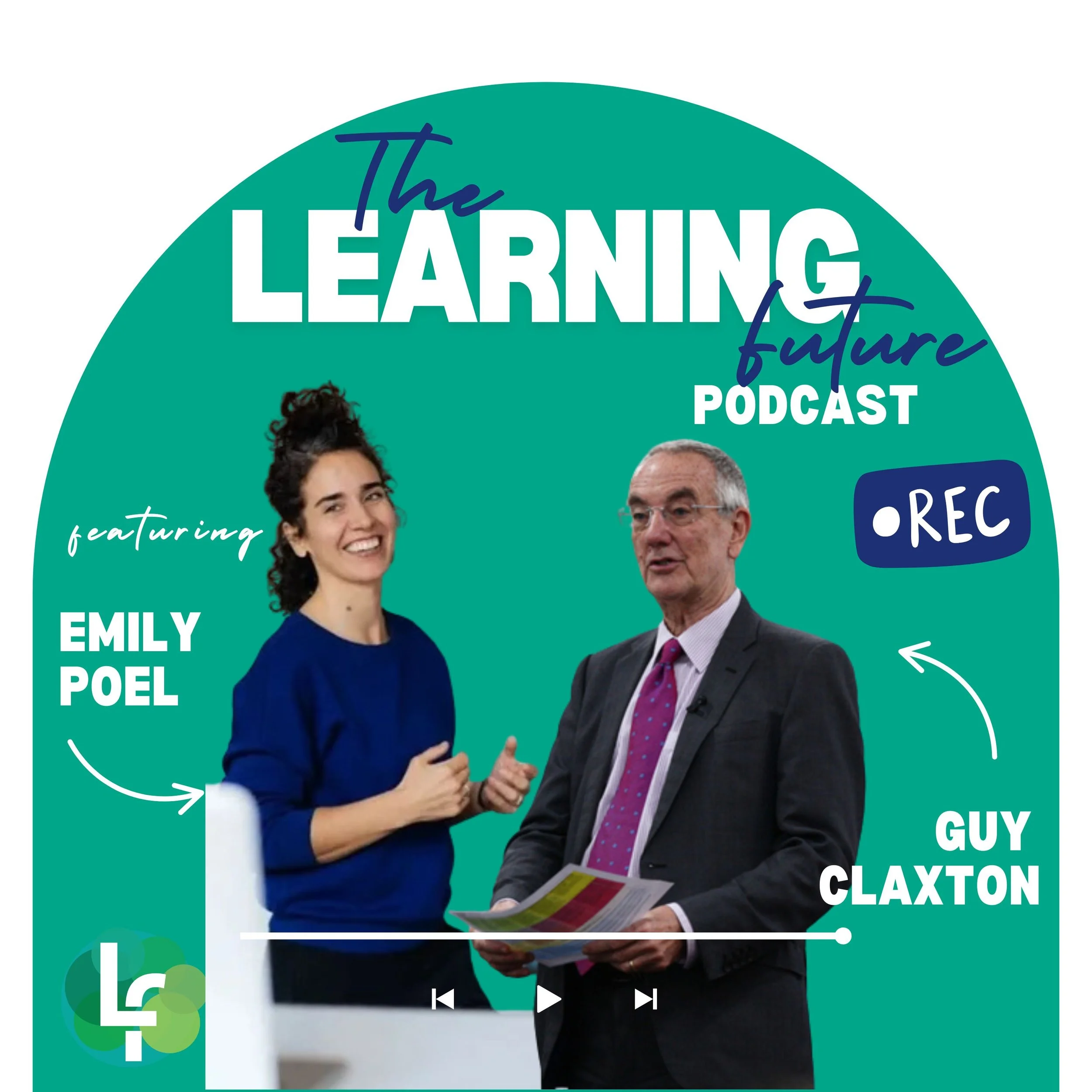
🌳 If learning is a full-body activity, why do we still design education as though the body is a distraction?
🌳 If competence builds confidence, should education spend less time teaching students about things and more time helping them actually do things?
🎙️ Episode Summary
In this episode of the Learning Future Podcast, Louka Parry connects with Guy Claxton and Emily Kohl, authors of Bodies of Learning: How Embodiment Science Transforms Education. Their conversation dives deep into the relationship between our physical selves and the learning process, shedding light on how embodiment can reshape our understanding of intelligence and education.
Guy challenges the tendency to equate intelligence with intellect alone. He argues for a broader understanding of intelligence that includes movement, perception, emotion, intuition, physical experience and action — what he and Emily describe as the body-mind.
Emily brings a practical lens to embodiment — particularly the importance of reconnecting with our own experience, noticing the body, creating space for reflection, and allowing learners and educators to experiment with what helps them learn.
👤 About Emily Poel
She is an embodiment trainer, consultant and somatic practitioner whose work explores how embodied awareness and movement can support thinking, learning and creativity. A former performer and choreographer, Emily now focuses on applying embodiment science within education, working with educators and students to develop practical approaches to learning and complex challenges. She is co-author, with Guy Claxton, of Bodies of Learning: How Embodiment Science Transforms Education.
👤 About Guy Claxton
He is a cognitive scientist and author of more than 30 books on psychology and education. A Fellow of the British Psychological Society, the Academy of Social Sciences and the Royal Society of Arts, he holds a double first in Natural Sciences from Cambridge and a DPhil in Experimental Psychology from Oxford. He is co-author, with Emily Poel, of Bodies of Learning: How Embodiment Science Transforms Education.
🔗 Connect with Emily Poel & Guy Claxton
Emily Poel LinkedIn
Guy Claxton LinkedIn
Book: Bodies of Learning: How Embodiment Science Transforms Education
🔗 Stay Connected with Louka Parry
For the latest learning innovation follow Louka on LinkedIn
Share your thoughts by visitingwww.thelearningfuture.com
Tune in to be inspired, challenged, and reminded why love truly is at the heart of learning.
[Transcript Automated]
Louka Parry (00:10)
Hello everybody and welcome back to the Learning Future Podcast. I am, of course, your host, fellow human Louka Parry, and today I'm absolutely delighted to be joined by two wonderful guests whose book I hold in my hand right now, and we're gonna investigate further. They are Emeritus Professor Guy Claxton, who is Emeritus Professor of the Learning Sciences at the University of Winchester, Centre for Real World Learning, and author of many books, Guy, including The Future of Teaching. and intelligence in the flesh. And I haven't spent time with you in person, Guy, but we were just working out. It's been many, many years ago, so it's delightful to reconnect over this format.
Guy (00:50)
Yes, I remember a very large auditorium somewhere in Adelaide.
Louka Parry (00:54)
It's right at the Convention Centre. So it's great to great to be able to explore human development with you once more. And also joining us is Emily Poel who is a Berlin-based embodiment practitioner and trainer with a background in somatic practices, contemporary dance and history. She develops approaches to show how movement and physical awareness shape learning, thinking and creativity, and has taught internationally for over fifteen years. I'm sure neither of those bios do you justice as the unique, very interesting people that you are.
But I'm sure our listeners will be able to hear more about who you are and the work that you do over the course of this conversation. Thank you for joining us.
Guy (01:33)
pleasure.
Emily Poel (01:33)
Thanks for having us.
Louka Parry (01:37)
I'm holding this book in my hand, Bodies of Learning, How Embodiment Science Transforms Education, and I've been obsessed with this topic, as all the listeners that are listening to this podcast would would know. Take us into what's something surprising that you have learnt through this collaboration between the two of you in putting together this piece of work that I think is so timely for this moment in in education.
Guy (02:02)
who's going to start? do you want to kick off?
Louka Parry (02:05)
Kick off
Emily Poel (02:05)
mean th okay, there there are many ways to answer this question. but I think I think what surprised me and and was how much I enjoyed the struggle and and the struggle of of well, it was a very good struggle and it was a conversation the entire time and and we've remained friends and we've gone through ups and downs and learned from each other and ch changed our viewpoints and and I think I think what surprised me and what I learned is is is was even just having the pleasure of going through such an embodied learning process while writing the book and seeing how how relational thinking is, how we're responding to each other all the time and to the different ideas and and I think it was just so interesting to reflect on the whole process in in all its glory.
Louka Parry (03:02)
Mmm. Was there was there one finding, when you think about the book as it kind of came to fruition where you thought, wow, that is something that I think is very interesting from your perspective?
Emily Poel (03:17)
Yeah, and I think it it really is along these lines of that learning is development. I think I understood that in a new way. Like learning is physical, neural, biological movement and development and change. And by kind of working through all the science and trying to put it together, I really did understand it in a new way for me.
Louka Parry (03:45)
Brilliant. Guy, what would you what would you say to this? What have you learned?
Guy (03:49)
One of the findings that surprised me, continues to surprise me, is a little laboratory experiment, think reasonably well replicated now, of looking at what is going on in your brain.
when you're given the task was you're given different sentences and you to look at you're lying on your back in the scanner or something like that and the task is simple you just have to say whether this is a well-formed sentence in English or not whether it's jumbled up but the most important ones what's going on in your brain when for example you read the sentence that says John grasped the hammer and without having to do anything the bit of your brain that controls the clenching of your fist automatically lights up.
So there's your body gets in on the act whether it's necessary or not, whether it's helpful or not, whether you want it to or not, it can't help itself getting in on the act. That's number one. But number two is supposing the sentence you were given was John grasped the argument. Exactly the same thing happens. The hand grasping bit of your brain still lights up. It can't help itself. So there's right there you have the fact that there's a strong integration between what we call in the book almost like two different planes of information stored in your central nervous system that we call the life scape and the word scape and the life scape
Guy (05:37)
is all your what you've distilled out of your experiences.
all the kind of expectations and anxieties and tricks all the behavioral and perceptual and emotional stuff which enables us to live the kind of the lived the lived learning the experiential learning of our lives if you like and then
Louka Parry (05:59)
Mm.
Guy (06:00)
early on in our lives we start to develop this other layer or this other the wordscape which kind of hovers over the top of the life scape and first of all we learn words that are just like
names for things that we already know. Dog. and your mummy points at a dog. So you make this connection that this strange conjunction of sounds, the word dog, is a way of accessing everything you know and feel about Fido, the family
Louka Parry (06:32)
huh.
Guy (06:33)
golden retriever, whatever it might be. What happens in education?
put very crudely is that often the life scape gets forgotten. The life scape gets ignored. And to be a fully functioning human being
You have to have your life scape and your wordscape strongly connected so that your thinking, if you like, is always grounded. Remember that grasping the argument in your hand subconsciously, subliminally your hand gets ready to clench. Scientists, when they're figuring out a new... trying to figure out a new phenomenon, almost always there's lots of interesting research on this, almost always reach
for concrete analogies. So they start saying, well, maybe it's a bit like this. Maybe the atom's a bit like a current bun. And someone else comes along and says, no, it's a bit like a mini solar system. And then someone says, no, it's not like that. It's like something smeared out in space, like the
Louka Parry (07:40)
Mm.
Guy (07:40)
way or something like that. So, and even in quite abstract discourse, the brain and it's all it's experiential knowledge is always
kind of there behind the scenes helping out sometimes potentially misdirecting but sometimes helping out and it's to the detriment of the way we conceive about learning to neglect that and to ignore that to treat that kind of embodied movement based feeling in involved sensory to treat all that stuff as if it was somehow childish you may you may remember you know John Piaget talked about
Louka Parry (08:20)
Yes.
Guy (08:20)
about
possible, so to speak, to kick the ladder away behind you.
There's something in the Bible, isn't there, about when I was a child, I thought as a child, I saw as a child, but now I see the world clearly. And that assumption, not that we expand the variety of our ways of thinking and learning, but that some are better than others and the physical ones should be ignored. So for me, that's the continual, that's one of the kind of core...
You could say it's surprise, that little laboratory result of the grasping thing, it kind of sums this up in a way for me. Sorry, that was bit of a ramble, Luca, but it was getting
Louka Parry (09:32)
No, not at all. I
Guy (09:35)
into the content a bit, I think.
Louka Parry (09:37)
I love it, I love it. And I you know, as you said, grasping, I found especially the third time, I found myself maybe it's the mirror neurons as well, because I can see you guy. I also grasped my hand physically. Absolutely. And so this you know, this idea of im of you know intelligence, which I want us to come to. but before
Guy (09:59)
Mmm.
Louka Parry (09:59)
before we do, I want you to take us into the
Set
the scene for us a little bit more, right, around the mind-body schism. Because this might be the first time that some people are hearing of even the construct of embodiment itself. And it can feel a bit new agey. So maybe one of one of you can speak to you know where why we've gotten to this point where certain and I think, you know, Guy, to your reflection, you know, side.
Guy (10:26)
What very embodied
cat on your table, Luke.
Louka Parry (10:29)
Very body
cat, you see that? Yeah, and she's, you know, coming to say our love was So yeah, what w how do we get to this point in human development systems, to be a bit more broad, certainly schools, where we think we are a floating brain and the role of you know, is to move ourselves from the body is to move the floating brain from one intellectual
Guy (10:50)
Yeah,
Louka Parry (10:50)
experience to another.
Guy (10:52)
right exactly. Or as the great late Sir Ken Robinson used to say, we've learned to think of our body just as a way of giving our minds to a meeting.
Louka Parry (11:03)
It's good.
Guy (11:04)
And so the physical stuff is denigrated. Part of the origins of the book was to try and think about
why the physical, the embodied is so marginalized in education. We were just, I was just listening to an interview on the news this morning, the morning chat show on radio about talking to the secretary, the minister for education. And people are still grappling with this kind of almost irresistible denigration of the vocational.
the physical.
Louka Parry (11:45)
Yeah.
Guy (11:46)
Like if things you do with your hands are second rate and this was being reiterated on the radio. It's like those who can do become academic and if you can't cut it in the academic world then you can go and become a beautician or a plumber.
right and that that riddles particularly in english but also european society and culture i don't think it's quite as bad in australia but it's still it's still there people still grapple with it it's not quite as bad in germany where emily lives either but england is the epitome it's the pits
Louka Parry (12:22)
Yes.
Guy (12:22)
the england was the country to put the pits into epitome
of this thing. So we
Louka Parry (12:32)
Yeah.
Guy (12:33)
began to see that this mind-body split, the idea that mind and body are separate, that mind is smart and body isn't, that body is corrupt and unreliable and emotional, that the more
human, an aspect of human experience involves the body the less intelligent it is. And that intelligence, another aspect of that, is that our notion of intelligence therefore becomes almost identical with our notion of intellect. The concept
Louka Parry (13:12)
Yes.
Guy (13:13)
of intelligence becomes intellectual. So anything that isn't intellectual is therefore necessarily seen as less intelligent.
And what all this research is telling us is that that is quite wrong. It's like saying actually our intelligence involves a sort of orchestra of cognitive assets which include our sensing and our moving, our ability to tinker. lot of learning happens through tinkering in the real world.
Louka Parry (13:45)
Mm.
Guy (13:46)
Or as the English writer coined this wonderful word, thinkering.
Louka Parry (13:52)
Ha ha ha. It's good.
Guy (13:52)
So a lot
of people do their thinking when they're tinkering. But you're not allowed to tinker in school. That's called doodling or fidgeting.
Louka Parry (14:03)
Fidgeting, yes.
Guy (14:05)
Something like that. So there's almost like a kind of reflex ban on any kind of movement in schools. And it's seen as a distraction or
Louka Parry (14:14)
Mm.
Guy (14:14)
even as something kind of pathological or problematic about moving.
Louka Parry (14:20)
Mm.
Guy (14:21)
That was part of the origin of this. One of the questions was why are attempts at improving...
schools often so short-lived or so strongly resisted. There's a strong movement in your country as there is in mine for people to claim that the science tells us that the only rational method of educating is to have kids sitting in rows being told things and spitting them back at you. And
Louka Parry (14:48)
Yeah.
Guy (14:48)
that's a travesty. I'm a professor of the learning sciences. That's a complete corruption of what is going on in the learning science world. What's going on?
is the realization that to be really real world smart you need to be smart at perceiving, smart at being in touch with your interest, with what's going on inside your own body, which maybe can pick up on when I've finished rabbiting on. It's smart respecting the knowledge that we have that is in our muscles and in our bones as well as the knowledge that is in our heads. So it's like it's smart to
think about education as embracing the entire, what a fancy word that we often use because we prefer it to cognitive, epistemic orchestra of smart tools in our heads. And what we've done in education is to shrink that down just to the brass section. think
Louka Parry (15:49)
nice.
Guy (15:50)
overt, explicit, clear. You can hear the trumpets and the trombones going in the background. And to say that's all we're going to have. So our image of education has been built around this kind of privileged subset.
of ways of engaging, but the body has all kinds of different ways of speaking to us. The new understanding of intuition, for example, there's a lovely book recently published by an Australian academic, I forget which university he's at, called Joel Pearson, about the science of intuition. Intuition is not infallible, but it is meaningful. And it's worth heeding.
but not uncritically. So we ought to be teaching kids like when and how is it good to pay attention to what your lower back is saying.
Louka Parry (16:44)
Yes.
Guy (16:45)
or
what your facial muscles are saying or what your breathing pattern is saying because there's information there. Not infallible like conscious analytical reasoning is not infallible. You know if you start off with the wrong premises you can reason your way into a whole load of misapprehensions can't you? So
Louka Parry (17:08)
Absolutely.
Guy (17:09)
learning to embrace that. So we think you know we need to smash the body and mind
back together. So we use the word body mind which does have some kind of new agey, woo woo, slight connotations but actually there's a very simple way of understanding that. We have a variety of different ways of aspects of our thinking about the body. Like we think about appearance is one aspect of the body. We think about medicine and illness is one aspect of one...
perspective, you might say, of the body, or muscular development or skill development, or the anatomical perspective. But what we haven't had very well up until now is a perspective on the body as a highly complex system of information and communication.
You know, we're a big complex body and we don't function well unless we function in concept. Back
Louka Parry (18:13)
Yes.
Guy (18:14)
to my musical metaphors. So the internal Intel and coms systems are absolutely critical. Now that's not woo woo, that's sound science.
So in order to kind of represent that we've said let's call it the body mind which is the body viewed from the perspective of how well are these comms systems working.
because we know that to make good all-round decisions you have to be in touch with what's going on in your guts, with your tummy. The work of Antonio Damasio, who wrote a very influential book called Descartes' Error, which is exactly about this
Louka Parry (18:56)
Yes.
Guy (18:56)
connection. People who have certain
Louka Parry (18:58)
Schism.
Guy (18:59)
kind of brain damage, what it's left them with is a disconnection between their emotions and their intellect.
So their intellect becomes unguided or untethered
Louka Parry (19:14)
huh.
Guy (19:15)
by the sort of the... you know, our emotions are what tells us what's valuable, what's significant, what's threatening, what's important
Louka Parry (19:23)
Yes.
Guy (19:24)
in our environment. And if you have a disconnection in your brain, you're left with someone who's potentially just as clever as they ever were, but they're not smart.
Louka Parry (19:37)
Yes, great distinction.
Guy (19:39)
they mess up in life continually though they can still do you know the cryptic crossword as well as they ever did. So it's a very clear demonstration of how that integration functional integration of paying attention to what's going on to the little signal from your tummy when you meet someone which either goes hmm or it goes uh-uh.
Louka Parry (20:04)
Mm-hmm.
Guy (20:06)
doesn't it? know? And again, those signals may be misinformed
Louka Parry (20:08)
Absolutely.
Guy (20:10)
on the basis of our experience, but they have value, they have cognitive resonance inside us. So, that'll do. Let me shut up.
Louka Parry (20:22)
That's brilliant, guy.
Honestly, I could listen to that all day. But there's too much coming through for people to grasp onto. But you know, this I just gotta flag a few things here. Number one is the body-mind as a new way of understanding. Your the metaphor of the symphony is su is really powerful. Just the brass section playing is not nearly as interesting as the full orchestra in concert.
Guy (20:46)
Exactly.
Exactly.
Louka Parry (20:48)
And even using the word
resonance, you know, it picks up, I think, a lot of the work I'm interested in around living systems and complex adaptive systems, you know, even the regeneration. We are a
Guy (20:55)
Mm-hmm. Yeah.
Louka Parry (20:57)
system of systems that is indivisible, but we can try our best to divide and try to understand through the wordscape, which again is so beautiful in terms of the layer on top of the life scape. Emily, you're you're the embodiment practitioner, you know, and I I l I'm a
P teacher and dancer, you know, also by training. So I'm very resident with you as well. Take us into your world and your angle of looking through this also. Because for you, there's probably some things that are pretty obvious that sometimes, you know, we can overcomplicate perhaps or try to evaluate in particular ways. So what's your perspective on the faulty foundations perhaps that have got us to this point?
Emily Poel (21:39)
Yeah, and and I think that was even part of the starting point for me was how many things that are utterly obvious to me from my perspective in my line of work are not obvious to teachers at school or parents or th that that it it was kind of just mysterious to me how much we don't all know and understand certain very basic things. Or maybe back to the wordscape lifescape again, we intellectually know them, but we're not doing them.
Like that's a whole nother interesting manifestation of the bind mind-body schism and split. So so there's there's so much in there and I think part of it for me was so enjoying, like we just did now, like guy's ability to to have such a rich wordscape that brings us back into the experience scape and we can start to make connections and notice things differently or feel things differently and and that's I think
what was what was so valuable and attractive to me was like how we can articulate some of this now better and make it more understandable and more normal for people and less scary for teachers and and I think I've I've had many experiences over the years of of where we we we go through this initial awkwardness together. Like it's strange for people in a room together to take a deep audible breath. Like we're at a point where that's weird and
Breathing breathing is something we just do anyway. And so it's it's for me, my my interest and my angle is just including that dimension back into the picture because it's just been so left out. And
Louka Parry (23:18)
Yes.
Emily Poel (23:19)
and and and it can be added back in in very small ways that that can turn out to be pretty profound. We can also take a larger move of redesigning things more radically, which I think is also needed, but
for small steps that go towards yeah, just bringing it back together again. I think we have a huge work to do of just putting everything that's gotten separated and measurable and analyzable to be measured and when now we have to put it back together again because it makes us sick when we separate as much as we do.
Louka Parry (23:57)
I couldn't agree with you more. you'll be delighted to know I do box breathing in most of my keynotes up front. And it's remarkable how how you
Emily Poel (24:05)
Awesome. Yeah.
Louka Parry (24:07)
feel the room regulate downwards through the parasympathetic nervous system, usually with, you know, longer exhale, whatever the whatever the kind of breath practice we're using. But even this question, Emily, love I use it provocatively. It has anyone taught you to breathe?
It's kind of like the it's like a nonsensical question. And yet I read the book Breath by James Nestor some five years ago. And I was
Emily Poel (24:33)
Me too, it's great. Yeah.
Louka Parry (24:35)
just like, well, this is completely missing from h from the conversation in anything around development and the kind of corruption of the learning sciences guy, to use your terminology, with which of course I completely agree, is to somehow assume the myth of this type of
i like a certain narrow view of intelligence or the human experiences everything. What beyond breath, Emily, take us into the practicalities. You know, if w tell us a bit more about the life's cape. You know, what what could happen? I mean I know we're jumping a bit forward, but you've got eighty-seven things to try at school. That's quite a lot of things as a chapter in the book I don't know why I decided on eighty-seven. But you know what are some of the ones that if you're a an hardworking educator, what can you just pick up with?
and bring in in terms of an embodiment practice that is gonna help optimise, connect, you know, the learning environment in terms the learning experience.
Emily Poel (25:31)
think in that chapter what we wanted to show is is that you can start small and tiny or you can go bigger and broader. and and I think even many of the suggestions in that chapter they they come around again in different colors or in different forms or you start to this is that again and and I think it it kind of works on you. And I think what was so important to me to show is that you can enter from any door.
Like the it it yes, there can be a kind of linear process and that is probably useful at the beginning. But once you get a few basic principles, you can just there are as many ways of doing this as there are people.
in the world, you know, there is really not
Louka Parry (26:13)
Yeah.
Emily Poel (26:14)
a right answer. There's like what f makes sense to your situation and your context. And that's that's why I love this four E, five E embodiment science so much, because it gives you different entry points. And you could you can start with simple body awareness, like a simple check in at the beginning of the day, how am I right now? But you have to take a moment to to
drop in and notice and I think sometimes what we're not able to do right away is take the time for it. So that's why I'm I'm not against small things, but I think we have to add the dimension of time because the body the the experience scape is is in a different time scale than the idea scape, let's say, or the the speed at which our minds can move. so there are different speeds and rhythms and timescales. I think if we're just more aware of them
we know when
Louka Parry (27:06)
Yes.
Emily Poel (27:07)
to use them and and then it so we have to try it out and experience things and reflect on it and say, that was good, not good. Why is there resistance? Maybe that's even interesting that there's resistance in me to this thing. Why is that? And so there's all kinds of nuance and things that that we can arrive to though only when we start to try it out for ourselves. And
Louka Parry (27:28)
Yeah. Yeah.
Emily Poel (27:30)
we can talk about it for years and we talk about it for and and and and
And I think there's value in learning how to talk about it well and understand it deeply, don't get me wrong. We cannot skip the practice part. Because that's where then the new development starts to happen in all of us. So anyway, so I didn't I didn't completely answer your question though. Guy, go ahead.
Guy (27:51)
Well, I was just going to say that one significant thread of the book which Emily insisted upon and which I quite
Louka Parry (27:59)
huh.
Guy (27:59)
rightly was that very regular, very often there's like an invitation to the reader to kind of stop and you know what's going on with you now as an embodied reader.
How is this making you feel? have one of the little exercises in the book is we just kind of have a list of evocative words and we say just kind of say this word to yourself under your breath and see if anything interesting happens in your body like kiss or vomit or snuggle or you know...
It's like,
Louka Parry (28:37)
Yes.
Guy (28:37)
the body is, Emily keeps insisting on, which is absolutely right. The body is in on the game whether you notice it or not. You know, it's
Louka Parry (28:45)
Yes.
Guy (28:47)
people talk about people being disembodied. This is something I've learned more recently from People talk about being disembodied, but actually you can't ever be disembodied. You can be a bit disconnected.
or
Louka Parry (28:59)
Yeah.
Guy (29:00)
fragmented, that internal comms system can become, there are ways in which it can become dysfunctional or less functional, but we never ever become completely disembodied. And one of the ways like the sort of body oriented therapies are just about retraining ourselves through the deliberate deployment of our attention.
to say, know, what kind of little habits have I got stuck in? Or, you know, it's actually quite difficult to pay attention to what's going on in my left knee, but it's not stupid to try from time to time to see if you know, you can treat awareness in a lot of spiritual exercises as a kind of fluid. And it's like, you know, can that can you let that fluid seep into, you know, what's going on in the muscles of your bottom right now? What's going
Louka Parry (29:56)
Mm.
Guy (29:57)
on in the
tension behind your eyes right now and all of those you know also the ability to do that we did running up to the launch
And
some of this, we did a very nice kind of in-person launch for the book. As part of the run-up to that, we hijacked a couple of primary schools and went into the schools and got the teachers and the kids to agree to be our co-researchers. We said to them, you know, we're really interested in this question. Does how you move influence how you learn and think? For example.
Or does paying attention to your insides make any difference to the way you learn? And to start with, they thought this was a bit weird. But when we got them into it, what was really interesting was signing the kids up as our co-researchers because they really liked that.
Louka Parry (30:54)
Yeah.
Guy (30:55)
You know, they liked doing something real. They were doing some proper science. And, you know, lo and behold, they came up not they didn't all agree because all, you know, their mind, their body minds are all different. They have different experiences.
different things. The kids had lots of little insights about, know, whether doing 10 star jumps before I sit down to do my maths homework is useful or not. And for some kids it is and for some kids it isn't. Or whether, you know, paying attention to what the muscles in your face are doing. Does that tell you anything about is that helping doing this French translation or is that getting in the way? Those kinds of things.
And they came out with, you know, very quickly they got over the barrier of this is, you know, this is weird. And they really started to get interested. The teachers as well as the kids started to get interested and generate for themselves little observations and little insights about the connectedness of mind and body in ways that they'd never noticed before. And it all got rather exciting. They produced big sort of posters of their insights.
which they brought to our launch. And a room full of people were looking around to see what these seven-year-olds had figured out for themselves about how, as one of our slogans is, how learning is actually a full-body activity.
Louka Parry (32:26)
Yeah, that's so good.
Emily Poel (32:28)
Yeah, the and
and they were they were so it was truly interesting to read their feedback and and how clear they were. Walking actually helps me for this thing but not for that thing or there was sort of
Guy (32:40)
Mm.
Emily Poel (32:40)
universal agreement about stretching being a good thing which was
Guy (32:44)
Yeah, yeah.
Emily Poel (32:44)
interesting. So it just little surprises along the way and and like I said, like how different it was from person to person, but there was an environment that they were all discussing and exchanging and reflecting and and I think this
point about being co-researchers, that was another one of my learnings from the whole book process and that absolutely came from Guy and his, you know, expertise in all of this educational landscape of stuff. And and it was a key point, I think, in these projects of of how to get teachers and students reflecting and learning together. And not it's just this top down thing that's being imposed, but we're actually figuring this out together. And I think that's huge.
Louka Parry (33:27)
What I love about that is it's so easy. I think I think we spoke about this again. And I'll try to use this language, maybe not correctly, so correct me if I'm wrong. But you know, we use the wordscape in such a dominant way. And so we'll just talk about the importance of things. Or they talk about the importance of embodiment. Instead of getting everybody up and singing. And you know, w one thing that I did recently, which feels edgy, which is an interesting thing when you're in a room of human beings, was to get everyone to sing.
And it's such an interesting kind of phenomenon because singing in a collective as a collective action, it kind of this is it can be a self transcendent experience in which you are part of something
Guy (34:08)
Yeah.
Louka Parry (34:08)
greater than yourself. You're in this body, you're creating sound. A lot of people think they can't sing, which is physiologically untrue. It just might not be our singing tune. So I just I find this just so fascinating, especially when you think about even the way that we
As educators, develop ourselves. We might talk about these these phenomena or that learning is a full-body activity, but heaven forbid that we were all to stand up and dance
Guy (34:39)
Yeah.
Louka Parry (34:39)
or move or intercept or body scan or breathe or whatever the case is. So I'm I'm very curious if we when you look to the future, you know, what would an embodiment science-led school?
And I don't want to again create embodiment science as one frame, just as we have with cognitive load theory and the science of learning guy, you know, and they're like. You know, obviously it's part of a large picture. But what is the what is the picture of a really dynamic school that's doing this really well? Especially where we've got young people as co-researchers.
Emily Poel (35:13)
Yeah, and and I think I learned about so many great examples of schools and programs that are already going in this direction through the book process. And so again, I don't think there's one right answer. There's only in that ecosystem of that school and that place and those people and what's possible there. But if again there there's this whole I mean
Just including understanding ourselves as bodies moving in the world, figuring things out. That is already a different spart starting point and already makes you question, why are we sitting for seven hours a day? Like that it it it makes no sense. It is deeply insane. Like if you start to look from from the embodiment science point of view, right? And
Louka Parry (35:58)
Yes.
Emily Poel (35:59)
so so there's even awareness of myself as a body, motion during the day. I'm going to different places, I'm doing different things, I maybe interacting with different people.
Ideally, I'm working on projects that are meaningful to me and interesting to me personally, and I'm allowed to choose some of what's going on there. And I'm allowed to solve problems in my immediate surroundings and community. And that also makes me feel good because I am helping other people and I'm learning how to collaborate. And so a lot of these things are happening in in different programs already. And I I just started to pick out some of the ingredients that are
Louka Parry (36:36)
Mm.
Emily Poel (36:36)
that are running through them.
But there's d absolutely some kind of then I don't know, emotional awareness or I think words like psychological safety, I think Guy has brought up epistemic saf safety, which I actually really love, where it's safe to not know, or it's safe to make mistakes or to figure things out. It's it's it gives a different feel than psychological safety only, you know? So so I think
Louka Parry (37:03)
Yes, yes.
Emily Poel (37:04)
but also from these from these
good example programs that students can fail and they can present their failures as learning and then they try something else because what they initially thought didn't work, that's how it works or that's that's how learning works. And so it like just to integrate that into school from a early age and I think Guy has great markers of like even what is a learner learner profile and how can it start early on and evolve with increasing complexity as you you get older.
Like that there's some kind of concept for that. and this piece of I think I don't know, meaningful learning, that it's not just abstract things that I'm supposed to memorize, that it has meaning in for me and the world is I think huge. and then and then I know both you and Guy are I think are are great on this point of of dispositions and character development and like then that's all just flowing through.
everything and happening as you go. And so I think that th for instance the International Baccalaureate Citizen Transformation Pathway
Louka Parry (38:11)
Yes.
Emily Poel (38:12)
is one, big picture learning in Australia is one, the African Leadership Academy is another one. There's the solutionary approach. I I didn't know about all these things before. And then I think why doesn't everyone know about this? Like why aren't all schools like this? What? Like it makes no sense. So
Louka Parry (38:29)
That's that's one of
the Emily, that's one of the big questions that we're all trying to figure out. And I think
Emily Poel (38:36)
Yeah.
Louka Parry (38:38)
and I I don't know, Guy, I'd love you to get in on this too. Emily, I think what we don't I think when we seek to scale things in education, we are not thinking intentionally.
Because we can't. Because we can only spread things. I mean that's system language really. But Charlie Leadbeater is ringing in my mind as I say these things, because he's so brilliant at this. And and a colleague. And so I just I think there's something about how do we share the best ideas? And and that's kind of the question I want you to both come to really is
where do you s where do you start? Because I feel like in our work teachers are they're and you know you would see it too, they're they haven't got a spare five minutes in a in a week that is jam packed with a lot of instructional content time. So I wonder about where you create some spaciousness.
And where you start with some micro practices at least to get you moving in this way as we seek to do it. Guy, what what is your reflection to this? Yeah, jump in.
Guy (39:42)
I was just, I'm still stuck on the previous conversation if I can
Louka Parry (39:46)
Please.
Guy (39:47)
jump in on that. For me, one of the big shifts is shifting the center of gravity of education from thinking to doing. It's like if you take a full body view of learning, my working definition of learning, learning is what we do that churns experience into competence.
That's what kids want.
Louka Parry (40:11)
that's great.
Guy (40:12)
They want competence. Because out of competence comes confidence. And kids a lot are lacking real world confidence.
I think more than anything else, know, they put they most kids wouldn't put it this way, but it's like, well, some of them do. I just remembered a seminar I ran a while ago with primary school kids where we just asked them what it is they wanted to learn most. What did they really want from their learning in school?
I forget what the most popular thing was. Interestingly, I've forgotten that. But the second most popular thing that they wanted was to learn self-defense.
Louka Parry (40:55)
Wow.
Guy (40:56)
These eight year olds and nine year olds, they wanted to feel safer out in the big wide world. You know, that if life as a kid, if there was a bit of bullying going on, they wanted to feel more competent so that they could feel more confident. And one of the big sort of bug bears, one of the big known negatives of the mind body split is that it disconnects, is that
it creates a separate world which exactly as you say it's like we zoom in and do nothing but talk about things one of my gurus is a guy from harvard called david perkins who talks about the blight
Louka Parry (41:37)
yes.
Guy (41:39)
of aboutism in school
Louka Parry (41:41)
That
sounds like that.
Guy (41:43)
We rarely
do things, we just sit thinking about things. Even things like cooking and woodwork, God help us get turned into aboutism. You have to write a little essay about the different types of joint or something or other. It's like, what a travesty. It's like I had a friend whose child, a nine-year-old...
child was doing all kinds of whizzy things on her computer when she got home and she came home from school one day and her mum said what did you do and she said we had to write an essay about the functions of the mouse right and she knew her body mind knew more about the functions of the mouth that i do or than lots of people do
So it's that shift. And then you end up focusing on privileging only the tools of the wordscape. Recall, retention, regurgitation, everything is the tools that are admired and privileged are tools which restrict your attention to only what's going on in the wordscape. And that can't be right, can it?
So that shifting of the center of gravity. So it's all about learning to do. That doesn't mean you don't think, it just means your thinking is there as a powerful tool in the service of your doing. Right?
Louka Parry (43:14)
Mm.
Guy (43:15)
We think in order to come up with better ways of doing things.
And that's such a radical shift, isn't it? It's so simple, so obvious, so obviously true. And yet so much of what passes for education has been built on the converse of that or the neglect of that simple truth. You wonder why kids are disengaged. It's because they're not learning.
Louka Parry (43:38)
Precisely.
Guy (43:39)
They're not learning to do anything important, anything significant, anything that matters. In other words, anything that has emotional resonance. No, we don't want that. That's too
tricky in the classroom. We want to populate the curriculum with topics that are so dull that nobody could ever get worked up about them.
Louka Parry (44:00)
Guy, you know, it it it reminds I don't know if you know this example, but there was a case here in Australia where one of the curriculum authorities, assessment authorities really, was thinking about removing the performance, externally assessed performance element of drama and
Guy (44:16)
Yes.
Louka Parry (44:17)
replacing it with an internally assessed aboutism. And
Guy (44:22)
Yeah.
Louka Parry (44:22)
thankfully there was a backlash and they didn't proceed with that. But that I think is epitomizes the kind of thinking
Of well bit we want to be clear about the assessment. You know, we want to make sure we know things. And yet this
Guy (44:34)
Yep.
Louka Parry (44:35)
co Gene Clinton, he's a psychiatrist, clinical professor in Canada who I love and has been on this podcast, talks about the tyranny of cognitive obsession. It's
Guy (44:44)
Yes.
Louka Parry (44:45)
tyrannical in its nature. You know, we forget all these other dimensions the social, the emotional, the physical, the spiritual, all of it. Because we just
Guy (44:52)
Yeah, yeah.
Louka Parry (44:53)
need to know. And I wonder, yeah.
Guy (44:55)
Yeah, well
that's why we tend to prefer the less common word epistemic to the more common word cognitive because it's very difficult the way the cognitive and cognition that concept
Louka Parry (45:10)
Yes.
Guy (45:11)
has been captured by the intellectualists. So
Louka Parry (45:15)
Yes.
Guy (45:16)
if we want a broader sense
of everything in our bodies and our minds that contributes to our intelligence, to our ability to function intelligently in the world. We need another word. So that's why we use epistemic. think about, know, if you want the 87 smart things are like little stepping stones that teachers could do right now. But if you wanted to jump instead of inching forward, which is
Louka Parry (45:44)
Yes.
Guy (45:44)
important. If you wanted to think in terms of a jump forward, we tend to think of school now as what it ought to be is a kind of thorough going broad range epistemic apprenticeship where you really learn when and how to think critically, to think creatively, to think collaboratively, to do what an academic friend of mine calls inter-thinking.
which is such
Louka Parry (46:10)
Mm.
Guy (46:10)
a powerful concept. That's what and I did. That's what drew us together, was the kind of the power and the excitement and the fun of the kind of inter-thinking that we did, we discovered we could do together, which is what the book came out of that. just that being able to kind of go for that full-bodied thing. So what would a rich full-bodied 12 year, 21st century,
inflected epistemic apprenticeship look like is the $64,000 question for education.
Forget the about ism forget the retention forget the test retest all that kind of thing What does it mean to be a fully function or functioning all-round? smart person who in such a complex demanding world can not disengage Cannot trivialize situations Cannot retreat into my football team or my favorite singer But who have the tools to give them the
confidence to engage with the requisite degree of complexity with all the terribly complex things that are going on in our world. And if we don't educate the next cohort of young people to have that subtlety, to be able to think systemically, for example, to be able to understand how to harness their creativity, if we don't have that, then populism is going to win.
You know, our democracy,
Louka Parry (47:48)
Yes.
Guy (47:49)
even just more than our democracy, is at stake here. That seven million people with college educations voted for Trump.
7 million people whose education did not teach them to think carefully and broadly and holistically and analytically about who to vote for. They just went for, you know, be a good person to have a drink within the pub or something like that. Democracy demands of people
Guy (48:21)
to function well. It demands that they are confident in their ability to deal with complexity.
education is not providing that then shame on education.
Louka Parry (48:33)
That's a r rallying cry, guy. And I I stand firmly alongside you in that. I have so that's just opened up so many other questions, guy. You can't do this at the end of our time together. But anyway, we'll you know, we'll I'll I'll continue to reach out and chat with you. I would love to try to land this plane because and and I just want to flag a few things. Like AI is a forcing function for rehumanizing
education. Interesting thesis. You know,
Guy (49:03)
That's a nice way to put it, yeah.
Louka Parry (49:06)
there's like you know you know, because there's of course but then there's also the attention merchants and the attention economy and now the attachment economy which is quickly following that with chatbots and companions. And I think deeply
Louka Parry (49:18)
about this. and especially for the future of our kids and my kids. You know that what
what this all means and certainly returning to the body seems to be such a simple thing. It's it's crazy we carry it up we carry it around with us. We are it. So Emily,
Louka Parry (49:38)
I'd love you Emily just to if you what is some of your final takeaways from this journey that you've gone on and you know something to leave our listeners with.
Take her message or two.
Emily Poel (49:55)
Thanks for adding the or two, because it's really hard to choose just one thing.
Louka Parry (49:58)
all three. Yes, okay. Well you've got we've got a little bit of time.
Emily Poel (50:03)
Well no, it's I think I think what we're talking about is a process of learning how to value our experience again. And that each of our experiences matters and we need to kind of work on being able to
feel our own experience and to take it seriously because that's gotten lost. So so at one of these school projects where Guy and I we worked together or both two of them actually, we worked together with a a wonderful science writer named Carolyn Williams and she did a great presentation. She wrote Move while you're b I don't remember the subtitle at this moment, but there's move and inner sense, so movement and and interoception.
And she gave a great introduction to interoception where she landed on the definition of interoception as my sense of me here now. And that has stayed with me ever since. And and that this sense of me here now, and if it's clear and if it's grounded and if it's regulated, then I can move, I don't know, in a way that is that that is appropriate and fitting to what's happening.
If I'm disconnected and less aware of me here now, I'm gonna do all kinds of other things that maybe are influencing me from outside or driving me this way or the media is nudging me that way. If I have lost my sense of me here now, it's much easier to manipulate me, let's say. So that's part of the reason why I'm for this re-cultivation of our sense of us here now, whether it's me alone or me with others, and that that has value and importance.
And there's a lot that goes along with that. That's one thing. that it's that that us here now is important. That's the one thing. And another thing is is start where you are. There is it whatever small thing, if it's two deep breaths, if it's wiggling your toes, if it's getting your students to stand up more often, just start where you are and try things and see where it takes you.
And and I've since the book came out have gotten the most amazing messages on LinkedIn and kind of responses of people doing this or trying that and it's so inspiring to hear because it's what I hoped. Like like that stuff like that, like little experiments would come out of people digesting the book and and taking it in. And I've also heard a number of times now of people reading it slowly. And I think that's true it's true. It needs time like to take
Louka Parry (52:37)
that's nice.
Emily Poel (52:39)
it in and to let it work on you and
take breaks and I mean it's part of the prompts throughout the book as a guy said before and but so it's I was just also happy to hear that feedback that that somehow it asks you to read it slowly and I thought that's a good thing. So if if the book takes time I think that's also as it should be.
Louka Parry (53:02)
Beautifully put. I love that. Please, please guy.
Guy (53:03)
Can I add a very short thought, the take home message?
I want to speak directly to high school teachers and high school principals. And I want to say, please check your impulse to be sniffy about this stuff. This is as meaningful to you as it is to primary school teachers.
and that the more you delve into this the more you will realize that the depth of kids understanding of history or physics or maths is just as embodied is just as dependent upon that presence.
that bringing the full force of your intelligence to what's going on around you. So please try and notice and resist that impulse to be sniffy and to say this is all very well but you know this is a bit childish and when kids get to high school you know we have to sweep all that childish stuff away and it's all about algebra and abstract formalizations. They're okay there's
nothing wrong with them but don't disconnect them from the life scape please and don't disconnect yourself when you're in the classroom with your bride or your recalcitrant groups of 15 year olds. Don't disconnect yourself from your life scapes either.
Louka Parry (54:32)
It's so beautiful, both of you. I mean, we have covered some ground, be it the life scape and the wordscape upon which the rests upon it. That learning is a full-body activity. That's just so beautifully put. This learning the moving from thinking to doing, where learning experiences turn into competence, competence becomes confidence.
Moving from cognitive epistemic experience. I think that is really powerful. All these reframes and the body-mind. We are, after all, a living system. Imagine that. Imagine that. do you
Guy (55:09)
Yeah.
Louka Parry (55:10)
know the one the one regret I have, Emily and Guy, is that I've just finished my manuscript last week and I I have a whole chapter on embodiment. And this I just I did I did get this book before I submitted it. And so there's gonna have to be some kind of updates because
I think this embodiment piece is like it's not just a return to how do we learn optimally, it really is a reclamation of what it means to be a human being. And so from one educator to two other fabulous educators, thank you very much for bringing this into the world with Bodies of Learning, how embodiment science transformed education. And thank you for joining us for the Learning Future podcast.
Guy (55:48)
It's a pleasure.
Emily Poel (55:50)
Thanks Louka it was a great time together.