The Future of Learning at Human Scale with Pascale Quester S11E1 (140)
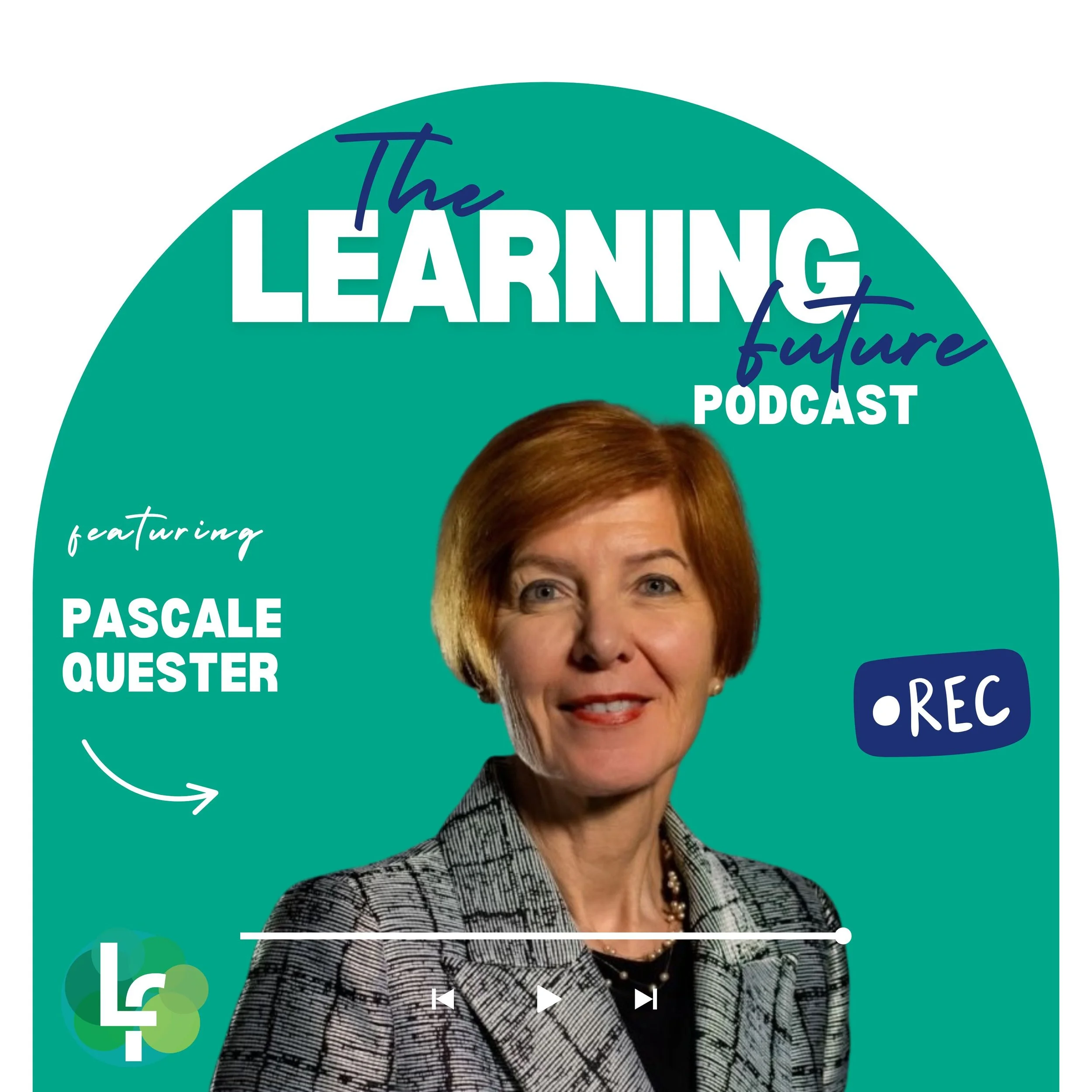
What if the biggest barrier to the future of learning is not technology — but our attachment to the past?
If real learning requires discomfort, have we made education too safe to be transformative?
🎙️ Episode Summary
In this episode of The Learning Future Podcast, Louka Parry speaks with Professor Pascale Quester, Vice-Chancellor and President of Swinburne University of Technology, about what higher education must become in an age of AI, rapid change and growing complexity. Pascale challenges the deep conservatism that still shapes education, arguing that universities must move beyond inherited models like lectures and exams and instead rethink assessment, learning and capability from the ground up. Together, they explore the role of productive struggle in learning, the difference between friction that supports growth and friction that blocks access, and why authentic assessment matters more than ever.
The conversation also examines Swinburne’s bold strategic direction, including its focus on personalised learning, technological infusion, entrepreneurial thinking and global relevance without simply replicating itself everywhere. Pascale makes a compelling case for a more human-centred, adaptive and differentiated university model—one that builds resilience, welcomes discomfort, and prepares learners not just with knowledge or skills, but with the capacity to keep learning for life. At its core, this episode is a powerful reflection on unlearning, transformation and the future of universities in a world that urgently needs stronger, wiser and more capable humans.
👤 About Pascale Quester
Before joining Swinburne, Professor Quester was Deputy Vice-Chancellor and President (Academic) at the University of Adelaide (2011–2020). She had previously held various roles at the University of Adelaide, including Executive Dean of the Faculty of the Professions (2006–2011), Associate Dean of Research for the Faculty of the Professions (2001–2006) and inaugural Professor of Marketing in the Adelaide Business School (2001–2020).
Professor Quester is an active and respected researcher in the areas of consumer behaviour and marketing communications. Her qualifications include a Bachelor of Business Administration from her native France, a Master of Arts (Marketing) from Ohio State University in the United States and a PhD from Massey University in New Zealand.
In 2023, Professor Quester received one of France’s highest honours, the medal of Officier de l’Ordre National du Merite.
In 2012, Professor Quester was awarded the Chevalier de l’Ordre National du Mérite (National Order of Merit), one of France's highest honours, in recognition of her contribution to higher education in both France and Australia.
In 2009, she was elected Distinguished Fellow of the Australia and New Zealand Marketing Academy.
In 2007, she also received France’s highest academic recognition by becoming Professeur des Universités.
Professor Quester has held several visiting professorial appointments, including at La Sorbonne, Paris II, ESSEC Business School, and the University of Nancy in France.
🔗 Connect with Pascale Quester
🔗 Stay Connected with Louka Parry
For the latest learning innovation follow Louka on LinkedIn
Share your thoughts by visiting www.thelearningfuture.com
Tune in to be inspired, challenged, and reminded why love truly is at the heart of learning.
[Transcript Automated]
Louka Parry (00:01)
Well, hello everybody and welcome back to the Learning Future podcast. I'm your host, course, Louka Parry and it's my absolute delight to today have one of my favorite human beings on the podcast. We are speaking with Professor Pascale Quester She's the vice chancellor and president of Swinburne University of Technology, which is one of Australia's leading research and innovation led institutions. She commenced her tenure in August 2020 and she's been reappointed. She's going to be out there till 2030. So we're going to talk a little bit about the future of that.
Before joining Swinburne, she actually served at the University of Adelaide, which is my hometown, and she held several leadership roles, including executive dean, professor of marketing and others. She hails from her native France, but she has studied in the US. She has a PhD from Massey University in New Zealand, very much a global citizen, Pascal. And whenever we happen to talk, I'm always kind of elevated by the generative space of the ideas. So thank you so much for taking the time to join us today.
Pascale Quester (00:56)
Good to be with you Louka
Louka Parry (00:59)
Fantastic. My first question is always the same and it's what is something that you are learning at the moment something that's capturing your attention? Let's go.
Pascale Quester (01:08)
Well, something that I probably knew intuitively to be true, but realized as we go forward with a very transformative strategic plan, is how deep down many educators remain quite conservative. nowhere is it more evident than when we start talking about the holy grail of assessment, which of course has come under question because of all of the
AI and the capacity that AI has to cheat at writing essay. And of course the inevitable question is, so why are we assessing with essays? And this is where you see a wall of kind of resistance to colonialism. I was always, you know, assessed with essay, yes. And why does it make it the right type of assessment? you actually find that people tend to naturally coalesce around the familiar.
and the familiar is the way they were taught. And then immediately you start to say, what if things were entirely different? And I'm always surprised that educators who should be always kind of tempted to learn and keen to learn are actually people who tend to be actually very unable to unlearn the way things were.
Louka Parry (02:17)
It's such a, it's a profound statement. know, the future doesn't belong to those that can't read and write, but those who can unlearn, relearn. This is one of Alvin Toffler quote. So take us into, you know, at the moment, if we'd just take a step back, we're in this, this moment, it's 2026. You know, we have this new wave of quite transformational technology that's shifting the kind of macroeconomic climate, certainly the tasks, you know. And so, you know,
Louka Parry (02:46)
I really want this conversation to be from your lens, which is uniquely kind of thinking about the future of higher education. And so take us into the project of transforming Swinburne, but also more broadly about the kind of the raison d'être of a university in 2030, for example.
Pascale Quester (03:04)
So I'm a bit torn between the view that perhaps we overstate, the momentous step that we have to confront, and sometimes understatus. And I'm really intrigued by this intersection of technology and learning and how that is going to play out in the future.
not in a way that I think most people think as a kind of substitution that people will use AI instead of, whereas I think it's actually quite additive, it's quite kind of complementary, it's quite symbiotic, what if we learned with AI? And that's a completely different proposition. But I think that as people kind of talk about how we are on the verge of something kind of catastrophic, the book was the actual technology that transformed learning in medieval time. And the lecture, I like to remind my colleagues who never want to let go of the lecture, want to make it compulsory before people can sit exam, that the lecture was devised as a method to kind of do what the books could not do because they were not affordable at the time. And then we had the book, but we still kept the lecture. And at some point you said,
Pascale Quester (04:15)
Okay, so we've had the books for a thousand years now. Isn't it time we let go of the lecture? Can't we just kind of step to the next thing? And there is that sense that, you know, we tend to kind of see AI as this enormously transformative technology, but we've had others. And yet we have kind of maintained or always seen that new technology as yet another layer we put on top. What if we didn't need anything below if we had that?
What if that layer on top was strong enough, solid enough, or different enough that we actually didn't need all the stuff underneath? And that's kind of what I'm intrigued in kind of exploring. What do we need underneath?
Louka Parry (04:58)
It's so fascinating. It's almost like thinking about what are the minimum viable requirements for it to kind of, it's a new model rather than this idea of, yeah, as you say, you kind of pave as we do in human history, we just pave on top of everything else that came before. We don't necessarily remove it and redesign it and think differently about the utility. I find that really interesting and compelling. And as someone that's leading, you know, the complex organization that is a university, take us a little bit into the world of 2030 and especially I know quite a little bit about your university having you know done some work with you but I'm you know this idea about Astra you know the idea of a quantum leap rather than incremental improvement yeah where do you where do you want to go?
Pascale Quester (05:40)
So, and that's where we really
wanted, in fact, you know, one of the kind of interesting things about this strategic plan is that we had a very broad conversation and we invited not just staff, but students and partners and just about everybody who wanted to be part of that conversation. And I was quite open in saying, and this is because we're going to have AI help us read through all of that.
contribution by people and then we'll extract the theme but instead of just taking them as you know kind of divine mana we'll just reflect them back to people and people will have a chance to interpret what it means and then we will actually have the cognitive rigour of making sure that we're taking the things that are transversal, the thing that binds us together instead of the thing that makes us as always you know we tend to go into the vertical and the silo so
Pascale Quester (06:32)
It was actually a really good demonstration of how AI can help you do all of that kind of labor intensive compilation of things. But you don't take that for granted. It's not the full reality. You've got to reflect it back. You've got to get people's advice on it. They have to respond to it. And I'll give one example, because our new strategic plan has got four quantum leaps, but it started with initially five.
And there was one that was about, it was a bit similar to the fourth moonshot of the previous strategic plan. was all about wanting to be entrepreneurial and be willing willing to fail and being the prototype of something that is the university of the future rather than the reflection of something that was a university of the past. And at some point people reflected and saying, hang on a minute, this is not a separate thing. We should do that in everything else we do. So instead of having a fifth quantum leap that mandated it.
that we should be entrepreneurial. We decided to be entrepreneurial in the other four quantum leaps and then made it all the more sort of real and authentic because it was actually the human take on what otherwise would have been the AI conclusion. And I think this is where the nexus is, that combination of the critical thinking and the way of looking at the narrative rather than just kind of taking the summary view of what everybody else has been saying because
You know, people have only got that capacity for extrapolation. You want to kind of really force. And I think this is where learning happens. You know, we'll probably be talking about that in the next half hour, which is, you know, learning is hard. And if it's not hard, it's not learning. And so this whole notion that we've got to somehow, you know, protect the students and have trigger warning and just make it all so lovely and warm and comfortable. But there's no learning happening if it's easy because
Louka Parry (08:07)
Yes.
Pascale Quester (08:22)
Because learning is about transforming your cognitive pathways and it is about reshaping your brain and surely that can't happen in a completely sort of harmonious sugary way. But yet the resilience, you know, we were saying before what is underneath, think underneath any learning, there has to be a resilient learner that is not only willing, but actually anxious to kind of be uncomfortable because if they don't,
then the learning is going to be constrained.
Louka Parry (08:52)
Yes, I think that's puts puts so beautifully and of course, there's a lot of a lot of the conversations I'm having at the moment, Pascal are really centering on this question. The idea of friction is something I'm very curious about in particular, you know, and I think you've started to allude to it, the difference between a performance pathway versus a learning pathway. And so if the assessment is about performance, well, then I will offload all my cognition to just give you a product. And then of course, the data was just
as soon as I've submitted it, I don't remember any of it. It's one of the issues of cramming is also the same as it's gone, right? We haven't reshaped my cognitive pathways versus this kind of this process in whether it's grappling, there's struggle, there's discomfort, there's negative affect even, as part of that cognitive piece. So I don't feel good because I'm working really hard. But then of course, there's the accomplishment of achieving something. And I think there's this very interesting moment where we see, as you know,
Louka Parry (09:49)
You're kind of in the space around business and marketing too. You know, an obsession with frictionless experience in the digital world. And so of course, that's fine if you want to sell people a product, but of course in education, we're selling friction. Are we not? Where do you sit on this?
Pascale Quester (10:04)
Yes, see, we're a university of technology. So I often say, you know, that it's actually a law of physics that you need a friction to get a spark. So if you get no friction, you get no spark. But at the same time, I would say the friction has to be, we have to be discriminant in where we apply the friction. The friction has to be in the learning. What you don't want to do is to make it an obstacle course for a student to enroll.
Pascale Quester (10:30)
You don't want it to make an obstacle course for students to go from a vocational to a higher education pathway, for instance. So that bit absolutely needs to be frictionless because the friction may discourage people from continuing and then it may just turn away people who are full of talent and could contribute in whatever way. But the friction in the learning, if it's obvious to you,
it's probably not going to kind of stretch your cognitive capacity and you're probably not going to learn something. And in fact, you know, sometime, and as you say, I'm a marketing person, everybody knows marketing, right? It's easy. You just kind of look at TV and you've got like, people assume that it's easy. And if they assume that it is easy, they don't actually learn the hard stuff, which is the psychology, the economics, the behavioral science, the...
the digital element and all the rest of it that can actually make it a quite challenging ⁓ discipline. But there are other disciplines where you can't get past first base if you don't actually learn some stuff. And it's not going to come to you naturally, geometry, trigonometry. Nobody's born knowing about trigonometry. But if you don't learn that, then how are you going to move into the world of physics, right? The question is,
How do we make the reward loop? You know, I'm a behavioral scientist. Children need to have that feedback loop that encourages them. And as you said, the feeling of achievement is one thing, but also the notion of the kind of the curiosity for its own sake, the awesomeness of the universe. And one of the things that we're doing at Swinburne, which is quite an investment, is to actually create immersive experiences where
where kids as young as primary school kids will be able to see how the universe works. What happens when chaos collides and what happens when a black hole does something weird. And because that you can't help wanting to know more. And then if you told that this happened 8 billion years ago and we're just showing it to you on screen, but wouldn't that be nice to understand how that works? If you don't get that initial reward and feedback that
that makes a child wants to learn more, then you miss the chance. And I think you actually probably don't get too many chances that if you switch off that curiosity and feedback loop in an early child, it's not in year 12 that you're going to rekindle it. I think there needs to be a reinforcement. It's shaping behavior, right? You encourage it.
and you reward it in such a way that it is repeated and people have to be resilient and they have to be able to cope with failure. But if you have repeated experiences of failure, then you stop trying. And so it's the right balance between making things challenging, but not overwhelmingly difficult. It's not an obstacle course other than if there is an obstacle course, it's kind of customized.
Pascale Quester (13:29)
to the fitness of the person as opposed to kind of only meant for champions to kind of ⁓ conquer. And I do actually think this is where the educator skills comes in. to me, where technology is gonna play a major part and in some ways it's the kind of opposite of what marketing has been doing for decades. Instead of trying to kind of segment people and group them in herds of like people who do need the same thing.
Louka Parry (13:29)
Mm-hmm.
Yes, in a link. Yes, you look at it, you go, don't know. Yeah.
Pascale Quester (13:58)
The technology will enable us to customize. And if we can get to that holy grail of customizing education so that people have got the right mix of challenge, reward and resilience building element and experiences, then I think we're onto a really good thing.
Louka Parry (14:16)
I was just thinking about a nuance as you were talking then, know, struggle is one thing, but of course, productive struggle is a better frame because of course we can have unproductive struggle. And I think to your point, I think when we think about equity, you know, there's so much unproductive struggle in some ways that prevent people from stepping into, whereas within the learning experience, if you're grappling, it should be leading you towards the developmental continuum of something or a new understanding, a new skill.
I find that quite compelling. The other question I want to just come to is about really knowledge and transfer. Because as you've said, you took what was going to be a fifth focus group on enterprise entrepreneurship and you then said, no, this is part of everything we do at a university. Now some people, I'm not necessarily one of them, but some people would say, well universities just teach knowledge at scale. They're not connected to the real world.
You know, you don't even need a university degree anymore. You can just go straight into the workforce and the L &D. What's case that you make? Because clearly universities do need to be closer to transfer. But there's an assumption that you're not doing it already.
Pascale Quester (15:21)
Yeah, it's interesting because I've been perplexed and maybe because in Australia we like to keep things simple. you're in that team or you're in that team and you play that league or you play that league and see it's very dichotomous, right? We like to bifurcate. And one of the big bifurcation, which I think we're paying the price for now has been the kind of, the vocational is here and it's dealt with by the state and then the higher education is here. And I have had
famous conversation with vice chancellors will remain unnamed, where I ⁓ quite enjoyed demonstrating to them that if they had a medical school, they had the most vocational course ever. Because it's not as clear cut as this. can't prepare a musician in a conservatorium in a university and say you don't do vocational because they're going to practice on that violin for many years before they get to mastery, And you wouldn't launch.
Louka Parry (16:02)
Absolutely.
Yes.
Pascale Quester (16:17)
a doctor, dentist or a vet on the general public without giving them a fair amount of very practical training. And likewise, there is this expectation that people who do vocational courses are somehow lobotomized and they don't think at all. And it's a ridiculous characterization. And so I'm blessed with the fact that my university is a dual sector university. I see this as a really incredibly timely and necessary evolution of the system.
Pascale Quester (16:44)
Because if you look at each learner individually, they probably will require a different mix of vocational skills and kind of knowledge foundation. But I would also argue they will need to be equipped to acquire skills and to acquire knowledge throughout the rest of their lives. so giving them just one thing is going to put them on the track to nowhere really.
Because to me, the capacity to adapt will come from this particular mix of skill and knowledge, which I think just about every possible job would actually require them to have. So I refuse to kind of typecast our vocational learners as people who can't think. And I refuse to typecast our higher education learners as people who can't actually do things. And I think this is where, in terms of authentic assessment,
I much prefer to have a learner demonstrate what it is that they can do with their skills and knowledge than somebody who can tell me what it is that they know is in the textbook somewhere, because I have no idea whether they can make use of that. And so, you know, I come back to this notion of authentic assessment. How do we actually ensure that people have capacity to demonstrate
Louka Parry (17:55)
Yes.
Pascale Quester (18:04)
what they can do, whereas currently the assessment and the exam in particular, which I have a particular dislike of, an exam is there to test what you can't do and then take marks of you for what you can't do. It's incredibly deficit creating, right? So having the capacity to demonstrate what you can do and whether you can do it because you've had these skills or that knowledge, it's probably the way you combine the two.
Louka Parry (18:11)
Yes.
Yeah, correct point.
Pascale Quester (18:33)
to come up to an outcome, a solution, a recommendation, a creation, if it's an architect project, that is to me the test of whether or not you've integrated that learning into a coherent way of finding solutions to problems.
Louka Parry (18:49)
I think that's absolutely fascinating. I think this assessment question is one of the great questions for our learning systems. What are some of the stories or maybe experiments or use cases, Pascal, that you're playing with as a university, knowing that, as we started with, as educators, we can often grasp to our most familiar ways of doing and being.
Louka Parry (19:13)
And so what are you seeing emerge? What do you think is needed even as this world of kind of the hybrid virtual tutor plus the analog social cognition aspect collide?
Pascale Quester (19:24)
There's a great deal of conflicting elements in this. mean, the higher education is characterized by third party accreditation, which are really problematic because they tend to hold to very established model. In fact, that's kind of almost their raison d'etre, right? They're there to make sure that everybody does it the way that it was done to them. I have been known to describe exams to those people as intergenerational abuse, but you know.
I do think that for some of them, their love of exams comes from the fact that they've suffered them and therefore they want to inflict them in future generations, which I think is a strange motivation. But the reality of how this works is that the minute you start taking away the traditional exams, you are immediately going to be accused of dropping standards. You're immediately going to be accused of letting through students who don't deserve to pass.
Louka Parry (20:01)
very interesting.
Pascale Quester (20:18)
And so again, this notion of stage gate, we're here to stop the students from progressing and they're there to kind of show that we're wrong in telling them they can't, right? Which I think is just a very warped way of going about it. So in terms of how we've been, of course, we are experimental and entrepreneurial, so we didn't kind of start everywhere, but we started in our school of design. And the way that we thought about it is if you were a practicing designer or an architect,
In the professional environment, if you come up with a project that is not up to scratch, you're very unlikely to be told by the senior partner that this is a three out of 10. Now go and do another project. That's not what's going to happen. You're going to be told this is not good enough. Go back and do it until we tell you it's good enough, right? So that's actually what we do in the School of Design. You work on your project, you present this, you get feedback. And if it's not good enough, you're going to go back and you are charged with
Louka Parry (21:01)
Yes.
Pascale Quester (21:15)
with fixing it. And in demonstrating that you can fix whatever it is, you show two things. You show that you've been able to understand the feedback. You've been able to analyze that feedback and determine what's relevant and what's not. You've been able in your own mind to determine what it is that you need to do and those things that you disagree with. And then you're gonna come back with your next iteration where you're going to say, and I didn't do this because, but I did that because, and the way I did that is like that.
Now, this is an incredibly more constructive and intelligent way. And what it does mean is that in the world of work, when you get in there, you're not going to kind of get in the fetal position. And the minute somebody tells you you're not brilliant because your project is not fantastic, you're actually going to say, OK, well, I didn't think about that. So thank you for the feedback. I'm going to go back and think about it. And there's nothing. In some ways, you'll grow faster and you'll grow stronger.
Pascale Quester (22:11)
because as long as the feedback is provided in a way that is constructive, and in some professions, that's not always the case. Sometimes people think they shine through the cruelty with which they inflict feedback, and that's not good either. But it has actually shown great promise in that school, because we are building professionals who are going to be in a position to understand feedback, take it on board.
Pascale Quester (22:39)
argue with it, not take it blindly, but then go back and produce something better. Now, of course, it's not going to be applicable in the same way, know, discipline and, you know, walks of life. But the notion of actually assessing people on their capacity to integrate their initial understanding and then to iterate once they got additional feedback and then kind of contemplate the validity or otherwise of those things that have been said to them.
That's an incredibly more intelligent way of demonstrating that you understand something.
Louka Parry (23:13)
It's brilliant. I'm also thinking about the layer. It's far more sophisticated, isn't it, Pascal? It's really kind of assessment for the 21st century. But I'm also thinking about what we're learning from the kind of generative AI space and agentic AI space soon to be, where rather than being just the sole producer, you're effectively becoming increasingly a reviewer. You're becoming a manager.
And so even the capacity to give feedback to somebody becomes a key skill. Why? Because you can increase your productivity, supposedly, by being able to prompt intelligently to give critical feedback and to iterate a project to a point at which you think it it meets a particular standard, which is a professional standard. I really just think that's a compelling way. Where do you find Pascal? Because, you know, there'll be people that will say, well, we need the gates.
Pascal, do you know, there should be these things, know, quality control, exactly right. Well, how will we really know? I mean, and I think there's something about, you know, evidencing, which is of course, the work that we talk about, the Learning Creates Australia a bit, you know, how do we think about evidencing, you know, the ability to apply feedback to iterate versus this idea that there is a single moment in time where you must impress upon us your
Pascale Quester (24:06)
Quality control, quality control, right?
Louka Parry (24:34)
ability to recall and in some ways synthesize knowledge to create some kind of answers but you know it so rarely falls into that practical realm where it's useful perhaps.
Pascale Quester (24:46)
And I think part of the issue that we grapple with is that the model of universities, certainly in Australia, has been one where size has been equated to the capacity to do things. The method of assessment that I've just described, we couldn't do it if we were a university to us our size. And that's precisely why in our strategic plan, we have not wanted to become just bigger, but just better at a few things. And I think there is, I mean, it's quite...
It seemed incredibly new in Australia when I said, no, we don't want to get bigger. We just want to get better at the things we do, which means, by the way, that we are going to stop doing things and shock horror. We were going to kind of abandon some areas. That's the only way to avoid becoming just bigger. Right. And my view was that in a sector and I've described the sector as a reef where there were already too many whales.
We didn't want another whale. We certainly didn't need to be another whale. So we needed to be something else that added to the ecosystem in a way that was differentiated but useful, compatible as well as different. So we were not trying to eradicate all the species on the reef to of bring our own species to dominate. We wanted to be sort of living in harmony with the rest of the ecosystem. And I actually think that diversity in the ecosystem is actually the way for its resilience. So if people want to learn languages, they can't come to Swinburne. I'm not sorry about that. There are plenty of other places where they can go for language. And you and I, Louka, share a love of language. It's not that I don't like language. It's just that we are a university of technology. So come to us because we are a university at the human scale, but we still have a supercomputer. We still have amazing technology. We will have the Swinburne virtual universe that will all the kids from primary school onwards.
Louka Parry (26:21)
Peace.
Pascale Quester (26:37)
We have this world-leading capacity to get to data that only NASA and Caltech has and no other Australian university has. So if that is what you want to do, come to us because we do it at the world-leading level. But if you want to do the things that we don't do, good luck. Just there's plenty of other institutions where you can go and get that. We're not going to try and be mediocre at a lot of things. We're just going to be excellent at a few things.
Louka Parry (26:52)
Yes.
I was gonna be my next kind of reflection, Pascal. This idea to be bigger usually means growth across all domains. And so in some ways it's a Faustian bargain. You end up being okay at a lot of things rather than really specializing. I think your point, like in nature, in nature we think about biological systems and resilience, right? Everything is unique. is...
Louka Parry (27:32)
specifically designed to have a specific feature within an ecosystem. So I find that a really compelling metaphor as well. ⁓ Not surprisingly between the biological and the astrological, which of course you also like to speak to. I wanted to just double click a little bit more on this technology aspect because you are someone that is really paying attention to technology. And what do you see, you know, even the whole idea of chat GPT or Claude or Gemini, or all the other copilot, all these different models. Like what is your current position on how they can be used well? Because invariably students are using them now, teachers are using them, everybody's using them to some extent, at very different levels of effectiveness, especially when it comes to the learning process that we're talking about and cognitive offloading and all those kinds of things. So give us a little bit of a picture in terms of where we are now, what do you think's underway?
Pascale Quester (28:23)
So ⁓ as you know, because I know you've read it, our new strategic plan at Astra has got four quantum leaps. And the beauty of them is that they're all interconnected. We can't succeed at one if we fail at the others. And the first one is to deliver a very personalized, customized pathway to success. And by the way, this is for our learner, but it is also for our staff if they want to create a company and it is to our partner if they want to kind of find a solution.
Pascale Quester (28:47)
But our second quantum leap is that we want to lean and infuse technology in everything we do. I think you'll find that 90 % of the public discourse at the moment about AI is about the substitution to assessment and cheating on exams and all the rest of it. Well, it turns out that actually AI, if it is to be a substitute, probably would be a personalized tutor. It's endlessly patient. It never loses its nerves.
And actually some of the research that we do at Swinburne shows that it shapes very often more empathetic responses than a human would, particularly a human that is actually perhaps exasperated about being, not understanding why the student doesn't get that very simple thing. AI is a sort of smooth and will rephrase in a different way and will try a different definition and will show a different. So there is a benefit in the...
Louka Parry (29:32)
Yes.
Pascale Quester (29:44)
in the use of AI in the teaching. Forget about the assessment. In the teaching, in the capacity to phrase and rephrase and present the information in a variety of way. And in the classroom, as you well know, you'll get the one kid who gets it first off, who's gonna get royally bored by the time the teacher explains it the fifth time for little John at the back who still doesn't get it. And at the end of that hour, you'll have one really bored bright student
one probably still not quite sure, sort of a poor student or less able to understand the concept on the day. And then the others are somewhere in between. Well, AI actually tells you that you could actually tailor the experience and progress the learner because this learner who got the concept first off on this day might actually be the one that doesn't get it two days later for another concept. we...
Louka Parry (30:41)
Yes.
Pascale Quester (30:42)
We want to be the university where not only do we lean and infuse technology in everything we do, we don't just teach technology, we demonstrate technology, we speak the truth about the technology we provide and de-dramatize and de-demonize technology. We see what it can do as well as what it can't do. We're ready to kill the stuff that doesn't work and we can speak from a position of informed
Louka Parry (30:51)
Nice.
Pascale Quester (31:09)
rational assessment of the merit of it, which probably means not reading the newspaper headline on it, because they do the opposite, right? They want to create the drama. They want to create the drama. They want to create fear. They want to create all of these things. We want to be the kind of the well-informed sort of trusted expert in relation to that. But if we...
Louka Parry (31:14)
Mmm.
It definitely definitely means that.
Pascale Quester (31:32)
If we fail at our quantum leap two, which is to infuse technology in everything we do, not just teach it, but live it, we won't be able to deliver the personalized pathway to success, which is our quantum leap one. And our third quantum leap is we really want to kind of be there in creating the industries of the future because we have ways of doing things that other universities do not have access to. And the fourth one is actually that we want to see the world as our campus.
And unlike the other universities who tend to kind of just want to do a mini-me somewhere, like, you know, we'll have a campus here and we'll have a campus there. We do have a beautiful campus in Malaysia, which is just fantastic. But there are some places where what they want is somebody who can help them with a curriculum. And in some places they want some help or collaboration in relation to energy transition. And in others, they want to kind of know how it is that we're so successful in the innovation and, you know, startup phase. So we don't have to be.
the same everywhere. And there is this kind of awful term that I got from the marketing literature a few years back, which is globalization. We want to respond to local needs from a place of global expertise. And so that is very different from wanting to just clone ourselves, which in my mind proves just a certain degree of arrogance, like we're so good, we're gonna clone ourselves. But also the kind of...
Louka Parry (32:55)
Yes.
Pascale Quester (32:56)
the very likely probability that you're going to miss the mark because actually, as you know, other places are not like Australia. What they need is not what Australia needs. And so how about we listen to what they need and then provide what it is that we can help them acquire or grow. And at the end of the day, we are all in a similar business, I suppose, which is, you know, we are in the business of developing human capital, but it takes very different
approach is to do that. And I think that's what we should be committed to.
Louka Parry (33:31)
I love that. It's almost like the idea of kind of local science. You take the universal principles and then you apply them to the context. And context is so, context is queen, which is one of my favorite reflections, always. And I think it's why this scale construct doesn't always work out when we talk about human systems, Pascal. And this idea of like bigger is better. I've often heard scale is male and pale and stale.
Louka Parry (33:55)
You know, it's like, everything's like, we're going big, we're going to get like a billion, billion users, etc. It's always the kind of, and like, it's great if you're solving a really key problem. But there's something about spreading instead of scaling, which I find far more compelling because it assumes agency and co-design at the local level versus, we're doing this. Well, why are we doing this? because headquarters says that we do this, you know, or in K-12.
Pascale Quester (34:18)
because the others are doing it.
Louka Parry (34:20)
Oh, yeah, because the others are doing. Oh, yeah, that's exactly right. So we don't want to miss out on the way rather than being unapologetically yourself as an organization. And of course, this all applies at an individual level as well. How do you individuate across your lifespan using learning as your vehicle so that you can become increasingly valuable both in a marketplace and in the community? I think that's the core. I mean, that's what drives me, Pascal, is like, can you get to a place where everyone is as unique as possible?
Pascale Quester (34:43)
Yeah!
Louka Parry (34:49)
rather than cloned and then from that place you can create value that is your best place to create. ⁓
Pascale Quester (34:56)
Yeah, and I mean, I subscribe to the view that you've got to make yourself increasingly valuable, but I'm going to say something that probably will shock you. I think there's real wisdom in trying to make yourself highly dispensable. And I think that's the success of good teaching. It's when the learner is equipped and can learn without you because they know how to learn. And so to me, the great achievement of the teacher
is to make him or herself dispensable. If you make yourself more valuable and in the process of making yourself more valuable, you make yourself indispensable, you're putting the learner in a position of fragility because you go and they lost. And I think the real achievement of the teacher is to no longer be needed.
Louka Parry (35:46)
Mm. Do you know, it's such an interesting, I mean, we haven't, it's probably beyond the scope of this conversation, but you, you ultimately think about a company, a company seeks to make itself indispensable in some ways, right? Versus a social impact organization, which in some ways tries to solve the issue so that it no longer exists as an organization. It's just really interesting framing. we've got a few minutes left, Pascal. I want you to take us into the future.
Pascale Quester (35:51)
Mm, mm.
That's right.
Louka Parry (36:09)
Now let's go even beyond 2030. And I'd love for you to kind of map out what you think, you know, one of the scenarios, perhaps even your preferred scenario is for the kind of human capital space in 2035, or even let's say 2040. That means you have to be a bit speculative, that you're very well placed to look at trends and signals. But you know, what do you, where do you think we are heading? What's the destination that we're trying to, you know, meander our way towards?
Pascale Quester (36:34)
Well, to be honest, I see decreasing value in trying to predict anything. And in fact, a statement that says our strategic plan goes to 2030 is kind of ignoring the fact that we are currently subject to such sometimes vindictive government decisions and hostile public discourse. That in some ways, it's probably a little bit, you know,
It's not very pragmatic to want to kind of project yourself in that time frame. I do think this is actually why there's such value in staying small and nimble. You don't know which direction things are gonna go, but if you can run faster than the others and you can get to the hill if there's a flood or to the clearing if there's a fire, that notion of being nimble and quick to change tack.
if need be, that is certainly one of the reasons why we don't want to get bigger and why we absolutely want to develop the flexibility that comes from that vocational and higher education sort of kind of enrichment, if you like. We live in a troubled world and I would think that one of the virtue, and it is actually part of the ideal of the universities, to really create people who reconnect
with the capacity to have very respectful and civil conversation with people you fundamentally disagree with. And to me, the problem is, know, social media has been really problematic in that way because it actually takes away any dissenting voices. And I just hate the simple fact that we have to have trigger warning to say to students, hang on, we're gonna say something and that's gonna kind of cause a little bit of discomfort.
Everything we say should create some discomfort because otherwise nobody's learning, right? So it's how do we make people resilient to dissent and how do we make them comfortable in disagreement? How does it not become personal? How does it not become an insult? How does it not become a, well, if you're not with me, you're against me and therefore you deserve to die, which is kind of almost what the level of geopolitics has become now, right?
Louka Parry (38:25)
Yes.
Pascale Quester (38:45)
So to me, there is a profoundly urgent need for universities to actually train people to be in that zone of discomfort that comes from being surrounded by people you either don't understand or don't agree with. And this is one of the reasons why I've been for a long time a strong advocate of student mobility, because you can't really explain to anyone what being a foreigner is until they've been the foreigner. You know, there's only a level of sympathy that people can say, you know, there's foreigners everywhere and they don't eat the same food and they don't do this and that. Try being the foreigner. And all of a sudden say, geez, all those people think differently from me and I'm the odd one out and I'm going to have to understand why it is that they do the things they do. And rather than say they're all wrong and I'm right, I'm going to have to understand what it is to be in that group.
Louka Parry (39:17)
Yes.
Pascale Quester (39:42)
if we could replicate this in a way that is safe, in a way that is kind of, know, I believe in vaccination. So there we go. We're going to have inoculation of dissent and discomfort until people build resilience and immunity to the kind of tripe that is going on social media where people, young people believe and do not question opinions simply because that's what they.
kind of think and therefore anybody who kind of thinks the same as them is going to reinforce them. So my optimistic view of the future is I hope we're going to save this planet. And Swinburne has actually achieved carbon neutrality in November last year, which was no mean feat. I do hope we can save this planet, but I do think we've got to prepare for plan B. So space exploration, some kind of exo-
Louka Parry (40:20)
Wow. Congratulations.
Pascale Quester (40:32)
planet system might be handy to have, but if we go to another planet and start fighting with each other, we might as well stay here and vaporize because that might actually be the best thing for the planet. you know, if you ask me to really conjecture long term, I'd have to say we have a moment here where we can choose to either survive together or blow the place apart.
Louka Parry (40:59)
It's such a deep truth. Pascal, it's just the choice that we have, you know, ⁓ in every moment. No, no, me too. You know, it's like there can be a plan B, but it's not going to be nearly as nice as this incredible planet that we're on. Such a great conversation, Pascal. Thank you so much for taking us into this world of learning technology. I just think there's so much here about owning your brand identity in particular.
Pascale Quester (41:04)
I'm all for saving the planet.
Louka Parry (41:24)
and saying this is who we are unapologetically. There's definitely something there that can be kind of taken around strategic play, which is why I think you've done a great job on the strategy. My final question to you is just a take home message that you have from your vantage point leading a university in Australia at this moment in time. What's something that you would want to resonate in the minds of our listeners?
Pascale Quester (41:44)
Well, I think universities are very often, not just university, but schools. And I would want us to all have a conversation around the learner so that we don't kind of separate the school from the TAFE, from the university. We're all into that human capital development. We do tend to talk about skills. tend to talk about, I prefer to talk about capabilities. And one of these that you and I have just talked about is that kind of resilience element. How do we...
build stronger humans so that they can actually learn better, run faster, do more things, be more innovative, be more comfortable in discomfort and all the rest of it. So the element of, you know, we don't do that by over protecting people. We don't do that by not confronting people with difficult choices, but it's how do we do it in a way that is building them up rather than destroying them. That's the key to me.
Louka Parry (42:42)
think it's so beautiful. The concept that I love is anti-fragility, of course, because I've come to Taleb's work recently. And it's just this idea that it's not even just to be resilient, it's to know that through adversity and struggle, I become stronger. And that, that I think is just the core part of a really powerful human development experience.
Louka Parry (43:04)
Pascal, thank you so much for the work you do. Such a passionate advocate for what's possible. It's been a delight to have you on the Learning Future podcast.
Pascale Quester (43:12)
Pleasure to be with you, Louka.
Louka Parry (43:14)
Merci bien.