MasterClass, AI & the New Age of Education with David Rogier S11E2 (141)
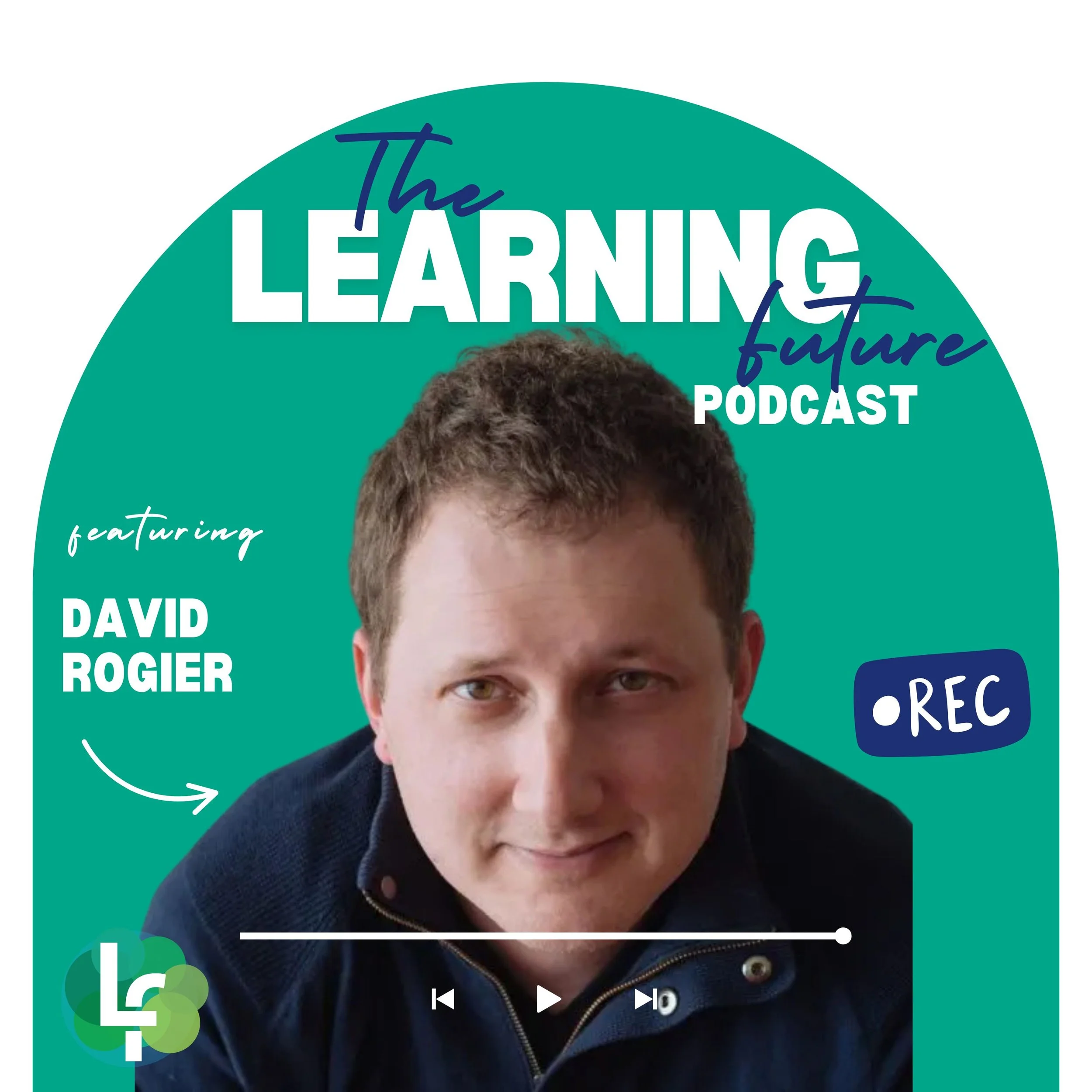
What if the real purpose of education is no longer to deliver knowledge, but to develop people who can continuously relearn, adapt, and create value in a world where information is everywhere?
If AI can compress years of learning into months, what should schools, universities, and employers still uniquely provide that technology cannot?
🎙️ Episode Summary
In this episode of The Learning Future Podcast, Louka Parry speaks with David Rogier, CEO and co-founder of MasterClass, about how technology, AI, and changing workforce demands are reshaping the future of learning. David shares the origin of MasterClass, why great education should also be engaging, and how personalized, AI-supported learning could dramatically accelerate skill development. Together, they explore the rise of agency, the growing value of generalists and lifelong learners, and why schools and universities must shift from static knowledge delivery to helping people learn how to learn. The conversation also touches on identity, adaptability, meaningful work, and what it will take to build more human-centered learning experiences in a rapidly changing world.
👤 About David Rogier
David Rogier is the founder and CEO of MasterClass, the streaming platform that has redefined online education by bringing the world's greatest minds directly to millions of learners worldwide. With more than 200 instructors—from Serena Williams and Gordon Ramsay to Martin Scorsese and Mark Cuban—MasterClass has built an unmatched library of Emmy-nominated, Oscar-nominated, and James Beard Award-winning content.
Growing up, David loved learning but often struggled in school. Determined to reinvent the traditional model and provide lifelong learning opportunities for everyone, he created MasterClass in 2015. His vision was to capture, share and preserve invaluable knowledge and stories from the world’s best so future generations could access and appreciate them. MasterClass has since transformed the lifelong-learning category providing unprecedented access to the world’s best practitioners. With classes on a wide range of subjects, MasterClass has grown into one of the largest online learning platforms in the world.
David has raised over $500 million to build MasterClass into a global brand. He was named to Fortune's "40 Under 40" list of the most influential leaders in media and entertainment, and recognized as one of Variety's Hollywood New Leaders.
Beyond MasterClass, David is an active angel investor with a track record of backing breakthrough companies at the intersection of AI and infrastructure, including Metronome (acquired by Stripe for $1B), Weights & Biases (acquired by CoreWeave for $1.7B), and Lovable, one of Europe's fastest-growing startups.
David is a leading voice on AI's transformation of the workforce. He has pioneered AI integration across MasterClass's operations and developed a distinct perspective on how AI is reshaping talent markets—arguing that AI empowers generalists to perform specialist-level work while commoditizing mid-tier expertise, with profound implications for hiring, workforce development, and career strategy.
David holds a BA from Washington University in St. Louis and an MBA from Stanford Graduate School of Business.
🔗 Connect with David Rogier
🔗 Stay Connected with Louka Parry
For the latest learning innovation follow Louka on LinkedIn
Share your thoughts by visitingwww.thelearningfuture.com
Tune in to be inspired, challenged, and reminded why love truly is at the heart of learning.
[Transcript Automated]
Louka Parry (00:00)
Well, hello friends and welcome back to the learning future podcast. I'm your host, Louka Parry I'm absolutely delighted to have today's guest joining us all the way from the USA. Today we're speaking with David Rogier and ⁓ David is the CEO and co-founder of masterclass, which is an incredibly high quality online learning system that hosts courses from the world's best. And I mean the world's best people like Gordon Ramsey, Mariah Carey, Steph Curry, Mark Cuban, Martin Scorsese, Malcolm Gladwell, Jane Goodall. mean, the list is actually mind blowing.
how you've been able to weave all these people together to share their expertise. As we're gonna hear, Masterclass really is trying to shake up learning. It has these global names sharing their expertise. But of course, we're in this moment, which offers us incredible opportunity to leverage technology to try to think about human development in a more holistic way. David is a serial entrepreneur and investor and holds an MBA from Stanford. David, it's great to have you on the Learning Future podcast.
David (00:54)
It's an honor to be here.
Louka Parry (00:56)
I'm so excited to hear from you. So let's just kick straight in before we jump into the future of learning. What is something that you are learning at the moment, either personally or professionally?
David (01:07)
a lot. think two that are very recent. ⁓ For the past couple of years, I've been trying to learn Brazilian Jiu Jitsu, which is a humbling, every day as I go is very humbling. The other one is, I know we will dive into it. We have been working a lot on what personalized education looks like.
looks and feels like. So I've been working on my own my own tool to be my own my my my own teacher and to as the test subject. I chose a book that I haven't read that I've always wanted to. It's it's by it's by Yval Harari his Nexus book. So I've been using that as the like test subject. So I've been learning that a thousand times.
as I use that as my example.
Louka Parry (02:08)
I love it, I love it. saw actually on your LinkedIn that you, I think you call it Davify. You're kind of learning.
David (02:14)
I have some custom GBTs. One that's for my two is to help me learn the day. If I want is actually ⁓ to write in my style so that I've trained it on my writing style. So if I have like some thoughts, I can put it in there and then it writes it in myself.
Louka Parry (02:26)
⁓ cool.
Love it, love ⁓ it. There's so many different ideas to tap into, but we'll stay on task. For those people that may not have heard of Masterclass, what is it and what's the main problem that it seeks to solve?
David (02:49)
I started Masterclass because education changed the life for me and my family. My grandmother escaped the Holocaust and instilled in me that education is the only thing that someone can't take away from you. So I wanted Masterclass to become that. So it lets you learn from, it lets anybody learn from the best in the world, but it's to learn things that can actually transform your life.
That's what MasterClass tries to do.
Louka Parry (03:23)
It's give us a little bit about this, you know, cause often it's kind of Netflix level, like movie quality courses, which is kind of a, was a new feature. You know, we've had MOOCs around for a long time and kind of the online learning platforms, you know, LMS is for a very long time, but you know, there's something quite unique about this idea of having such high quality, uh, production.
David (03:32)
Yeah. Yeah.
Yeah.
Yeah.
I mean, it's so interesting because, you know, the idea for that came from, I love to learn, but I wouldn't take these MOOCs. And I was wondering why. And he looked at them. It was a webcam in back of a classroom. And I was like, well, like I will sit and watch every episode of the wire. Why is that? And it's just, you know,
the effort and emphasis put not only on the visual, but on the storytelling and the craft. And so we said, why can't we combine those two worlds? often, especially in the beginning of masterclass, the press would often ask us, are you education or are you entertainment? Are you education or are you entertainment? And I always thought that was such a false premise. The best education is also entertaining.
Louka Parry (04:31)
Interesting.
David (04:37)
And I think that just goes to show the issue we have in our culture and society where when we think of education, we are supposed to be bored and frustrated and not want to do it.
Louka Parry (04:46)
Yeah.
It's such a great false dichotomy, right? That you've called a culture for the worst place. know, if you're a teacher listening to this, an educator, and you're in your own lesson and you go like, gee, this lesson is pretty boring and you're the architect and the deliverer, you know? And so there's absolutely this idea of engagement. ⁓ as I think we're seeing young people vote with their choices now increasingly, what they want to listen to. Yeah.
David (05:13)
100%. And I
also think the role of education has changed. mean, when I went to school, I was rewarded if I knew the capitals of American states.
In this world, that is not what you should be teaching. That's not what you should, you should be teaching because information is now excess information is now so easily accessible. It's not about the access to it or what the information it's how to synthesize it. What, what are the questions to ask? And I think when we think back of
the classes and the school experience we had that we loved the most. It was often a professor that cared, but it was one that made it interesting and exciting. And that's not the same. I mean, that's going to change, but that's, think, a big job as educators is how to get people to really engage.
Louka Parry (06:07)
have some.
love it. love it. Let's talk a little bit about the future of learning and development now, because you're kind of going there, right? So this whole kind of concept of compliance or even like an achiever mode, which is low agency, maybe high engagement that seems to be ending in my view. And so this kind of idea of the explorer mode, which is high agency individuals, you know, I've heard you talk about, mean, I also think, you know, the idea of like a one person unicorn is, a likely scenario in the next few years, you know,
you'll be rewarded for how agentic you are, how much value you can create, not just for inner passive knowledge. And so that's the interesting transition, but take us into kind of your view of the landscape and what's changing.
David (06:56)
Okay, so you have to remember the context I have is in adult ed in adult ed education. So in adult education, you have one set of it was just for the love of learning. What we have seen at masterclass is when there's high stress in the world, high anxiety in the world, high uncertainty in the world.
your capacity and threshold to learn just for the sake of I love to learn, it drops very extremely quickly. And what comes to mind much more is like, Hey, I want to improve my life now. So that usually means it can be in health, it can be a mental health, ⁓ or it can be in your relationships, or it's in work and jobs. And
I think what happens in the personal side, on the health side, you start to go to things much more that you can have control or influence on. Which means it can be your mental health, your brain health, your gut health, that really happens. On the relationships get strained because all those things in a stressful world, all those institutions that you usually rely on to help reduce your stress,
are gone. So you put all that pressure onto your partner, which puts additional stress, which is why you want to learn and prove it. But I think one of the biggest transitions we're seeing now is career and work. So I have very strong points of view on this.
I think...
The best way to think about it is probably like the barbell effect, which basically means to me is that careers on one side are going to do well, careers on the other side are going do well, everything in the center is going to be gone. So let's die it. So let's jump into that for a second. If you are a okay copyright, if you write ad.
Louka Parry (09:00)
interesting.
David (09:14)
ads on the marketing side as a copywriter. And you are okay to go.
Anybody else now can use AI and do almost as good of a job as you can.
at a much faster rate.
So those people who are okay at their jobs, who like we in school so much have been told, I need to find an area and get good at it. I think that's the wrong advice. I think for most people, if you do that, you are now screwed. And the job losses you've seen are happening in those types of work. What is gonna succeed and do well?
Louka Parry (09:48)
Mm-hmm.
David (10:01)
If you are world class at that thing, so if you're a copywriter and you are top 1%, you are much better than I can be with with any AI tool. You are more valid, you are more valid, you were worth more and more valid and more valuable because somebody else can't do it. And now you're able to, if you use AI, you are amazingly good at it. The other skill that I don't know if you all felt this, but I felt this way that I was definitely told to never become is a generalist.
If you are generalist now, this is your high agency, right? You made, you can do now most jobs with, with it, with these tools. So, and everybody else kind of screwed. Now that is terrifying, but also for people that love to learn, that's what you want to do. You want to learn a little bit about finance, a little bit about education, a little bit about the marketing side. And all of a sudden.
Louka Parry (10:31)
Yep.
David (10:59)
Finally, it's our time to shine.
Louka Parry (11:02)
Yeah.
I mean, I feel like you're describing me, David, in one context. It's actually why I chose to move into education myself because I was just so curious and I won the all-rounder award at high school for whatever that's worth. Yeah, of course. So I was, I was kind of this deep generalist and that's, it's kind of a way that I've thought about my own life. And I think this, this kind of hyper specialist versus generalist idea is a very interesting one to explore. Take us a bit more into this, this idea of employability, right? I saw a Stanford.
David (11:14)
No way.
Louka Parry (11:31)
Um, study that came out recently, you may know the one that looked at these entry level jobs, you know, 13 % fewer entry level jobs based on payroll data, which means it's real. It's not just conceptual. And so this idea of those first few rungs of these ladders, the career ladder we've been told to pursue kind of getting knocked out. So my thesis obviously is that it's your learning capability across life. That's going to distinguish you from others. Can you out learn yourself? Yes or no. And so.
David (11:58)
I 100 % agree, I
100 % agree with you.
Louka Parry (12:00)
So what's, so what are you seeing in terms of this in the kind of workforce side that we need to pay attention to, especially when, then of course take us into the idea of, you know, post-secondary, the tertiary space, you know, the MBA, which you hold by the way, and my wife is actually studying at the moment. So, you know, but like, what's the value of this? Like how, how does knowledge and skill kind of now entangle into agency?
David (12:12)
yeah.
Yeah, I do.
Yeah.
Anytime a technological large scale tech innovation has occurred, talking from the printing press to the spreadsheet to the phone, there is usually a mass level of people that lose. If you think about it, before spreadsheets, clerks,
were a big profession. That employed, forgot the number, I think the United States, just under a million folks or something like that were clerks. All of a sudden, the spread, here comes spreadsheet, all gone. But here's, this is what's interesting about that group. The need for financial analysts increased.
Because all of sudden the cost to do it now, to do it now, the numbers you could do and how you process them actually dropped a lot. So actually now people want to do it more. So it's not that if you, if it was net net, it was actually net growth. The problem was, is the people that lost, lost big. So I think your job and our job is if we are in a profession that's going to lose big is figuring out how not to lose big and how to adapt. Now here's where it gets scary. If you lose your job.
because of a massive displacement.
The statistics show that over your life, your income will drop by about 20 % and stay that way for your entire life. Even worse than that, your mortality rate in the first year goes up by almost double. It literally causes people to die. And the best predictor of that not happening to you, the best thing you're able to do is get a job within the first month or two after that happens and occurs.
How do you do that to our discussion? You have to know how to do more than what your job is. So if you're able to do good job on marketing, if you were a clerk who's also interested in tech or in the accounting side, finance, you have lots of jobs going to you. So it's that you have to be able to stack your skills a little bit more to do that. And so when you do that, I think then the role of school changes. Because then all of a sudden, the role of school is not, if I look at my mom and dad,
Louka Parry (14:39)
Hmm.
David (14:51)
They were both lawyers. What they learned in school would last them for almost their entire career. I what they learned in law school, they would take a day a year and a course somewhere to set up a date. Now, if you're out of the workforce for six months, you are way out of date. So I think school's job is to teach you how to learn and how to actually think. And I know those are easy things to say and very hard to do, but I think those are the creep that that is how we have to start thinking about school.
Louka Parry (15:05)
you
A hundred percent. We talk a lot about metacognition or meta learning. You know, how do I think about my thinking? How do I learn about my own learning? And, know, to be able to drive oneself forward, you know, the, shift from the efficiency era, I did my macro credential, but I spent 40 years, you know, getting a rather return to the learning paradigm, which is, this is consistent re-skilling and even in some ways job crafting, which is where the kind of career design, life design world exists as also, yeah.
David (15:45)
100%. And I think,
I mean, you obviously will know this and a whole bunch of folks that are going to listen to this podcast, but most people don't know how we actually learn. know, how many of us were asked, are you a visual learner? Are you a kinesthetic learner, auditory learner? I mean, that's all BS. There is no, there isn't any evidence of any of that work. It is true. And so we don't even know how to learn, I think, right. And what actually makes easy to learn. Right.
Louka Parry (16:07)
It is.
It's a great point. This is why the learning sciences matter so much. These neuromyths, they just endure. It's kind of like this, ⁓ I heard this one time I'm going to teach in these different ways, but they are neuromyths. It feels right. Yeah. Yeah. But I think it's why they're kind of the ear of the learning sciences. I think is we're entering, you know, it's like, not just how do I learn? How do I remember? You know, kind of cognitive psychology, but you know, the full gamut.
David (16:24)
It feels right. Yeah.
Louka Parry (16:40)
of all these different convergence, mind, brain, body, education is how I like to think about it, you know, the convergent Venn diagram. So, to take us then is that let's go into the college university, you know, business school example, you know, because one of the things, and we work with universities at the learning future also, you know, they're trying to reinvent themselves. This idea of kind of the not the cognitive ladder, you know, and the academy is being disrupted.
David (16:50)
Yeah.
Louka Parry (17:06)
what do you see and what are you actually doing at Masterclass about this idea of the kind of new executive or the new executive program?
David (17:14)
Okay, so I was on paternity leave and one thing, thank you, Bridget. She's now 10, she's now 10 months old. So I'm on leave and one of the I started to read a lot on paternity leave was academic work on AI and learning.
Louka Parry (17:18)
Congratulations! That's amazing, David. Good for you.
beautiful.
David (17:35)
That was fun for me. And as you can tell, I'm very cool. ⁓ And I found a ⁓ paper done by the World Bank. The World Bank took 100,000 kids who were learning English. And then half of them, they had them twice a week in an afterschool lab with a pedagogically guided chat GPT.
Louka Parry (17:37)
Yeah.
David (18:04)
That group, that second group, they found using ChatGPT in this guided way for 18 hours was equivalent to a year and a half in the classroom. And it stuck with them after a year. So I was...
Louka Parry (18:17)
I think.
David (18:22)
Blown away by that. figured out who the master graders were. I called them up, them if they thought it would work for adults. They said, absolutely. I was skeptical. I reached out to our academic advisors, asked them. They also were like, it should work for adults. I was skeptical. So we then ran our own test. We took a group of our students. It was a small test. We took a group of them. We put a third of them in the Chris Voss hostage negotiation class. We took a third of them, had them use ChatGBT in study mode.
And then a third, use our pedagogy, which is basically combining all the learning systems and tools that we talked about combined with our videos and our content. That third group learned the same amount as the first two groups in about 60 % less time.
And I was like, holy moly, I mean, like, oh my God, because now you're saying I could, what took somebody two academic years to do, they could learn in months. So we reached out to ChatGBT, to OpenAI, and we reached out to the Chicago University Booth School of Business, one of the top MBA programs. And we said, what if we designed something like
Louka Parry (19:22)
Hmm
David (19:40)
an MBA program for the modern era that was teaching all the things that we just discussed that people need to learn. But instead of taking years, it would just take months because it was AI first. They said, yes, we then signed up some of the best academics in the world, some of the biggest names in the world, and we're launching a program that for a fraction of the cost of
you know, for 2500 bucks, is a fraction of the cost of any master's degree fraction, you will get a business education. The companies like Bain and Deloitte have said, I will hire from this group of people. Yeah.
Louka Parry (20:14)
That's absolutely a fraction of the cost.
That is so interesting, mate. Talk about a use case ⁓ across the whole learning ecosystem. know, and obviously you've been an innovator and a first mover. It feels like this is also, you know, a first move in terms of this new wave of hybrid analog. Yeah.
David (20:45)
I 100 % think so. And I'm
glad to talk about anybody, anybody wants to talk about, about, about this with me and roll, roll it out at their institutions. I'm totally glad to help because this is, think this, this is in some ways, I think it's a dream of us who love education and want to change the world. Cause all of a sudden I can offer a to a personalized instructor for somebody in a way that we now know has huge impact. And it can be at
Additive to a classroom experience, but insanely additive. And I think if schools aren't doing this, you are doing a disservice to everyone.
Louka Parry (21:25)
Yeah. It's fascinating. Just looking across the landscape here, you know, some universities are, it kind of looks at how traditional the institution is, you know, some just straight up banned everything. And others of course took a far more proactive view and said, okay, well, this is actually about us helping you use this tool to create value. And that ultimately means to be able to learn. ⁓ study talk about the, I want you to talk, cause you obviously done a deep dive in your paternity leave about the kind of impact.
David (21:52)
Yeah.
Louka Parry (21:54)
of AI on cognition as part of learning. I've been doing my own deep dive and, well, I mean, I think we're probably going to see eye to eye on this. You know, if you cognitively offload too much and create cognitive debt, you're not learning at all. You're just performing and producing an artifact. So take us a little bit into, you know, the fact that this study mode needs to be Socratic needs to be, you know, tutor, not assistant, I think is the really key distinction, right?
David (21:58)
Yeah, I would love your hot sale.
100%.
So our approach to this is saying, they're learning McKin... ⁓
to learn that make you feel like you learn. Those, might not actually help you learn, but they make you feel like you learn. Those feel good. So you need to overweight the amount of those in the beginning, because you want the sense of, progressing, I'm learning, I'm loving this, I'm learning so much. Then what we call it is you sneak in some of the vegetables, which are some of the techniques. For example,
to interleave things in school. I always thought that was a horrible technique. I should stay on one subject and stick with it. No, but we know from all the work out there that if you interleave and you force me to learn some math and then I do some spelling and I go back to the math, I'm going to remember more. So we make sure in ours that we interleave stuff, but it's surrounded by the stuff that makes you feel good. And so then when you do the interleaving, you able like, OK, that's fine. But we know that is where the that that is where you actually learn.
Louka Parry (23:18)
Yeah.
David (23:29)
And so because the problem is unlike, you know, this is adult education compared to school kids. School kids by law have to stay in school and they can't vote with their feet for a while. Adults can. And so we, think from from the very beginning, masterclass had to focus on an engaged on that engage, engage, engage, engage, which I think that's why that's one of our strengths, because we had to. Otherwise, people would just leave.
Louka Parry (23:38)
the
It's so good that, you know, you've just prompted a memory for my early teaching career, which was in the outback of Australia in a country, small country school. ⁓ and of course, what was quite unique about that context is if I wasn't engaging, the students would leave. They'd just walk out. So I, from the beginning, I had this engagement imperative. Yeah.
David (24:02)
Well, cool.
Okay, can I ask you a
How helpful if at all do you think that was? Because at the time I'm sure that was brutal. But at the time I would think that would sting your ego. Yeah.
Louka Parry (24:23)
incredibly helpful now. Yeah. At the time I was like, it was brutal. It was
brutal. I thought, I a bad, you know, do I not have any understanding of pedagogy? Am I not engaging? But of course what it did was help me develop a toolkit where I had to design everything to really capture attention, which is funny because it's also what social media has been doing for 15 years as well. But you know, in the analog space and quite good.
David (24:46)
Yeah, share. It's okay
if you share something that you learned and how to capture attention.
Louka Parry (24:53)
Absolutely. You know, so I, um, I expected my deep generalist roots, but you know, the whole idea is I would use music. I would use a hook. start to really understand, okay, how do you make this relevant, especially in a place where the context was quite unique, there's an outback, you know, in the country, you know, and I'm from the, I'm from Adelaide, a small city in Australia. So it's just, was okay. How do I make this relevant? How do I tap this into lived experience in a way that creates, I would even say enchantment, which one of my favorite words.
David (25:00)
Hmm. Hmm.
Mmm. Mmm.
Louka Parry (25:22)
Learning should be enchanting, David.
It shouldn't, it shouldn't suck. But of course, one of the things that we know from the learning sciences and psychology is the harder that we think and work, the greater our negative affect. So if we're really grappling, we start to feel bad over time, which is why we need the accomplishment at the end to feel like we achieved. And so I love the kind of design that you've got on that front end and how it links together. what, what question I have for you about this, ⁓ is like,
David (25:42)
I appreciate it.
Yeah, that's awesome by the
way. Yeah, true.
Louka Parry (25:52)
Thank you. Thanks. It's
just like the fully human aspect of what we are rather than pretending that we just move a brain around in a body. You know, it's strange how mass education has become what it's become. But I wonder to that point, I wonder about the social fabric, like the social cognition in this day, because one of the things I note is as we personalize learning for everybody, there's a danger that we've all gone off and personalized. We've actually haven't had shared experiences to help us sense make. So have you thought about that? What kind of
David (26:03)
I totally agree.
Louka Parry (26:22)
design have you got to enable that to take place.
David (26:23)
I have,
it's really hard. I'm hesitating because I think that's caused a lot of ills in our society at large right now. I mean, the internet did a lot of amazing things, but also that segmentation of information has caused a lot of harm. How we do it is,
we can control what you learn.
but not the examples that it uses. it it engages you, on the, you know, yours, if it's the art of getting attention and engagement, for you, it would focus on the outback and how to do it there. For me, it might be in a video that we're gonna film, but we can structure that the principles it's gonna teach are the same, right? Then two, for our program, we are trying to do some things that force that. So one, we still have things on the video side that are recorded for our instructors.
to build some of those amazing stories, all the stories we have them sharing. And then we do some in-person. So Chicago booth is hosting everybody in-person. So, I mean, it's really trying to be a hybrid of those things. But I think it's so interesting about that though is, know, if you think about a university, at least in the States, the effects of what you learn from an academic perspective and a cognitive perspective can be amazing and great.
Louka Parry (27:38)
Mm.
David (27:54)
But I argue you learn almost as much on the social side. But what's interesting to me is universities in the States are not designed for the social learning experience. I remember at a professor undergrad, was like, don't have a comparative advantage in extracurricular activities and clubs. There's nobody here that has a PhD in that.
Right. And yet that's a big part of it. And so I think what it causes us, I was like, okay, well, if a lot of the learning is going to happen in a personalized way, when you do bring everybody all together in a group, what are like the things that you could actually design and use to build those rapport and to make it that you learn the most from social interactions? So I guess it gives you an opportunity to actually design for those social interactions.
Louka Parry (28:22)
interesting.
That's so yeah, it's really well way a good way to put it, you know, because often they happen by accident, but of course you can do them by design. And we should, especially because our time is, you know, with the tension. People aren't mulling about wandering around university. People are working there, you know, there's a cost of living crisis globally.
David (29:05)
And there is crap
to that and the specialty in that, that's not. So how can we bring that to this? Yeah.
Louka Parry (29:11)
Yeah,
yeah, I really like the way that you that you're thinking about that. ⁓ Take us into a bit of a speculative future, David, because you're ⁓ however many years you are into the masterclass endeavor, you know, clearly you're like leading in this in this space. And also you're trying to influence the landscape or the ecosystem. So if I'm sitting here, let's say someone, you know, child just was born. Well, let's talk about your child, perhaps, you know, 10 months old. So your child finishes secondary school.
you know, in 17 years time, and they're about to embark upon kind of their next step in learning in which will be a life full of learning. would, I would absolutely wait here. Like, what do you, what's the, what's the vision? What's the vision for you? ⁓ when you think about the current experience and its deficits and positives, but also the future experience, what do we need to hold onto as we design for that future world?
David (29:52)
I hope so.
If we do it right.
educational institutions will look nothing like they are today. The role of educational institutions will be to make world class per centralized instruction, number one. Number two, world class, for lack of a bed, of a bed word, like almost on the coat, on the coat.
coaching side, On encouraging, but on pushing back, right? That and then, and these do all, and then they all have to be the same institutions. The third is there'll be world-class at the in-person experience. We know the building on the social skills is incredibly important and a predictor of tons of success and outcomes. ⁓ and that's something and like,
Louka Parry (30:55)
Mm.
David (31:07)
If you think about it, we focus primarily on number one so far in our society and world, but there wasn't as much pressure that the education itself was really good because the rate of change was so slow. Now with the rate of change happening so fast, I think there'll be much more emphasis on effectiveness in the first bucket. So if I had a wager in
Louka Parry (31:24)
Yeah.
David (31:38)
Everything happens way slower than you you think it should, but I can't imagine why most master's degree programs that aren't in the top 10 in their craft still exist in 10 years. It's a waste of money. ⁓ I think the top institutions that is a signal and a brand that is very hard to rub.
Louka Parry (31:43)
Hmm.
Wow.
David (32:08)
and build and I think those will still thrive. But the ones I think even those will become much more on the hybrid side. And I think you'll see a rise in the human skills education. And I have a hard time believing those same institutions are in teaching. I think it'll be different institutions, but those are some of most important skills that you can learn today.
Louka Parry (32:12)
Hmm.
Mmm.
Beautiful. I find that really compelling actually. For me there's... I know what I want it to look like. You know, I've got my preferred scenario and in some way it's this idea. Well, if you think about the reflection that talent is universal, but opportunity is not. The reason I was drawn to education, I'm the son of two immigrants here in Australia, ⁓ education, similar to perhaps your journey. It was the ticket.
David (32:38)
What is it that you think the world's going to look like in 10?
wait, Yeah.
Louka Parry (33:03)
You know, it was the thing that mattered more than anything else in my household. And certainly from my grandparents generation in particular, um, you know, who didn't have a good education and came from a rural village in Greece on my mom's side. So for me, it's the idea that like the access gap that we still have in education, you know, there's tens of millions, even hundreds of millions of children not in school today at the K to 12 level. And there's this enormous wave of
AI that is going to shift how we work. And I think your reflection on, you know, we want to live a meaningful life. And that means, you know, how we contribute to the world is one of the key factors in that. And so how do we think about learning as a lifelong endeavor? Not as something I did at school. And I think there are huge swathes of the population that for not their own fault, really were turned off the concept of learning.
David (33:47)
Yeah.
100%.
Louka Parry (34:01)
But now they need to turn themselves back onto it as quickly as possible. So that's my sense is that, you know, sovereign, transparent learner profile wallet that I carry across my course. Like I have a passport for my learning. David, this is one of the artifacts that I'm working on with some groups. The whole idea is, know, cool. Well, here's my passport to get from country to country. Here's my learner passport that shows all the different knowledge skills with a Jagged profile, strength based.
you know, as I try to continually refine my ability to create value while I'm lucky to be here alive.
David (34:32)
I think that's
so cool. I actually tried to put into like check GPT. What is it you think my biggest gaps are that I need to learn now? Cause this only exposed to a certain set of things, but that was really interesting to see, right? The blind spots ad cause that's almost the inverse of the passport, right? Of like all the countries, all the blank page. How many blank pages do I have? Right.
Louka Parry (34:40)
⁓ nice.
You
That's good. actually did a, was a Dan pink version of that. know he's on your platform too, but yeah, he did that blind spot one and I went through it last week, ⁓ with my team and it was, it was us 80 % like triggering, like it was bang on and then 20 % I think was probably, you know, slightly off, but that that's, it's just such a powerful thing. It's like, who am I? What can I do? What do I need to know? And I think that's the thing I want to double click on David is not, what do need to know? It's like,
David (35:06)
Yeah, yeah, yeah, I'll try.
Louka Parry (35:21)
You want to get down to that level of identity, you know, around the habit formation. I am a person who does this rather than, I've read a book one time. So I'm curious in that trans that transformation for sure. ⁓ Love it.
David (35:32)
Yeah, yeah.
Okay, can I push back on that a little bit?
Louka Parry (35:38)
Please.
David (35:43)
I sometimes fear that attaching identity isn't exactly what you said. you know, I'm pushing a little bit, but attaching identity to skills or craft can be a constraint on you in a negative way, because you start doing your identity or it or you're hesitant to expand beyond that. When I think sometimes those constraints are artificially
Louka Parry (35:50)
Yeah, yeah, no, we'll go ahead,
David (36:13)
designed.
Louka Parry (36:15)
That's, I think that's a fair, yeah. No, I think, I think you've, I think you're onto it there. actually think identity calcification is an enormous challenge for all of us and I suffer from it like everybody else. I am this kind of, so I think that the second part of that is learning should be part of my identity. But the point is it's not that I calcify to, and I think this is the whole idea. If I've been a truck driver for 20 years and you know, Tesla's pushing out self-driving trucks and automation and
David (36:15)
Reaction, you think you're right, wrong.
Yes.
Louka Parry (36:45)
You know, I need to be able to relinquish my identity to form a new one. And so that idea of kind of identity agility, without that, I think we're all screwed. I'm screwed. I teach this way and this is what it is. And you see that in any, ⁓ I'm a businessman and business needs to be done this way. We don't need the new tech. And you know, the landscape is riddled with leaders and companies that thought that way. And then of course we're out innovated by the competitors. yeah. Who am I becoming? Might be a better question.
David (36:55)
Yeah. Yeah.
Yeah, no, no, yeah, totally. ⁓ Yeah, I agree.
Yeah. I like that. I like that. like that. Yeah. Yeah.
Louka Parry (37:15)
Who am I continually becoming? And there is no arrival. It's a fallacy. The arrival
fallacy. when I get to that, then I'll be sufficiently prepared. Just a constant process, which I think is why I love your work at Masterclass in particular for that. ⁓ And goodness me, there's a lot that you can learn on there. So, there's a lot you can learn on there. So David, let's just to close this out. ⁓
David (37:22)
Yeah, no, it's a constant journey.
Thank you so much. Thank you.
Yeah, I think so too. ⁓
Louka Parry (37:44)
What's the thing that I think matters the most to you? why have you chosen this work? You alluded to a little bit, education's important, but what's driving you to get up every morning and to continue?
David (37:50)
Yeah.
Louka Parry (37:57)
pushing this forward.
David (38:11)
hesitating because I want give you the real answer. It is...
I love it. I mean, I love it. And I was trying to think like, why? And I think...
It combines so many of things that makes me feel full in life. ⁓ I love to learn and every day I'm learning a tremendous amount. I don't want to be on my deathbed in hopefully a long time and think I didn't try to make an impact and I'm trying to make an impact. ⁓ To create and build things brings me immense joy. ⁓
And then the advent of AI has been like another, just like energy boost to me, because the things that you can now create that you could never do beforehand are just so exciting and fascinating that.
Yeah, I don't know. It unlocks more of the world. And then the questions oppose us to your point. How are our brains going to change? Are there positive ways we want it to change? It's all negative, right? Like, what is that? And how can we influence that? nobody really knows the answers yet. And so we're all trying to think, think, to try to apply what we've learned in the past, how to think through it and apply it.
That's awesome, because it's a chance to shape our world and improve it. Yeah.
Louka Parry (39:49)
I love it, honestly, I love your, I'd call it confident humility, you know? It's like, no, you know, love to do it. And you're there absolutely going for it at the same time, David. So full kudos to you. My final question is if you were to leave resonating in the minds of our listeners and viewers today, like one mantra, one reflection, what is that take home message?
David (39:54)
Appreciate it. Thank you.
Yeah. Thank you. Yes,
I've been thinking a lot about the words of Jon Kabat-Zinn of recent, and I think there's something that really hit home.
with me about that, that he said, you know, for all the talk we do about the craft of meditation, mindfulness, I'm going to, I'm going to paraphrase cause he's much more, you know, L. is word-nerving. Yeah. But basically the craft of meditation is not to end up at the end of your life and being like,
Louka Parry (40:53)
Yeah, he's a dude. Yeah.
David (41:04)
damn, I made all the wrong choices. I made a bad choice of friends, bad choice of career, bad choice in how I live my life. That's the goal of it. And all of a sudden when I heard him talk about that.
You're like, that's kind of what I want to make sure I do in life. So like in my deathbed, I didn't mess it up that bad. Right. And so all of a sudden that to me is a relief as a mantra frame, if you will, like a lot of the stuff just goes into the trash can because you just I don't think you're just not going to care about any of that stuff. And so what are you going to care about for me, my family, spending time with them, laughing with friends.
and doing work that I feel like had impact. And everything else is noise.
Louka Parry (41:58)
David, damn, what a mic drop. Thank you so much for the work you do and for sharing your time with us on the Learning Future podcast today.
David (42:06)
Legend should be here, Luke.
I really appreciate it. It really means a lot.