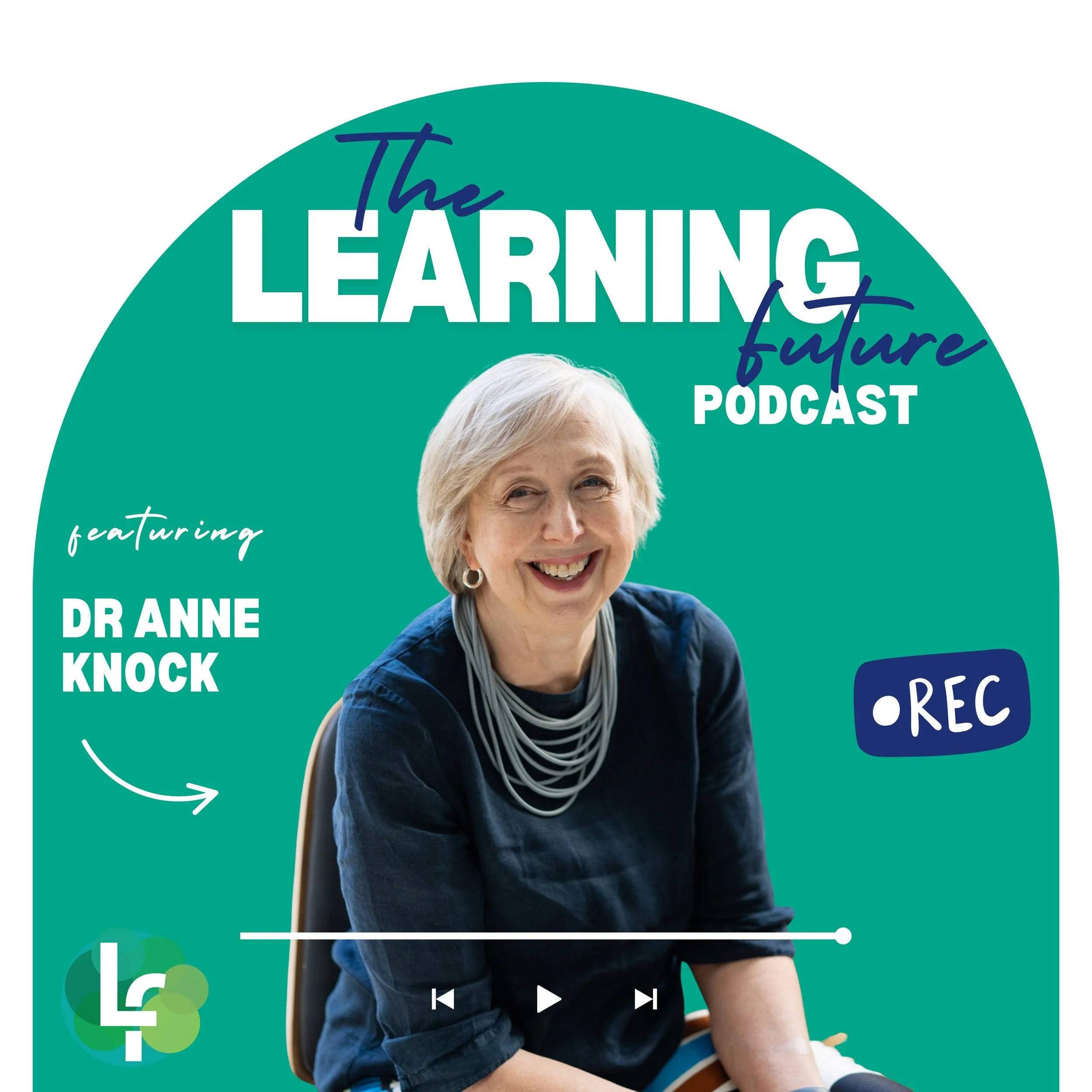
From Certainty to Clarity: Designing Schools for a Complex Future with Dr Anne Knock S10E9 (139)
If schools truly exist for learners, why do so many of our systems still require young people to serve the timetable—rather than the timetable serving them?
If complexity—not linearity—is the reality of learning, what holds us back from embracing design mindsets that allow for iteration, co-creation, and shared agency?
🎙️ Episode Summary
In this episode of the Learning Future podcast, Louka Parry interviews Dr. Anne Knock, a leading figure in educational strategy and design. They discuss the importance of strategic design in education, the role of complexity theory, and the need for schools to adapt to a rapidly changing world. Dr. Knock shares insights from her book, 'School by Design,' emphasizing the shift from traditional classroom models to more dynamic learning ecosystems. The conversation also explores the significance of leadership, values, and practical tools in transforming educational environments for the benefit of students.
👤 About Dr Anne Knock
Dr Anne Knock is an educator, facilitator, and coach who enables profound shifts in strategy, leadership, culture and pedagogy through her wisdom. At The Learning Future, Anne leads programs and projects to help educators, leaders and organisations step into the future through strategic design and learning experiences that optimistically chart a path ahead in our increasingly complex world.
Anne holds a PhD in Education from The University of Melbourne with a focus in complexity theory, revealing how to craft successful and sustainable practice and culture in innovative learning environments. She also routinely supports education leaders and architects to develop school masterplans and design briefs.
Commencing as a primary teacher, Anne has experience in community development, school system administration, and school-based innovation consultancy. Anne also leads the executive coaching and learning tour aspects of The Learning Future, supporting schools and organisations to integrate the cutting edge of school design, philosophy and practice.
Having worked and toured leaders across multiple continents, Anne has depth of knowledge of the international education landscape and regularly connects with a global community of like-minded professionals.
📘 Takeaways
Strategic design is about creating adaptable strategies for complex educational environments.
Complexity theory helps educators navigate uncertainty and embrace multiple pathways to success.
The shift from traditional classrooms to learning ecosystems is essential for modern education.
Agentic learning design places students at the center of the learning experience.
Effective leadership involves listening to teachers and fostering collaborative environments.
Practical tools and frameworks can democratize decision-making in educational settings.
Values should be lived out in school culture, not just stated as ideals.
Design thinking is crucial for addressing complex problems in education.
Schools must prioritize the student experience in their vision and strategies.
The future of education requires a focus on agency, belonging, curiosity, and discernment.
🔗 Connect with Dr Anne and Resources Mentioned
🔗 Stay Connected with Louka Parry
For the latest learning innovation follow Louka on LinkedIn
Share your thoughts by visiting www.thelearningfuture.com
Tune in to be inspired, challenged, and reminded why love truly is at the heart of learning.
[Transcript Automated]
Louka Parry (00:01)
Well, hello everybody and welcome back to the learning future podcast. I, you're in for a special treat today as am I, because our guest today is Dr. Anne Knock. ⁓ Dr. Anne Knock in full disclosure is a friend and colleague of mine at the learning future. She's actually our director of strategy, culture and learning environments. But beyond that, she just brings an amazing array of skills and experience to the education landscape that she works across.
Anne Knock (00:03)
Thank you.
Louka Parry (00:31)
She's also delightfully the author of a recently released book called School by Design, a field guide to transforming learning, culture, and place. Anne has a PhD from the University of Melbourne that explored how teachers successfully and sustainably transition into innovative learning environments within the context of complexity theory. She has also led now for some, for many years, I'll say Anne.
Anne Knock (00:59)
Thank you.
Louka Parry (00:59)
professional study tours across the
globe, in particular to Europe, ⁓ where the participants get to see leadership and education across different contexts, countries, cities, and certainly an array of practices. She's a mother of two, ⁓ and is just an absolute lover of the outdoors and an incredible human being. And how fun is this? Thanks for joining us on the Learning Future podcast.
Anne Knock (01:27)
It's so lovely to talk to you, Louka It's been so long since we've spoken. I know.
Louka Parry (01:31)
It's, it's, I know, I know, you know, 20 minutes ago, had a great chat about
what we're doing. ⁓ but it is really lovely actually. I just want to say congratulations on putting this, this work together, you know, across all the decades of experience you've had, all the learning you've had, you've, you've really kind of said, this is something that I, think we need to understand in our work across schools. My first question is going to be, what is something that you are learning at this point in time?
Anne Knock (01:41)
Thanks.
It is.
Well, right now, our work, Louka, your work and my work is so much engaged in designing strategy. When we talk to our schools, we often say, yes, we say strategic planning because that's what people know it as. But in reality, we do strategic design. So I'm learning formally strategic design or strategy by design through IDOU. But I'm also learning at every engagement we have with one of our schools, I learn
bit more about what it means to be strategic and how we can help schools be strategic as they navigate their way through a complex and uncertain future.
Louka Parry (02:40)
Hmm. And I've learned a lot about complexity from you, especially from your research. want you to just take us into that world a little bit. Like everyone understands what a strategic plan is, you know, it's often on the website or something. What's really the difference between strategic design and a strategic plan and how does complexity play a role in that difference?
Anne Knock (02:51)
Yeah.
Hmm.
When I was... ⁓
doing my PhD, ⁓ I really struggle with the whole philosophical, know, the F in PhD is philosophy. And I struggled with, you know, getting my head around that. It wasn't until one of my supervisors said, you should read Complexity Theory. And I read it and thought, ⁓ this is, where's this been all my life? This is who I am. I think this way. When you think in complexity, you're not satisfied with simple five-step plans. You actually know that there are so many variables coming.
in
and there's so many ways that you could achieve the outcomes you want to achieve. There's not one way to get there. I think that's the essence of complexity is being comfortable with that sense of getting clarity from uncertainty rather than certainty. This is the way we're going to go. And when I talk to schools, I don't explain this, always say, yes, you remember those schools who did their strategic plan in 2019, it didn't quite play out the way they wanted it to play out. That's where we are with complexity.
complexity and that's why we talk about strategic design because we know the context, we know our students, know the, crudely, the market that our school might appeal to.
But we can't assume the way we've always done it and we just keep going on business as usual is going to actually serve our young people and their future because in essence, the strategic plan is about what are we doing for our young people and for their future, not maintaining our systems, business as usual.
Louka Parry (04:38)
Mmm.
It's something that we obviously reflect a lot on, Ann, is this
idea that a strategy implicates a set of choices. Of course, in our futures work, it's really about stating the collective vision for the preferred future that you want to create. And then of course, making a set of choices that arcs your organization from where you are now to where you want to be. And I'm just really, I'm really interested in this, the space in between.
Anne Knock (04:55)
Basically. Yeah.
Yes.
Yeah.
Louka Parry (05:13)
which I think you and I often talk about as complexity and certainly that's been your worldview. ⁓ I think the challenge that we find, and I want you to talk a bit to this, Anne, is there's safety uncertainty, especially now in this world where we see exponential change with converging technologies, synthetic biology and artificial intelligence add in, you know, energy transformation, geopolitics. There's so much going on. So.
Anne Knock (05:14)
Yeah.
Hmm.
sure.
Yep.
Mm.
Louka Parry (05:44)
Can you kind of explain like what you've noticed about even the, as we, as you work with these leaders across the world, what are you noticing about the shift from certainty to clarity? Perhaps.
Anne Knock (05:52)
Mm.
I think there's a misconception that complexity is chaos, is chaotic, and it's not. So I'm sitting here and I'm looking out at, ⁓ looking at a bush. I live in the city but I have a ⁓ bush outlook and it is complex. There's so many different trees that I can see out there.
Louka Parry (06:10)
Interesting.
Anne Knock (06:23)
It's not, you and I talk about, it's not that ordered, you know, single pine forest, they're all in rows. It's the complexity of this. But in complexity is order. What we are doing is helping our schools and we do strategic work, is acknowledging the context that we're in, then creating a sense of order.
I learned this just personally in my life. I was a kid who lost everything, you know, came home without all of that sort of thing. But it's in meaning, I guess in my adult life and not all that recent. So it has been all that recent that I realized that sense of order is really important and having systems, systems that allow us to be ⁓ both attend to the order, but be flexible and adaptable as well.
Louka Parry (06:54)
Hahaha
Anne Knock (07:17)
These things aren't mutually exclusive.
Louka Parry (07:19)
Hmm. It's a beautiful, beautiful way to put it. And just to come to your book, you know, you have two parts of the book. ⁓ really the first is foundations for change. Yes. The one you're holding in your hand for anyone listening to this. ⁓ yeah, it's, it's a fantastic way that you framed this. so part one, foundations for change part two, the playbook take us first into the foundations for change, you know, including what is the shift from.
Anne Knock (07:26)
Yeah. Yeah. What you mean? You mean this one here?
Hmm. Hmm.
Louka Parry (07:49)
classroom to learning ecosystem or leadership or same page-ness, which is the word I associate almost the most with you. ⁓ you know, agentic learning design. does that, does that matter? And then of course your zone of genius uniquely is this power of place learning in a specifically designed space and how that, how that interfaces.
Anne Knock (07:50)
sure. ⁓
Yep.
Yeah. Yeah.
So to get a little bit meta with this, I'm looking at the construct of the whole book. It's very much a reflection of me is this is not a book where you go, start at chapter one and I finish at chapter, what's the last chapter, chapter 11. I finish at chapter 11, right? It's not linear because life isn't linear. Part one, that foundation for change really is about what I discovered throughout my professional life in education.
and then narrowed it down to my PhD thesis, which is also, there's a whole chapter in there about my professional approach to education. So it is very much a story of what I've discovered throughout life. And I just... ⁓
drew out those things from a PhD thesis, the key concepts, and I've attempted to put them in a palatable format so that people can really help to understand. When I was sitting in my, just tangent here, when I was sitting in my graduation, the two education PhDs, people sitting either side said, I'm glad that's over, I hate my thesis, and I just sat there and said, I really love mine, it's really important to me, it was important, the concepts taught me so much,
Louka Parry (09:26)
Yeah.
Yes.
Anne Knock (09:31)
This was
hard, no doubt about that, but what I learnt from it has been so valuable because it's validated, I guess, a lot of the things I've been talking about. That idea that, ⁓ even that first chapter of classrooms to ecosystems, that idea that that classroom, that linear organization of children,
One of the people I quote right 2017 in New Zealand academic talks about the paradigm of one, one teacher, one classroom, one.
subject at a time, one club, know, one bunch of kids, and that have this whole paradigm of education is based around this paradigm of one. Where nothing outside of education is a paradigm of one, it's a paradigm of together. And so the founding premise of my book really centres on, I looked at teachers who were co-teaching and what made that, what was the tipping point for them in the co-teaching environment to be able to say, this is
Louka Parry (10:07)
Hmm. That's cool. Yeah.
Interesting.
Hmm.
Anne Knock (10:35)
both successful and sustainable and generally speaking they said, we just wouldn't go back. We just love this idea of being with colleagues. Which led me to the idea of same-pageness. this concept came because every team in some way or another spoke about being on the same page was critical.
Louka Parry (10:41)
Hmm.
Anne Knock (10:57)
Even the ones where it wasn't working well said, imagine the possibilities if both grade partners were on the same page. Whereas others said, you know, sometimes kids try to play us off like they do with mum versus dad, but we're on the same page, they know, right? So it was just a word that emerged in every team that I talked about in this co-teaching in these innovative learning environments.
Louka Parry (11:04)
Hmm.
Yeah.
Anne Knock (11:21)
Now, caveat here, innovative learning environment doesn't mean open plan. None of these, you know, we've got this fixation in education that's either traditional classroom or it's open plan. What I'm talking about here is an environment that allows for different types of learning, pedagogy, grouping, ways of working to simultaneously occur in the one place. Bit like how lots of the world works.
Louka Parry (11:49)
Mmm
Anne Knock (11:49)
but
it's a shift we have to make in education.
Louka Parry (11:53)
Beautiful. What about the role of ⁓ the kind of chapter on agentic learning design? Tell us why that framing, why agentic learning design versus another way of perhaps approaching or designing a learning experience.
Anne Knock (12:11)
Yeah, well, agentic learning design puts the student as the agent, puts them at the heart.
We use design principles in our work. We do empathy mapping. We look at the context and the experience of the student. ⁓ When we work with schools, we have those four domains, the learner experience, professional culture, systems, organization, and in places and spaces. But it's always first, the learner experience. We always need to come back to that before we jump to how we're going to work in our professional culture.
And I have an abiding memory of this when I was working at the school in Sydney where Stephen Harris was the principal. And there was an amazing space there and Ludibi and Chantelle Love in particular were such inspirations in how they worked and how they made 180 kids and six teachers work. I could see it firsthand. But I remember walking into a room one day when Chantelle was sitting down with a couple of students.
She was running through the unit of work they were going to teach in the next term with these students saying, what do you think? Is this going to work for you? How will this? Getting their take on it rather than saying it's secret teachers business and then we give the big reveal.
Louka Parry (13:26)
Wow, interesting.
Anne Knock (13:30)
How do we get the students take on it? And that's what's at the heart of agentic learning design is doing it from the perspective of the learner and differentiation then becomes part of the whole package. How are we ensuring if we empathy map that those different personas that we might have highlighted are each going to have a quality experience?
Louka Parry (13:52)
Mmm.
The other piece in this work that's really brought to the surface is the role of leadership. So I'd really like you to take us into that idea of theory to action is one thing, but then how do we transform as leaders ⁓ into... What is your kind of... With all the incredibly different contexts in which you've worked, Anne, I think it's such a rich experience you bring to this.
Anne Knock (14:03)
Mm-hmm.
Mm. Mm.
Thank
Louka Parry (14:23)
What is it that you notice about leaders and their development that you want to put here?
Anne Knock (14:26)
Yeah,
I think you and I would say we're noticing more and more that many leaders are seeking to move away from a hierarchical posture, that their word seeps down and that everyone carries it out. And we know, I guess one of the findings I had was
We need to shift from this hierarchical way of working and getting people, I use the term cross-scale relationships within the school hierarchy, because a hierarchy exists and it gets back to that sense we need order. So we're it's not sort of everyone equal, but there is a sense of order and there are decision-making accountabilities that need to be done, but there's also a sense of,
Freeing up the leader to say, you don't have to know everything and you don't have to have the answer to every question. That term, my colleague Steve Collis used to say when we were working on our workshops, the smartest person in the room is the room. ⁓
Louka Parry (15:20)
Mmm.
Anne Knock (15:33)
So how do we draw on those people? So I used an example in the book of one of the schools that I worked with as a case study. And it was a multi-cohort co-teaching environment. And the principal had some really tight ideas on how she saw it, what she wanted to make work, make it work. And one of them was that there should be no class teacher, all the teachers should work with all the children.
And the bunch of the teachers came to her and said, look, we really feel that these students actually need a home base, they need a home teacher, and they made the case. And instead of her going, no, no, no, this is how we're going to do it, she heard their point and said, okay, we'll work with that way, because she listened to what they were saying. So it's that sense of, we're helping leaders get off the hook, right? We're helping them not to think they have to have the answer.
Louka Parry (16:11)
Mmm.
Anne Knock (16:30)
And I think one of the things I began to see is that sense of there's not a separate office for each member of the leadership team, together in those offices bouncing off ideas, that kind of thing. That's a tangible way of actually seeing how that hierarchical way of working ⁓ is visible to the team around them, the staff around them, that we don't have our own offices. That's not the hierarchy we want. We want people together.
Louka Parry (17:02)
You talk about a few models in, well, you call them tools, right? And I think one of the best things about the book is the tools that are in it really. ⁓ you know, alongside the narrative, it's that here's something that is a mental model or frame or activity or something that you can kind of get your, get your hands around, I guess, as a reader and as a practitioner in a school or in a context where there's learning taking place.
Anne Knock (17:06)
Yeah.
Louka Parry (17:26)
You know, what are some of the ones that stand out to you most across that suite?
Anne Knock (17:29)
⁓ Yeah.
So you know, I'm an immensely practical person. I love the big ideas, but the how has always been my driver. Yes, it's wonderful to have these great ideas we want to do, but how do we get people around the ideas? And...
It was while I was ⁓ at Skill, my colleague Steve introduced me to the idea of learning design and design thinking. And I saw the value of dialogic, ⁓ making progress through dialogue, how we can bring out the, each person in the room has something to offer. So over the years, ⁓
I've, I use tools, some of the tools in the book are from ⁓ liberating structures. I did some training with them a number of years ago. They're ways of us just getting ideas out of our individual head into the collective consciousness. I use that.
Louka Parry (18:24)
Mmm.
Mmm.
Anne Knock (18:32)
I have this brain that makes up tools, so there are tools in there that I've made up and have worked with and used over time. It's just this way of thinking, what does this group need to make progress? We often know that the noisiest person around the table might get their voice heard first, and we also know that the quietest person around the table usually has the gold, but is too quiet to speak up. These tools sort of demoralize
or seek to democratise that way of thinking around the table to get the, get, a working consensus is a term I love, to reach a working consensus. We're not all going to agree, but can we reach a working consensus on this particular idea?
Louka Parry (19:16)
Mm.
Yeah,
the question that comes into my mind and that I've heard from you many times is like, can we live with this?
Anne Knock (19:26)
Yeah, yeah, yeah.
Louka Parry (19:28)
Instead
of like, we 100 % on, know, it's like, can you live with this? Absolutely. can.
Anne Knock (19:33)
And because at the heart of design is iterating and prototyping. I'm gonna have to live with it forever. We can live with it and we say, that's not working very well. What do we go back to? The thing I always love to say, it's never tied up in a bow and go, here it is. It's actually something that we're always working on. And I think that's a mindset that...
Louka Parry (19:37)
Yeah. Yeah. Yeah. So.
Yeah.
Yes.
Anne Knock (19:56)
is that shift from the hierarchical posture. Here it is, this is what we're going to do to the design thinking to say, we're always on a cycle of watching, observing. One of the questions I have is, what do you notice? Whether it's at the start of the process, what are you noticing that's causing us to think about this as a problem to be solved? And then as it's going on, what are you noticing? Continually looking at that to see whether or not what's working, what isn't.
Louka Parry (20:15)
you
Mmm.
Yeah. Yeah. I think one thing that I often think about Anne, it's like the, like what we just to your point, like, are we noticing? What are we paying attention to? It's just such a great question, especially, mean, even at the kind of societal social layer, you know, we have our attention is being hijacked right now. And this is a, I would say position that you and I hold and the learning future holds strongly, which is, you know, our
Anne Knock (20:50)
Okay.
Louka Parry (20:53)
attention is under attack and our cognition is also under attack. And so is childhood for a whole range of different reasons. Hence we're seeing this kind of push back against some of the kind of dark patterns and the big tech things that we're seeing happening in the, in the world. What do you think it is? I think we, you talk about the four elements that make a school a school, right? You know, Gielarsson's work, think it is, and you know, obviously it's the core of our work now that we've only go and work alongside schools and strategy.
Anne Knock (20:55)
Yeah.
Thank
Hmm.
Yeah.
Louka Parry (21:23)
Just take us a bit more into that. So much of this is just a framing exercise. If we're in this particular frame, we can't see outside of it. So if you just think teaching is I instruct, I teach, you learn, it's a transaction. That's one frame. But of course, the first frame we start with is learner experience. So take us a bit into the Venn diagram that we use, and particularly you use all the time, that tries to help
Anne Knock (21:25)
Yeah.
Hmm.
Yeah.
Louka Parry (21:52)
People notice what's taking place and from that place, craft good strategy and good action to change.
Anne Knock (21:54)
Thank
Yeah. When I was doing all my reading for my PhD thesis, a few people have been reading about the work of Gis Larsson. He is actually an in-school ⁓ teacher, he was researching in-school and learning environments. there was always this one quote that he had in his work is, school design is comprised of a network of elements.
that together make up the learning environment. And that was very powerful to me because it gets back to that sense of creating order. Where do we start? If we want to improve our school, if we want to make progress.
Louka Parry (22:44)
Mmm.
Anne Knock (22:45)
Where
do we start? could just... The thing about complexity theory is that we can't have a reductionist view. We take that part out, we fix that part, we put that part in, but we see... Instead, we see things as an ecosystem where this part impacts this part impacts this part. So that's great, but where do you start? So...
This network of elements, and we've ⁓ repurposed the language, different to the one that Giselaas and Owens and Valesky, they were the other two that talked about it. And we've talked about this in terms of student experience, professional culture, management and systems, and then places and spaces and resources. And I always talk about it in this way. And this is where I differ from those other researchers in this. I have an order to this.
Schools exist for the student experience. That's first. And when we talk about vision...
Louka, we always say that the school vision has to be centered around the student experience, the learner experience. We never have a school vision that says, this is a great place for teachers to work. No, it might be, but our vision has to be centered around the learner experience. So what is it that we see? I love, I often use the term, I get people to picture this and they describe the learner experience. But that human element is supported by the professional culture on the other side. And this is how the
Louka Parry (24:08)
Mmm.
Anne Knock (24:14)
adults in the environment work. What I discovered in my research was that the principal is the culture builder, or the leadership team might be the cultural builders, but it's the staff who are the cultural bearers. can't expect, we have to, they have to, that learner experience has to be reinforced by the culture that is... ⁓
Louka Parry (24:29)
Yeah.
Anne Knock (24:38)
modeled by the staff in the school. So if we focus on those two, so much of our work, isn't it, Louka, belongs in those two spaces. Helping people to go, what's the work for your students? What do you want for the professional culture? Just as a sidebar, when we talk about values,
How often do we see values in terms of the professional culture and how it's out working rather than seeing values as we want our children to have integrity, courage, and honesty. What does that mean? What does the value actually mean for the professional culture? Because value shaped culture, that's just a...
Louka Parry (25:11)
Yes.
Anne Knock (25:17)
persistent flee in the ear that I am about to people. So we get those human elements right. Then we talk about how we organise our systems. This is our diagram I'm describing here with my hands up. How we organise our systems. Because systems aren't humans. Systems have to support humans. I know you and I have read Rebecca Winthrop and Jenny Anderson's book about the disengaged teen. And right at the start of that, they describe the life of a student.
Louka Parry (25:18)
Yeah, good point. Yes.
Anne Knock (25:47)
Going into class, 40 minutes, that class, unpack, do that, think about that, pack it all up, go to the next one, repeat across the day. That is a system that we are serving instead of a system that serves the people. So we often use timetables as one of our key systems in the school, as is this system serving the people or?
Louka Parry (26:11)
Yeah.
Anne Knock (26:15)
are the people serving the system. And then when we get all of that right, or get clarity on those things, then we think about the learning environment and how the learning environment can support the human activity and the systems that serving the human activity. ⁓ I'm a big fan of not leaping to how do we design a school without thinking about those elements first.
Louka Parry (26:42)
I love the, I love how you described that. And obviously, you know, this is work that we do together and it's just so nice to hear you put it so crispy. Um, cause the framing, you know, even the values that hold professional culture. And one of the things that we've seen emerge through our work, course, is that values that are single terms, know, integrity, trust, respect. always think about, you know, it's a bit of an old example now, but Enron, you know, which effectively became a pyramid scheme and
Anne Knock (26:48)
Hmm.
Mm-hmm.
Louka Parry (27:10)
You know, was defrauding, you know, people billions of dollars, you know, had integrity and, you know, trust as part as their values. And so it's not what are the values you have. It's how these values lived out and this idea of mantras or phrases. So you hear, and you know, in all the great diverse schools we walk into and learning environments, you can just hear, you can hear the culture in the language. And as an applied linguist, you know how I nerd out about this.
Anne Knock (27:12)
Mm.
Yeah. Yeah.
.
Mm-hmm.
Louka Parry (27:36)
If you
record a conversation, work out how many questions there are, if there's collective pronouns or singular pronouns, all of those are cultural markers. You can actually predict quite well how effective a culture is based on the language used. So this idea of phrases that often hold tension in them is just something that I think is really interesting that we're seeing schools move with.
Anne Knock (27:40)
Mm. Mm.
Yeah.
Yeah.
Thank
And how
many of the schools that have that word excellence, which is a great word, but on its own.
Louka Parry (28:11)
It's an excellent way.
Anne Knock (28:15)
What's it saying? And we often get the ⁓ exec teams in particular we're working with to say, well, what do we mean by excellence? Do we have a shared understand? Are we on the same page with what excellence means for us, rather than it just means that it's only academic achievement and it's only the cream and it's those things. it's about, yeah, not throwing around words, but actually understanding and knowing what they mean.
Louka Parry (28:27)
Mmm.
Yeah. Yeah. It's such a great point. You know, I think the other thing I'm curious about Ann is, you know, my favorite, one of my favorite phrases at the moment is to include and transcend, you know, this idea because, know, we just, encounter so many dichotomies through our work. And yes, it's easy for us because we're not in the daily work of educating children and the complexity of that. we, but we are a little removed, but that also gives us a vantage point to realize that.
The camps don't necessarily serve us. Yes, we need to be clear about what we're doing and what we're going after. And so I think it's why this idea of, yes, we do this and we do this, the both and orientation rather than the either or orientation. And how else can we think contingently or lead adaptively if not using those kind of, those kind of aspects.
Anne Knock (29:28)
Okay.
Yeah,
yeah, I'm a big both-and fan.
Louka Parry (29:37)
Yes. Yeah. I'm really interested in, in what's an example that you would call out from your work? You know, this, the book is called school by design, you know, and so actually perhaps this is where we should make the case for design. You know, like I, and my journey, know, classroom teacher, into school leadership, some policy work, then, you know, teaching design thinking and innovation, I guess. And now, you know,
Anne Knock (29:49)
Mm.
Louka Parry (30:06)
of running this organization with you and a few others. What I've only just started to call myself a designer. And I think as teachers, we don't see ourselves as designers. Why should we?
Anne Knock (30:21)
designers think about possibilities and ⁓ not solutions, jumping to solutions. I guess I also nerd out on the Kinefen framework, Snowden's work, ⁓ and he talks about the four types of problems that we might face, simple, complicated, complex, and chaotic.
Now if it's a simple and a complicated problem, that's fine. Follow the plan. Get the right result. Follow a recipe. Get a tech expert in. They're fine. Complicated things can be, like I use the idea of the watch, it can be taken apart. looks, it's complicated. It's not complex. Take it apart, fix it, put it back together again. Chaotic are.
pin the tail on the donkey, you have no idea you've got nothing, you just need help to get if you're in a chaotic environment. the ⁓ complex environment is where we have both a sense of, we want to create order and we have a sense of optimism that actually we can see a way through. When you're playing pin the tail on the donkey, there's no optimism that you're going to get anything.
Louka Parry (31:40)
Yeah, it's a strange game that one.
Anne Knock (31:43)
Complex
problems, you go, actually I think we've got between us, among us, we've got the smarts to be able to do this. So there's optimism and there's confidence that what we bring to this task can get it done. So at the heart of design is complex problems to be solved. We don't need a design solution to...
repair a car. We just need to follow the manual to do that or get that person in. Design is when we need to, we've identified, we've noticed something, we can see it can be better, but we just don't have the clarity of the A to B, how are we going to get from the current state to the future state. But we see the future state as doable.
And that's where design comes into these problems. And if you think about everything around us, the problems that have shaped throughout history have been things where people have conquered a complex problem. ⁓
Louka Parry (32:49)
Hmm. So good. And it reminds me of one of my favorite sayings, which I don't know where it's come from, but you know, education isn't rocket science. It's far more complex than that, which I think just nails it. Like can you imagine, can you imagine even, you know, if you just zoom out for a minute, you think about, okay, let's put 27 unique human beings that are around the same age in a single room with one adult with, you know, and see what happens.
Anne Knock (33:00)
Yeah, because rocket science is complicated.
Louka Parry (33:17)
How complex is that? all have different needs. If anyone's got children and you think about your children have more than one, how similar are your two children that grew up in the same home? They're radically different usually, which is such a curiosity. know, so this idea that I think back to your point on excellence, know, there's excellence through a ranking paradigm, which is a standardization approach versus excellence to a personal parent.
Anne Knock (33:27)
That's right. That's right.
Yeah. Yeah. Yeah.
Yeah.
Louka Parry (33:43)
It is really
around uniqueness and contribution. Of course, you and I talk about this all the time in our work. What we need is really, how do get to matching rather than ranking, clarity rather than certainty, even the study of contribution rather than excellence. It's all I think so. It's just a really interesting piece. What are you going to do with the brilliant things that you've learned? How valuable can you be? How much value do you create for others for a marketplace?
Anne Knock (33:46)
Yeah.
Hmm.
Yeah.
Louka Parry (34:14)
through a role, whatever the case might be.
Yeah.
Anne Knock (34:20)
I guess the other thing that I had a tipping point when I was learning about design and somebody said to me, know, think about the problems we solve and the work people do. We don't want surgeons to be iterating and prototyping on us. That's not the, there are things that you don't have to put a design head to.
because we just want them to be research-based and to do all those things. But there are other things where we have been a wriggle room. ⁓ So in the work that we do, because we're really applying a lot of these things, is that idea of enabling constraints that we often talk about. And that helps us to go, OK, within a design parameter, there are constraints we work within. Think of the artist and the designer. The artist can go with whatever medium, do whatever they like. There's no constraints.
Louka Parry (34:47)
Mm-hmm.
Mmm.
Anne Knock (35:11)
designer thinks about who I'm designing for, what's the problem to be solved, but once we get those constraints right, then we can be free to be as creative as we want to be. And we look at those, when we work with schools in a design, strategic design perspective, we're saying to them, well what are the guiding principles of this? What's rock solid? We can't go beyond that.
Louka Parry (35:21)
Mmm.
Anne Knock (35:38)
And one of the things where there's a bit of wriggle room, where we can be adaptive and helping them get clarity on those two things. So it's often those foundational ⁓ values and those things that hold them together, their ethos, they're often the rock solid, but there's other things that aren't rock solid and we can actually ⁓ adapt in that context.
Louka Parry (35:41)
you
Hmm. Do you know, reminds me of a chat I had recently on this podcast, ⁓ with Jermaine Bob, who are futurists from the Institute for the Future. Bob, Bob Johansson said something beautiful, which was, you know, we always talk about guard rails, you know, but of course you hit a guard rail, you smash into it and your car, you know, collapses. And he's talking a bit more about like bounce ropes in a boxing ring, you know, so there's your constraint. And so you kind of.
Anne Knock (36:06)
Hmm, I like that one.
Yep.
Yeah.
Louka Parry (36:25)
You go and you nudge up against the constraint and it gives a little bit and then comes back and maybe it stays out because you've discovered new terrain. Or maybe it snaps back a bit more because you've gone too far. I thought that was such a good metaphor.
Anne Knock (36:33)
Yeah.
But the staunchens,
right, the staunchens that hold the bounce rope, lock solid. It's the rope where the bounce can happen. Yeah.
Louka Parry (36:40)
unlocked absolutely, absolutely solid. Yeah. Yeah. Great point.
As that Kookaburra makes, you know, agrees with the point in the background, how Australian for our non-Australian listeners, the iconic Kookaburra laugh. How brilliant. So, and you know, I'm just curious, just a couple last questions. Number one, you know, ⁓
Anne Knock (36:50)
The kookaburras, yeah. I know. ⁓
Louka Parry (37:06)
If you think of your vision for the future that you are really contributing to through your work and our work, which I'm very grateful for, you know, what, what would you say a school of the future from the future, your preferred future looks like, feels like, what's the learning experience? What is the professional culture? What kind of management and systems are there and what's happening in the places spaces? I know that's a big question.
Anne Knock (37:09)
Mm-hmm.
Louka Parry (37:35)
But you know, like what are some of the design principles at least that perhaps would come to your mind?
Anne Knock (37:40)
When you're asking that question, I came back to my really basic mantra of why I do this work. It came to me years ago. I just want to make schools better for kids. And when the person in the street sort of...
says to me, when I check in, right, doing something, I was checking in good car the other day at Car Resort and Airport, and giving my email and the goes, what's the learning future? And I kind of explained it and I said, well, you know what? We just want to make schools better for kids. And all of those things...
are saying, that's all we want to do, better for kids and their future and where they're headed and understanding that the world that we are of the now, not even the future, the world of the now is really different to the experience that I had when I was at school. But I fear that some students still have that experience that I had at school. And so we need to be brave to encompass all of these things. We need to be brave. not being,
not treating our young people like guinea pigs to say, you know, we're going to test this on you. Now we have that confidence and that optimism to say, we're going to work with this and we're going to make it better to have them to have the skills that they need for the future. You you and I talk a lot about the types of ⁓ attributes our young people are going to need. Agency belonging, curiosity, discernment and embodiment. They're our five. Well.
If a student is just going from one class to the next and they're sitting all day, they're not embodied learning. And if they're going off to do an assignment and they're just downloading the latest AI answer, they don't have a discernment. There's all these things we want schools to be, and that sense of agency is having their voice in the mix is so critical.
And that's why we love talking to kids, right? We do a lot of focus groups with young people and I just love hearing their perspectives of schools because I tell them, you know more about this school than anyone.
Louka Parry (39:45)
Hmm.
Yeah, it's so good. had a brief conversation with Larry Rosenstock from a high tech high recently. think I told you, Anne, and I've had him on a pod on the podcast before in the kind of early days. He founded high tech high 15 schools amazing. And the thing he kept on coming back to was kids know things we don't know. They know things we should.
Anne Knock (40:04)
Yeah.
Louka Parry (40:20)
Listen to the, it was just so on message with it. It is, it's kind of funny, you know, the identity piece of do I, do I miss myself concept, the Noah, the activator, the facilitator, the learner, or all those things as it's contextually relevant. You know, I think there's a calcification of identity in our world. That's quite problematic for all of us because.
Anne Knock (40:38)
All those things, yeah. Yeah.
Yeah.
Louka Parry (40:50)
we create our own ceiling and then we can't evolve
because I say this is who I am today, not this is who I am becoming. And I think there's that process of becoming that is just, I mean if it's not the core purpose of schooling, education, learning, I challenge someone to say there's another process that's more a process of becoming. ⁓
Anne Knock (40:54)
Yeah.
you
Louka Parry (41:13)
I mean, you know, learning
the expansion of the human spirit, of the human knowledge, the skill set, the dispositions, the attributes, our own uniqueness.
Anne Knock (41:17)
Mm-hmm.
Mm.
Louka Parry (41:24)
So thank you, Anne, for your uniqueness and what you bring to our work and to this world and to education, you know, through all the things that I feel very lucky to do with you. ⁓ I'd love you just to reflect and share something that you want to leave our listeners with. What's something that, you know, in, yeah, that for you from your unique vantage point, you want to say to everyone listening and watching.
Anne Knock (41:28)
Thank you.
Thank you.
I'm a big believer in what leaps into your head. And I guess I wanna tell people, you don't have to have the answers. You'd have to know the problem, but you don't, there's enough of us together.
that we can find a way forward and work toward an answer, which may not be the solution or answer. But I think we put a lot of pressure on ourselves to have to be the one to solve a problem, particularly leaders. And you don't have to be. You've got good people around you. Draw on them.
Louka Parry (42:35)
Drops Mike. Thank you, Anne. This wonderful chat, ⁓ in kind of a formal setting, which is quite unique for you and I with all the time we spend together. Well done on the book, School by Design, which is available everywhere. ⁓ including, and in ⁓ Anne's hand, including at thelearningfuture.com via our shop, which is actually the best way to buy it because Anne gets
Anne Knock (42:37)
Thank you.
Hmm.
Thanks.
Everywhere?
Hmm.
Louka Parry (43:05)
the most return on her investment of time through going through that. ⁓ but yeah, it's been wonderful to chat with you and just so good to see this work, this work evolve over a number of years as well. So thank you and thank you for joining me on this journey and on the learning future podcast.
Anne Knock (43:15)
Thanks. Thank you. Thanks.
Thank you so much. ⁓