🌳 What if the greatest barrier to student learning isn't their ability to progress, but a school system that expects everyone to learn the same things at the same time?
🌳 If every child is capable of growth, why do we continue to measure success through grades and age-based expectations rather than the progress each learner makes?
🎙️ Episode Summary
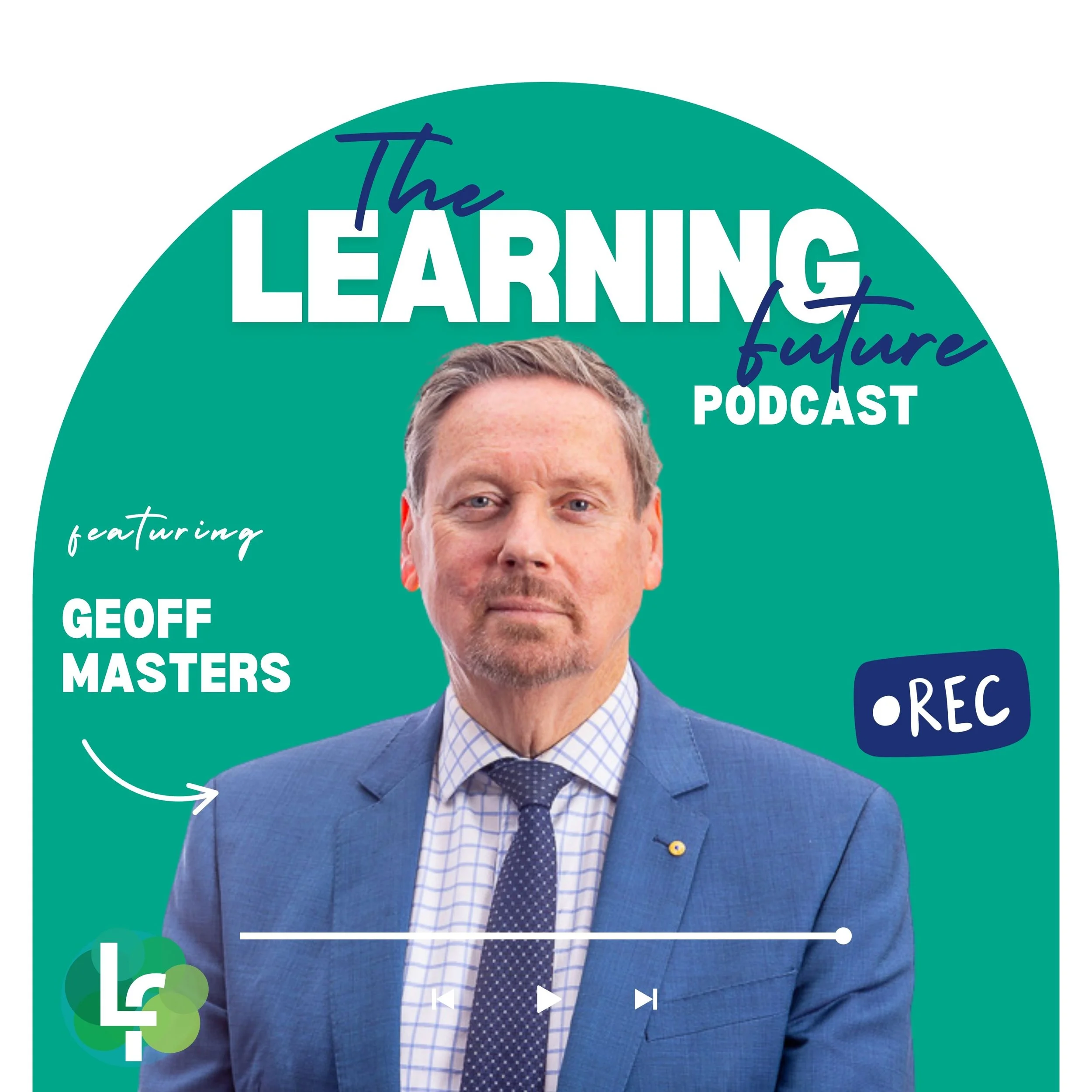
In this episode of The Learning Future Podcast, Louka Parry is joined by Geoff Masters, renowned education researcher, former CEO of the Australian Council for Educational Research (ACER), and author of The Children We Leave Behind: How School Could Be Done Differently.
Together, they challenge the industrial model of schooling, exploring how age-based curricula, standardised assessments and traditional grading systems can overlook individual learning needs and leave students increasingly disengaged.
Drawing on decades of research and insights from education systems around the world, Geoff makes the case for rethinking how we understand and measure learning. Their conversation explores the importance of recognising individual growth, empowering teachers through professional autonomy and meaningful relationships, and the potential of AI to support more personalised learning experiences.
At its heart, this conversation asks us to reconsider what education could look like if we moved beyond standardisation and instead designed schools around the belief that every child can learn, grow and flourish.
👤 About Geoff Masters AO
Geoff Masters AO was CEO and a member of the Board of the Australian Council for Educational Research from 1998 to 2024. He completed an award-winning PhD in psychometrics, assessment and statistical analysis at the University of Chicago and his subsequent research has been widely published. In 2023, he led an international study of high-performing school systems for the US National Center on Education and the Economy and authored its report Building a World-Class Learning System. He is also author of the book The Children We Leave Behind: How School Could Be Done Differently (Routledge, 2026). His contributions to education have been recognised through his appointment as an Officer of the Order of Australia.
🔗 Connect with Geoff Masters AO
🔗 Stay Connected with Louka Parry
For the latest learning innovation follow Louka on LinkedIn
Share your thoughts by visiting www.thelearningfuture.com
🎧 Tune in to be inspired, challenged, and reminded why love truly is at the heart of learning.
[Transcript Automated]
Louka Parry (00:00.664)
Well, hello everybody, and welcome back to the Learning Future Podcast. I'm, of course, your host, Louka Parry. Today, we're speaking with someone I've been trying to track down for many years across the Australian learning ecosystem here, Geoff Masters. he was the head of the Australian Council for Educational Research from 1998 to 2024. He was appointed an officer of the Order of Australia for his contributions to education, and he has been involved in many studies, but
One that's quite interesting we'll talk about is the twenty twenty three study of high performing school systems for the US National Center on Education and the Economy. Also beautifully, I'm holding in my hand his new book, The Children We Leave Behind How School Could Be Done Differently. And Geoff, we've spoken to many people on this podcast. I could think of fewer that have spent their entire life dedicated to try to understand systems and what school could be. So thank you so much for joining us for the Learning Future podcast.
Geoff Masters (00:56.828)
It's a pleasure, Louka. Very happy to be here.
Louka Parry (01:00.194)
My first question, mate, always, what is something that you've been learning recently?
Geoff Masters (01:06.624)
Well, that's a really interesting question because one of the things I think I've been learning recently is that there are lessons we can learn from the most unexpected places.
some of my career I've spent looking at high performing school systems. So we've had this belief and I've shared the belief at times that if we want to improve performance in our schools and if we want to improve equity we need to look at the world's top performers. You know we need to look at Korea, we need to look at Finland, Singapore, Hong Kong and so on and emulate what they're doing. But the problem with that and I have done some
work for the US National Centre on Education and the Economy looking at high performing systems of that kind. The problem one runs into when you look at those high performing systems is that
it's obvious that there are clear cultural factors in performance. So that contribute, they're not the full explanation for high performance, but they're certainly important contributors. So things like parental expectations, high parental expectations of students, the amount of homework that students do in a country, the pressure that examinations exert on students and schools. And so,
When I've done this work, it's led me to think, well, is that what we want? Do we want our students doing hours and hours of homework every night as they do in Estonia, for example? Do we want them under pressure from examinations in the way that South Korean kids are? And so...
Geoff Masters (02:51.356)
I'm not convinced that certainly there are things we can learn. There things that we can learn from high performing countries. Things like, you know, the vital importance of very well prepared teachers who know their subjects, who know how to teach their subjects, the importance of giving teachers a level of autonomy to make their own professional judgments about how to teach. there are definitely lessons and there are others as well, but there are definitely things we can learn from high performing systems. But what I've been reflecting on
Louka Parry (03:09.505)
Mm.
Geoff Masters (03:21.25)
very recently is that there may be lessons we can learn from the other end of the continuum from places like India and Mexico and Chile and Zambia and the reason I say that is those countries over quite a period of time now have been forced to stop and look at what's going on in a way that high-performing countries have not.
Louka Parry (03:49.773)
Mm.
Geoff Masters (03:49.844)
they've been forced to say, wait a minute, here in rural India, 50 % of year five students still can't read a year two text.
or as the World Bank concluded at the end of COVID, 70 % of students in low income, middle and low income countries struggle with easy texts of that kind. So what they've been forced, in a way forced to do, or at least some parts of their systems have been forced to do, is to say, wait a minute, maybe this doesn't make sense. Maybe it doesn't make sense to be teaching every year five child the year five mathematics curriculum.
when actually they're still performing like a year two student in mathematics. And so this is a long-winded answer to your question. Look about... But what they've been forced to do is to say, well...
Louka Parry (04:33.834)
Interesting.
Louka Parry (04:42.158)
No, no, it's fascinating.
Geoff Masters (04:48.102)
let's think differently rather than saying we know the child's age so we know what they're ready to learn. Let's work out where they really are in their learning. What point have they reached? And they might be a year behind, two years behind, three years behind or more. But let's be honest about that and let's recognise that, establish where they are and start from where they are.
Louka Parry (04:50.286)
Mm.
Louka Parry (04:55.768)
Yes.
Geoff Masters (05:12.634)
teach them from where they are. And so this movement really began in India in response to this concern that I've just been describing. And what they called it in India was teach at the right level.
Louka Parry (05:27.478)
Mm.
Geoff Masters (05:27.552)
teach every student at the right level, meaning the level that they're currently at, which could be ahead of grade expectations as well. But let's teach at the right level. And that means having a different kind of framework. It means not just inferring students' needs from their age.
but having a frame of reference that says, what level of mathematics have you reached in a sequence of levels of increasing mathematical proficiency across the years of school? What level have you reached? How can I meet you at your point of need with challenging stretch opportunities to learn? And how can I monitor the progress that you make across the years of school?
Now the relevance of all of that for Australia is that while we don't very often acknowledge it, we face a similar problem. So if you go back just a few weeks to when PISA results were released, if you look at the media around that little event, what you'll see is that there's a lot of comparative talk.
Louka Parry (06:31.192)
Yes.
Geoff Masters (06:39.936)
we're still above the OECD level. We've come down a little bit. Low socioeconomic kids are still underperforming high, et cetera, et But what you didn't hear in the media was that 29 % of 15 year olds in 2025 in mathematics
didn't meet the OECD's baseline level. Now the baseline level, if you sit down and look at it very carefully as I have, the baseline level that the OECD defines corresponds in broad terms to what we expect of primary school students.
So 29 % of Australian 15 year olds were unable to demonstrate what the curriculum in Australia expects of 12 year olds, basically. And another 22 % of students were able to demonstrate that baseline, but very little more than that baseline. So adding those two things together, you have about 50 % of Australian 15 year olds who are either below or just me.
reading what we expect in mathematics of primary school students and in reading the percentages 44%, not 50%. So my point Louka is the situation that we face in Australia, while it may not be as.
Louka Parry (07:59.704)
Wow.
Geoff Masters (08:10.43)
know, severe as the problem that's faced in some of these developing countries. For many students, it's the same issue. They're 15 years of age, and so they're being taught the year 10 curriculum because someone's decided that that's what a 15 year old should be taught. And yet for maybe half of 15 year olds, they're still two or three years below.
Louka Parry (08:23.011)
Yes.
Louka Parry (08:27.266)
Yes.
Geoff Masters (08:37.248)
what the curriculum expects and so they're being taught what they're not ready to learn. They lack the prerequisites and what we see is that many students in our schools are forced to move on because we organise the curriculum according to time. You have a fixed period of time to master a year level curriculum. You then have to move on to the next year's curriculum where you make a fresh start and the whole process recommences and...
You're taught, assessed and graded all over again. But the consequence of that for many students is that they slip increasingly behind. And that's the point of my book, The Children We Leave Behind. They slip increasingly behind as the year level curriculum becomes increasingly beyond their reach because they lack the prerequisites. So that's the first thing I do in the book is draw attention to this issue.
Louka Parry (09:23.256)
More difficult. Yeah.
Geoff Masters (09:32.416)
that we have many children in our schools who are being taught what they're really not ready to learn and the problem for some of them, many of them, becomes an increasing problem as they move through the years of school. And then I talk about, well, what might an alternative look like? And that takes me back to the sort of thing that I was just describing that is done in India and, you know, number of other countries that I mentioned.
Louka Parry (09:59.918)
Yeah.
Geoff Masters (10:00.096)
where rather than just assuming that a child is ready to be taught the year-level curriculum, we go to the trouble of establishing where they are and trying our best to meet them at their current level of attainment.
Louka Parry (10:07.097)
Yes.
Louka Parry (10:14.839)
All right, Geoff. There's so much in that. the so much to talk about, you know, the construct of performance and what constitutes performance into the future. You know, knowledge meets capabilities, the intricate balance between all that. And we'll we'll come to that. I want you to just take us though, you know, on this evolution of schooling, the need for reform and the evolution of schooling. Because it what you've just described as I've listened is based on is based on mental models. You're
date as as Sir Ken put it, you know, your your date of manufacturer, your birth date, is the most thing that you know, that's the determining factor for why you should be in this layer having this experience. We have an, you know, an age based curriculum, really. and you can understand why, you know, to try to deal with the complexity of human development. But clearly it doesn't I I mean you wonder in twenty twenty six, and I was saying before we went to rec you know, to record
We're a hundred and a hundred and sixty weeks from twenty thirty, which when the sustainable development goals are supposed to be fulfilled and all the r you know, requisite targets underpinning them. Take us on a journey for why these are still this is still the structure of schooling. You know, and and because it that seems to be the structural you know, as a teacher, you go into a classroom, you have twenty five kids, they have enormous variation in their kind of levels across different subjects and domains of knowledge, and you do your best to differentiate.
Well, what you know, how do we get to this point and then what might we do differently? As we're seeing in the kind of frugal innovation or, you know, I think Brookings called it the leapfrogging that can often happen in the majority world.
Geoff Masters (11:57.428)
Yeah, I think that's a very good question. Let's think about how we got to this point. I if you go back a couple of generations to my grandparents generation, many children in Australia were not taught in this kind of industrial model. I know my own grandparents, at least several of them, were taught in one teacher schools out in the bush where there were children from five years of age to probably 15 years of age in the same room with the same teacher. So it was a very different experience.
course as primary schooling in the late 19th century became compulsory it was important to
develop a system that would handle the very large numbers of students that were now coming to school. And the response was what I, and many others, referred to as the industrial model, where we batch students by age, we establish a central agency that's responsible for developing a curriculum and assessment examination processes and...
certification and so on, but it becomes very standardised. And we tell teachers what they should teach, when they should teach it, in varying degrees of detail across the world. as I keep saying, we try to infer what children are ready to learn from their age, essentially. And we consider that we're being fair, I think, because we're treating all students equally.
Louka Parry (13:07.769)
Mm.
Geoff Masters (13:32.352)
You're a 14 year old, so I'm teaching you the curriculum for 14 year olds. Everybody gets a chance to learn it. Then we assess and grade and you move on to the next curriculum. But as I keep saying, many students get left behind in that process. So that's the industrial model that we're working on. And even grading is something that probably came from industrial and agricultural contexts where we graded the products.
Louka Parry (13:32.629)
Interesting.
Louka Parry (13:55.225)
Yes.
Geoff Masters (14:02.316)
of the process. so we do, yes, yeah, yeah, yeah, that's right. Weapons grade plutonium or yeah, whatever. But that same thinking was then applied to schools. Well, we're just grade students according to how well they performed. But that in itself introduces a problem because a student this year can get a D.
Louka Parry (14:02.573)
Yes. Yeah, is this a a class A apple or a B apple or a C I S? What yeah. Yeah, that's right, precisely. Yeah.
Louka Parry (14:18.967)
Mm.
Geoff Masters (14:29.468)
next year can get a D, the following year can get a D, and we've given them no indication of the progress that they're no doubt making in a particular subject, in a particular area of learning, just getting a D again. we're, in a sense, we hide their growth or their progress from them when we do that. And even worse, in my view, we potentially send them a message that there's something stable about their ability to learn.
an A student or they're, know, irretrievably a D student. And we know what happens for many students. They get the message and the message being, I'm not a good learner. And so they start to disengage and they find things that they can do well. So I think the industrial model of schooling is leading to all these things that I'm talking about. It's contributing to student disengagement. We often talk about disengagement as though
It's a characteristic of students. School refusal is something that students do.
Louka Parry (15:34.423)
It's interesting.
Yes.
Geoff Masters (15:37.792)
disengaged teen topic of a book. but what we often don't do is to say, well, how is school contributing to disengagement? Because engagement really is a two way process. I sometimes think about things like gears. If you want gears to engage, there has to be alignment. And I think what's so often lacking is students can't see the relevance of what they're being taught often. And it's misaligned
Louka Parry (15:40.215)
A behavior. Yeah. Yeah.
Geoff Masters (16:07.646)
in the other sense that I've just been talking about, that students are being taught.
at the wrong level. They're not being challenged in the zone of proximal development as Fugotsky would have called it, either because they're being given challenges that are too easy or way beyond them. I think to answer the final part of your question, looking forward to the future, we have to think differently. We have to not think in this industrial model where we just group kids according to their age, but we need a model that says,
Louka Parry (16:25.274)
Mm.
Geoff Masters (16:42.12)
Firstly, every child is capable of learning. Every child is capable of making progress from where they are. And we expect every child to make excellent progress. You know, we're going to hold them to it. We're going to do everything we can to make sure they do make excellent progress and eventually achieve high standards. But it doesn't follow from that, that the answer is to teach every student the same things at the same time for the same amount of time.
Louka Parry (16:49.103)
Mm.
Geoff Masters (17:09.32)
to grade them and to move on to the next year's curriculum. So I think we need to think differently. We need to think about long-term growth or progress that students make. We need to recognise the variability that always exists, that currently exists and probably will always exist in levels of student attainment.
Louka Parry (17:20.835)
Yes.
Geoff Masters (17:32.48)
and we need to think about how we better meet individuals where we are and challenge them to make further growth.
Louka Parry (17:40.977)
It makes me think about th the like you you said this idea of the long term growth trajectory. And I think that's so interesting. I I I remember one of my beliefs, learning happens over time, performance happens at a point in time. And and I think it might have been Patrick Griffin I learned that from at Melbourne University, is a phenomenal educator and researcher who passed away recently. But that this idea of a developmental continuum rather than I mean, your point on grades is so
Geoff Masters (17:58.655)
Hmm.
Louka Parry (18:10.274)
It's so problematic, Geoff. And yet, we mandate the delivery of these grades. And so even if you have experienced a year of growth, you may still be a C student. I mean, what the the self-reporting grades, you know, this idea of the expectation effect, I'm never I'll never be good at this. It feels like the mechanisms that we're using still are very much limiting that idea of a long term trajectory.
Geoff Masters (18:22.471)
Exactly.
Louka Parry (18:37.336)
you missed you missed that class. Sorry about that. We move forward. So I wonder yeah.
Geoff Masters (18:42.308)
Yeah, I totally, sorry, I totally agree with what you're saying. I think our system is not designed to think about long-term growth and learning is an ongoing process. It's not just a matter of mastering this body of content, being graded on it and then moving on to the next body of content, which is completely separate.
Louka Parry (19:01.999)
Yes.
Geoff Masters (19:04.096)
So we need to think that learning is a lifelong process and you know the neuroscience supports this in terms of findings around brain plasticity and so on. Learning is an ongoing lifelong process and on that point the way we organise education often is inconsistent with this notion of a continuum as you called it or an ongoing progression of learning.
because there are transition points and there are different phases. so, know, preschool, learning in the preschool can often be quite different in philosophy and approach from learning at school, which can be quite different in primary school from secondary school, well, is usually, which is quite different from secondary school to post-secondary school. So we've created these artificial transition points on what should really be a continuum of learning. And for many students,
artificial transition points function as disjunctures in their learning. They often go backwards at that point. So yeah, I absolutely agree with what you're saying. Look, we need to move to an understanding of learning as long-term progress. We need to recognise that students of the same age are at very different points on that continuum of learning and we need to think about how we better meet them where they are.
Louka Parry (20:05.69)
Yes.
Louka Parry (20:27.62)
⁓ it's it's it's funny, Geoff. I'm I'm congrats on this book. I've just finished my own and gosh, it's difficult to write a book. And that's kind of the one of the things I investigated is the dis difference in the constructs of schooling, education, and learning. And we conflate learning and schooling, I think, all the time. Whereas I think what what I'm hearing in your and the way that you're framing this too is that learning is a lifelong activity. If anything, it's probably one of the most human things there is, is to kind of
The idea of growth, expansion, acquiry of new knowledge and skills, create something in a community or a marketplace with that. I I find and I think sometimes we are and I'm either quoting Sandra Milligan here or some other fantastic theorist, you know, which is, you know, we we want to move from this grammar of schooling to a language of learning. And I think that shift is when you start to break down these constructs of grade levels, grades, year levels, you know.
Geoff Masters (21:21.376)
Mmm.
Louka Parry (21:24.332)
Lock step standardization. I I I I do sometimes I'm very curious as how systems are responding globally to this. And this is my my next question to you, Geoff, is you've got here, is tighter prescription the answer? Because I think one of the hypotheses that I'm operating on is the background context for child development has shifted so significantly a la screen time, you know, social media, AI, you know, frictionless not digital experience.
And I think there's a really significant kind of reckoning and awakening in terms of consciousness about that. But some systems of course are saying, well, students, young people today, gen alpha, they struggle to pay attention more than previous generations because of the changing background context. So we need a tighter prescription for them. And I'd be very curious as to your views on that.
Geoff Masters (22:13.705)
Yeah, well, I think this is often a response to...
concerns about student performance. mean, across the world, many countries can see that student performance is declining. They're not quite sure why social media may well be an important factor in all of that technology. They're not quite sure why that's happening, but their reaction, their response is to say, let's tighten things up. And you know, this is not new. This has been going on for decades in a sense. So in countries like
Australia and England and the US, the response has been over decades to say, well, let's be clear about what every teacher should teach and every student should learn in each year of school. Let's develop a national curriculum and put that out there. Let's describe the standards that all students in a particular year of school should be expected to meet. Let's have systematic ways of doing that. the response has been to tighten up or
to be more prescriptive in terms of curriculum, assessment, reporting processes. But if you look across, as I say in my book, if you look across the three countries that I just mentioned, what you see from PISA at least, is that over the period that the 15 year olds in 2022, over the period that they were in school, the 10 years that they were in school,
from five years to 15 years of age.
Geoff Masters (23:51.143)
All those, three countries had a national curriculum, national assessment processes, national testing arrangements and so on in place. And yet in none of those countries did we see any improvement in reading, mathematics or science. So that in itself, I think is interesting. And you know, in some countries in, the US performance in mathematics has been on a very long term decline in England. Performance in science has been on a long term decline in Australia. Performance in all three areas have really been on
Louka Parry (24:20.442)
Yes.
Geoff Masters (24:21.076)
long-term decline. But the response of systems seems to me to be, okay, well, we'd better tighten up even further. We'd better tell teachers not only what they should teach and when they should be teaching it, but how they should teach. And so let's look around for evidence of effective teaching practices, which of course is always a good idea, but...
Louka Parry (24:30.821)
Yeah.
Geoff Masters (24:45.778)
it starts to run amok if you then say, and this is how every teacher should teach.
without variation, let's put it into a scripted lesson that we can give to every teacher with the expectation that they do this. And you can see this across the world, not just in Australia, but particularly actually in England and the US, the development of scripted lessons that go by different names, lessons often in the form of PowerPoint presentations that teachers are expected to use. So I think
Louka Parry (25:20.611)
My favourite.
Geoff Masters (25:21.813)
My point is...
Louka Parry (25:23.344)
Yes.
Geoff Masters (25:27.688)
A response of governments and education authorities over quite a period of time has been to say, well, the way to improve performance is to just be even clearer about year level expectations and what teachers should be teaching to a particular year level. And, you know, it'll be interesting to see whether there's any improvement as a result of all of that. But I have my doubts.
Louka Parry (25:54.994)
Do you I have mine as well, Geoff, and you wouldn't be surprised to hear that. And I there's a system leader recently was talk we're having this conversation and you know that there is a concern here that it becomes the board teaching the board. So and we're seeing the same thing with kind of some of the AI generated lesson plans where you know you're getting kind of AI slop and it's just a power delivery by power point once more. There's something that doesn't acknowledge I don't know, the the social cognition.
if we want to use Bandura's kind of work. Or you know, the the relational frame. What's the point of coming to sit in a room together, Geoff, if not to be with each other? I mean, I don't know if that's just too simplistic for me. But why do you th why do you think we continue upon this path? Is there you know, I and I wonder if you think public perception or media we're in a very interesting political landscape currently in Australia. That's also the case in other parts of the world where our listeners also are.
there's this idea that nine out of ten teachers can't teach was a was a recent headline that I saw and I thought, Well, I'm sure that's written by someone who's never been a teacher, I'll say that much, because if you've ever tried to teach a classroom of twenty five unique human beings in some powerful way, you would have a humility for the art, craft and science of that process. So why do we continue upon this path, Geoff? What is it about the way we look at systems, perhaps?
Geoff Masters (27:24.21)
Well, I think you're on the right track there. I think too often these developments underestimate the importance of relationships in the classroom. They de-professionalise often by telling teachers that their job is to deliver a scripted lesson.
Louka Parry (27:39.249)
Mm.
Geoff Masters (27:49.44)
And sometimes you'll hear people say that then removes from the equation teachers knowledge.
because they're just being asked to deliver something that's been developed hopefully in a competent way outside the classroom. So there's an undervaluing of professional expertise and of the importance of relationships and adaptation to local circumstances and professional knowledge.
So why is it happening? I come back to what I said earlier. I think it's partly a kind of knee-jerk response to anxiety or concern about what's happening with performance in schools. We see how many students are disengaged. And often we deal with that by
Louka Parry (28:43.257)
Mm.
Geoff Masters (28:46.364)
dealing with the symptom rather than what I would consider to be the underlying causes. We need to do something about disengagement as a symptom. And there's often a belief, repeating myself a bit here, but there's often a belief that the way to improve performance is to develop more rigorous approaches.
Louka Parry (28:48.369)
Up absolutely.
Geoff Masters (29:12.926)
more rigorous curricula, higher level standards, just hold all students to the same high standards. Tell teachers they have to get students to these standards. And you see politicians saying this. I mean, I've seen it in the media very recently following the PISA release. Politicians coming out and saying the answer is yes, better teaching, higher standards, more rigorous curriculum. That's the response.
Well, that's what we've been saying for a long time and it's not working.
Louka Parry (29:49.116)
Tell us then what's your what's your proposition? You know, this idea of I mean flourishing, eudaimonia like one of my favorite words, of course. And I I believe it to be perhaps even the purpose of life, if not the purpose of learning, is to kind of multi dimensionally to be expanded, challenged, in growth, contributing part of something greater than yourselves. So what does every child need to flourish? And then how do we redesign some of these system aspects, the curriculum, the assessments, maybe the the
way that we educate educators to align to that.
Geoff Masters (30:23.326)
Yes, well as you were pointing out there's a chapter of my book that asks that question, what does it take for every child to flourish? What will it mean? And it depends on some of the things we've just been talking about, good relationships within the classroom.
understanding learners as individuals, not just where they're at in their mathematics learning or in their reading, but their backgrounds. What are the issues for them? If possible, how do we support them with that? You mentioned the word flourishing, which is a popular word right now. And when people talk about flourishing, in my experience, they tend to refer to
Louka Parry (30:48.529)
Mm.
Geoff Masters (31:09.818)
the various dimensions, multi-dimensions as you said, on which we want young people to develop. We don't want them to just be narrowly academic. We don't want them to just be the stores of knowledge because that's what computers are designed for, to store and
and provide knowledge, we want them to be well-rounded young people who can think, think critically and creatively, who can work with others and so on. So flourishing for many people means we need to think more holistically about young people and we need to think deeply about what kinds of knowledge skills, values, attitudes.
dispositions are going to be required if they're to function and flourish in society in the future. But a point that I sometimes make is that flourishing, if you look at the dictionary, flourish is defined as growing or developing successfully.
Louka Parry (32:17.553)
Mm.
Geoff Masters (32:18.816)
And so I think once we start talking about flourishing, we're almost forced back to say, well, yes, we want students to develop in these new and different ways or maybe more highly prioritized ways than in the past. I mean, we've always expected students to think and think critically and creatively, but they're taking on a higher level of priority and prominence in schooling. Yes, we want that, but...
An aspect of this is growth. What does it mean to grow? How do we know if a student is becoming more globally minded, for example? What would be the evidence? What would be the indicators of that? How would we look for that? How would we support them to, if that's important to us, how would we support them to become more globally minded?
So growth, think, is an important part of our conversation about flourishing. And that takes me back to my book where growth is really a central theme, as you know, through the whole book.
Louka Parry (33:10.225)
Hm.
Louka Parry (33:22.541)
With the I find I find the need to enter synthesis rather than thesis and antithesis, Geoff, often. And I feel like it feels so good to be in a dichotomy. I am this and I'm anti you and whatever your belief system might be, right? I don't know if it's like egoically, it's kinda quite pleasurable to have that thing. I'm right. And yet I think the world itself is so much nuanced than that. And so
Geoff Masters (33:40.634)
Mm. Mm, mm.
Louka Parry (33:52.135)
Because people can say use the growth argument, but of course it for a narrow frame of human development. Yes, we want growth, but what we mean is academic growth speci specifically. and then on the other side you might say, Well we want we want being. We want young people to feel good. And that's also true. But it's course it's not an either or proposition that we're putting here, surely, right? It's the you need to do hard things, feel relationally connected, be able to regulate yourself.
Have some concept of your interceptive capability and use it well to relate to the world around you, create value. I mean that I know that's too big a frame, but it's so much easier for me to write a headline saying students failing or belonging's the only thing that matters. No, it's not. You need to belong and do things with the belonging, right?
Geoff Masters (34:33.844)
Yeah.
Geoff Masters (34:39.462)
Absolutely, absolutely. You can't dichotomize in the way that you're pointing out. It's really important that those things are integrated and thought of as part of the holistic development of a young person. And when we talk about growth, we can't be limiting growth to academic outcomes. But if as educators,
we have an interest in seeing students develop in particular ways, become more of something, then we must understand what we mean by more. So there's not much point in saying, I want students to be...
simple example, know, more creative thinkers. There's no point in saying that if we don't know what it would look like to become more creative in thinking and if we didn't know what we could watch for, there'd be no role for us as educators to support the development of those things. So as we move increasingly beyond a focus on academic outcomes, it's also important that we're very clear about what it is we're trying to develop.
in young people and we'll need to find alternative ways, new ways perhaps, of monitoring whether what we intend is actually occurring. We want them to be happy, we want them to be healthy and you we want high levels of well-being but we want many more things for young people as well.
Louka Parry (36:15.344)
Mm, I like that a lot. I I wonder, Geoff, one thing that I've I grapple with also, as I think about my obsession with the field of human development is that c it is actually so growth oriented. And I wonder about the kind of contrarian view, which is almost one of presence instead of productivity. And it's it's something that I struggle with, right? As a achiever kind of type myself, you'd wonder, you we kind of are we internalize this
My productivity equals my value and growth forever, infinite growth in a finite world may not be possible, said a Nobel laureate once, you know. Stiglitz. And so I I just I'm I'm curious about like what are the limits of this growth orientation to you? I mean, let's just say let's get a bit I don't know, futures for a moment, world building. Let's say that we get to a world where we realise growth and development is
you know, we really kind of get the systems right that work in that way. What does that unlock for us? 'Cause when I think about the most used word happy, healthy, kind of in their life people, for me it was going down to the kindergarten and watching the five year olds be in awe of the world around them. You know, and so I and I wonder about protecting childhood in the same breath as preparation for the world.
as kind of again two aspects to the work that we must do in learning systems and in our homes as well. What's your kind of what's your reflection on that?
Geoff Masters (37:51.806)
Yeah, well, I've always thought of schooling as much more than preparing for the future. I schooling, as many people have said, is part of life. And so we need to treat it in that way. But while children are in our care, we have a responsibility to ensure that every child is learning and developing, as well as feeling protected and connected.
Louka Parry (38:02.407)
Yeah.
Geoff Masters (38:21.73)
and as well as paying attention to their health and wellbeing. So during the schooling years, I think we need to be thinking about, as I said, how we want young people to develop and what does that look like as they're developing and where are they up to in that development and what can I do to further support them.
you're right you can't just go on improving forever in a finite world but people can keep learning throughout the lifespan.
Louka Parry (39:00.156)
Yes.
Geoff Masters (39:01.242)
And so we don't want to artificial ceilings on what individuals might be able to achieve. Even people who we know have special challenges, special difficulties, we shouldn't be setting artificial ceilings on how far they can go. The sky's the limit should be our attitude and then we do what we can to support them in that.
There may be some point in saying, look, by the end of school, we really would like every child to be able to read at at least this level. So it's a kind of line in the sand. And then from a growth perspective, we can ask the question, well, are you on a trajectory to meet that standard?
Louka Parry (39:55.25)
Mm-hmm.
Geoff Masters (39:55.38)
Yes, if you can get beyond that, that's fantastic. We'd like you to be beyond that, but at a minimum, shouldn't it be our expectation that every child reaches a certain level of understanding of science or proficiency in mathematics? There must be.
some minimum expectation. we might set standards or expectations of that kind, but then we need a way of, if we're to answer the question I asked, we need a way of looking at the trajectory that a child's on. Are they on track?
to meet that standard by the end of school. And often, given the way we do things, we don't provide an answer to that question. Will they have met an adequate standard of reading by the time they leave school? It's not easy to answer that question. In fact, you if you look at NAPLAN now,
Louka Parry (40:46.171)
Mm.
Geoff Masters (40:51.072)
It's not easy, certainly it's probably impossible for parents, to see the growth that a child makes in Napland reading, for example, from year three to year five to year seven to year nine. And that's because we've introduced these proficiency levels. I can't remember what they're named, but they're things like, you know, needs more support. So what parents are told is this child needs more support in reading in year three, they need more support in reading in
year five, they need more support in reading in year seven and so on. Again, not disclosing the growth that's actually occurring there, the learning trajectory that the child is on and whether they're on track to eventually meet some expected standard by the time they leave school. We could do all that. mean, the way we analyse NAPLAN would allow us to do what I've just been talking about, but we don't do it.
Louka Parry (41:23.569)
Year seven. Yeah.
Louka Parry (41:31.41)
Yes.
Louka Parry (41:49.332)
Tell tell us about let's go to the future. Let's reimagine schooling. And that plan for those outside Australia is our National Assessment Program for Literacy and Numeracy. It's an acronym. And and it basically looks at proficiency levels. But this is such a great idea, Geoff, because in effectively you could end up in a deficit view about your whole school. And you ask any adult walking around and you say, Did you enjoy school? And I'd wager it might be a coin toss. some people are like, nah, didn't like it at all. Some people say, Yeah, I got what I needed.
And that to me seems like a system, you know, we've got high standards within the systems, but for the you know, at as a comp if you were running an educate education as a product as a company, if half of your consumers said the product d I didn't enjoy the experience of the product, you would be in a bit of strife. You'd be looking, okay, well, how do we reform that transform it? So take us a bit into the future. What's required to reimagine some of these things? You've been, you know, giving us a kind of a few
crumbs a few aspects in. But what what's what do we do? Like how do we go about doing this?
Geoff Masters (42:54.696)
One thing I sometimes suggest to people is that they think about how we monitor progress in an area like music. Now, is, Australians will know what I'm saying here, but there are systems across the world that are similar.
What we do is we have a sequence of levels or grades of increasing proficiency in music. And we say that a person can be at level four, grade four piano, whether they're five years old or 75 years old.
Louka Parry (43:29.608)
Yes.
Geoff Masters (43:34.248)
because grade four piano is an absolute level of proficiency. And students are taught, supported by tutors and so on at grade four. When they feel that they're ready to demonstrate that they've mastered level four, they can move, and they do demonstrate it through an assessment, they then move on to level five and so on.
I think an interesting question is, could we organise mathematics learning in that way? Could students move through a sequence, rather than saying, I know your age so I know what I have to teach you, what if we had a sequence of levels of increasing proficiency in mathematics? We established where individuals were now, recognising as we...
Louka Parry (44:05.275)
Mm.
Geoff Masters (44:24.648)
can do that students are going to be at multiple different levels, students of the same age even, are going to be at different levels, meeting them at their point of need and having them move on not on the basis of time but on the basis of demonstrated mastery of what they've been learning. Could we do that in schools? Could we do it just in mathematics or just in reading for a start?
And if even that's too big a question, could we do it just in a particular phase of school? You know, K-1-2, for example. What if instead of saying you're in year one, so I'm going to teach you what is in the year one curriculum, what if I said across that three year span,
Louka Parry (45:07.899)
Mm.
Geoff Masters (45:14.418)
of grades, we're to work as a team, teachers are going to work as a team to establish where individuals are and support their further growth. Or in year seven to nine in mathematics.
Louka Parry (45:29.981)
Hmm. Notoriously difficult years as well, Geoff. So yeah, that's right.
Geoff Masters (45:34.0)
Yeah, yeah, yeah. And as I said, we know that, you know, half of year 10, half of 15 year olds in Australia are still performing like back at primary school level. What happens in years seven, eight and nine for those children? They're being taught curricula that for many students, even if it's not as high as 50%, it's for many students, it's beyond where they're currently at. What if in years seven, eight and nine we did what I just described? We said, rather than you being the year eight teacher and teacher,
in the Year 8 Mathematics Curriculum, what if we work together as a team?
to support all students across that. So this is just a suggestion that I'm making. But underlying all of this, Looker, is the idea of ongoing growth, long-term growth. And I think technology has a role to play here too. think as, yeah, as technology increasingly is used in schools, and I think AI eventually, its main use in schools
Louka Parry (46:11.644)
It's a great yeah, it's it's really a good example though. Yeah.
Louka Parry (46:26.004)
I was gonna ask you this question, Geoff, yeah.
Geoff Masters (46:38.382)
will be to support teachers in understanding where individuals are up to, what they misunderstand, what errors they're making, what challenges are going to be next, you know, the best to promote their further learning. That's the real use of AI in schools.
with AI and with technology, I think there's a greater opportunity to do what we've always wanted to do, to individualise, to personalise, but it's been so difficult in the industrial model of schooling. But with the support of technology, maybe we can have children being taught at their current level, progressing at their own rates, being supported in the best ways possible to continue their learning.
Louka Parry (47:24.084)
Hm. fantastic. Any we're almost at the end of time, Geoff. Remarkably. I mean I could keep going deep into all these aspects from your book and about the system. I I'd love you just to kind of make a final summary about what is it gonna take? What are the f what what I might say what are the conditions if we are that are needed if we are to have a reimagined school experience both for the young people and the adults that are serving those young people? What are some of the aspects that
Geoff Masters (47:54.688)
Well, I think we've touched on some of these. An important aspect is recognising the important role of the teacher and the teacher's relationships with children, the teacher's professional judgement about where students are at and what they're ready to learn.
So I mean, another reason that students often disengage in, you by years seven, eight and nine is that they've lost that one person that they had in primary school who understands them and is so committed to their learning. there, so we, know, and that might be a reason for rethinking the year seven, eight, nine phase of schooling as well. Is there more we could bring from the primary approach into those years of learning to support students? But
Louka Parry (48:28.583)
Yeah.
Geoff Masters (48:44.766)
The key role, the point I'm making is the key role of teachers in building relationships, understanding students, supporting them. I think teachers, rather than just delegating to teachers the job of meeting students' different needs, because that's what we do currently. We say, yes, we recognise that kids have different needs, so differentiate your teaching.
use multi-tiered support system. There are various strategies that you can use as a teacher to meet kids' needs, but that fails to acknowledge and appreciate the huge variability within year groups and the enormous challenge that's being given to teachers to address the variability that actually exists in most classrooms, not all, but most classrooms.
So the point I'm making now is that
School systems have a responsibility, education authorities have a responsibility to look at how they can better support teachers to meet students at their points of need. It's not enough to just say, we'll give you a common curriculum to teach to everybody at the same time and you work out how to differentiate. Systems need to say, a minute, in the way that they have in places like India and
Mexico and so on that I mentioned, wait a minute, maybe the structure that we're giving you is wrong. Maybe we need to think about a different machinery of schooling that allows you to establish where individuals are in their learning, meet them at their points of need, monitor their growth over long periods of time. Maybe that's the kind of structure that we need.
Louka Parry (50:13.084)
Mm.
Louka Parry (50:35.528)
Geoff, wonderful to finally catch up with you and chat about your new book, The Children We Leave Behind, How School Could Be Done Differently, and also just hear from all your decades of experience in advising education systems about how we might get long term growth as the goal and and perhaps even the reality for our young people. Thank you so much for joining us today on the Learning Future Podcast.
Geoff Masters (50:56.787)
It's been a pleasure.