What Schools Must Protect in an AI World with Andreas Schleicher S11E4 (143)
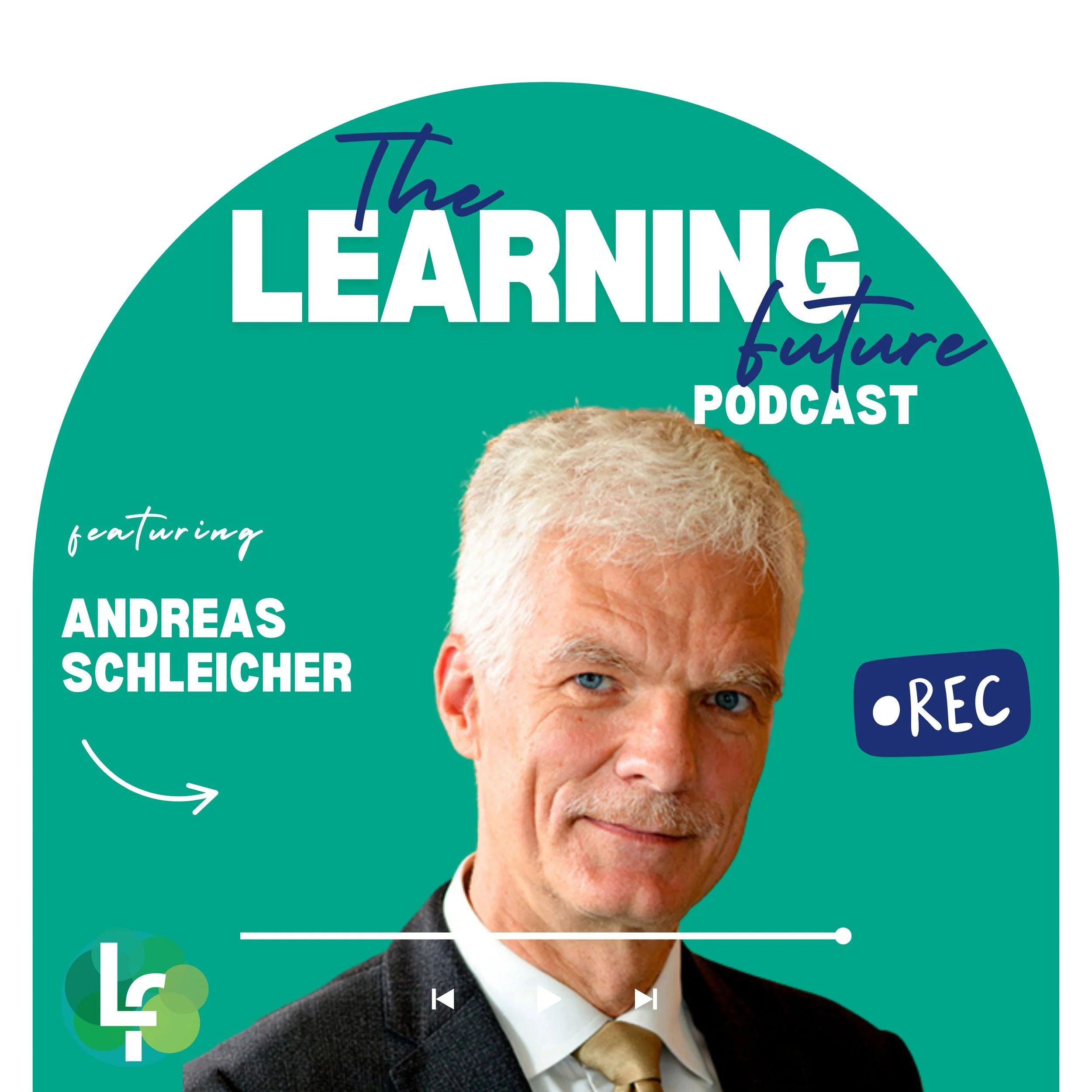
If AI can increasingly deliver content, then the real question for schools is no longer how we teach—but what education is actually for?
The systems that flourish in the future may not be the ones that optimize transmission, but the ones that protect relationships, agency, curiosity and deep human growth?
🎙️ Episode Summary
In this episode of The Learning Future Podcast, Louka Parry speaks with Andreas Schleicher, Director for Education and Skills at the OECD, about the changing purpose of education in an age of AI, uncertainty and rapid technological change.
Together, they explore how technology is shifting from being merely a tool to something that challenges what it means to be human. Andreas reflects on both the promise and risk of AI in education: its capacity to free teachers from routine tasks and personalise learning, but also its tendency to encourage cognitive offloading, weaken social connection and erode essential human capabilities if used poorly.
Louka and Andreas also discuss the changing role of teachers, not as content deliverers, but as mentors, designers of learning environments and builders of human connection. Drawing on examples from high-performing systems such as Estonia, Andreas highlights the importance of teacher professionalism, collaborative culture, student belonging and a more intentional design of schools as social spaces.
👤 About Andreas Schleicher
Andreas Schleicher is Director for Education and Skills at the Organisation for Economic Co-operation and Development (OECD). He initiated and oversees the Programme for International Student Assessment (PISA) and other international instruments that have created a global platform for policy-makers, researchers and educators to innovate and transform educational policies and practices.
He has worked for over 20 years with ministers and education leaders in over 80 countries to improve quality, equity and efficiency in education. Former U.S. Secretary of Education Arne Duncan said that Schleicher “understands the global issues and challenges as well as or better than anyone I’ve met, and he tells me the truth”. Former UK Secretary of State Michael Gove called Schleicher “the most important man in English education” – even though he is German and lives in France (The Atlantic, July 11).
As a key member of the OECD’s Senior Management team, he supports the Secretary-General with analysis and advice to advance economic growth and social progress, and promotes the work of the organization on a global stage. He also provides strategic and managerial oversight of the Education and Skills Directorate’s 200 staff.
He studied Physics in Germany and received a degree in Mathematics and Statistics in Australia. He is the recipient of numerous honors and awards, including the “Theodor Heuss” prize, awarded in the name of the first president of the Federal Republic of Germany for “exemplary democratic engagement”.
He holds honorary Professorships at the University of Heidelberg (Germany) and at the Borys Grinchenko Kyiv Metropolitan University (Ukraine).
🔗 Connect with Andreas Schleicher
🔗 Stay Connected with Louka Parry
For the latest learning innovation follow Louka on LinkedIn
Share your thoughts by visitingwww.thelearningfuture.com
Tune in to be inspired, challenged, and reminded why love truly is at the heart of learning.
[Transcript Automated]
Louka Parry (00:08)
Well, hello, dear friends and welcome back to the learning future podcast. I'm your host, Louka Parry Today, it's an absolute delight to be speaking with, in my view, one of the most influential voices in global education. Today's guest is the director for education and skills at the OECD, Andreas Schleicher. He leads the OECD's work on education policy and is best known for major international studies and reports, including the program for international student assessment, commonly known as PISA.
He works with governments and system leaders to better understand quality, equity and readiness for the future. In this conversation, we're going to kind of explore the latest work, what's happening to learning systems, the role of technology and artificial intelligence and a whole suite of really interesting reports that the OECD have been releasing recently. Hello, Andreas. It's great to see you again. Welcome to the podcast.
Andreas Schleicher (00:56)
Thanks so much for hosting me.
Louka Parry (00:58)
My first question is always the same in these conversations and it's a personal question around your own learning. What is something you are learning at this point? Something that's in the forefront of your mind.
Andreas Schleicher (01:09)
Obviously, you know how we engage with technology, you know, in the past we used technology, we looked at technology as a tool, so did I, and I think now technology challenges in who we are as humans. And I do think that's completely new experience that I see for myself, that I see around me.
Louka Parry (01:29)
Are you just before we get into kind of the OCD work as a as someone that is a learner yourself and you know you've studied here in Australia and you have a whole suite of different professional degrees. How are you finding your own use with some of the latest technologies that are like how are you finding your workflow your thinking influences.
Andreas Schleicher (01:48)
Well, you need I see I can see that a lot of things where I spend a lot of time was in the past. Technology can now do equally well. On the one hand, it frees up time for new things. I think that's really, really great. From writing a summary of a meeting to actually ⁓ summarizing reports and so on. At the very same time, you also see that ⁓ what we call
metacognitive laziness, know, sort of easily outsource some of your thinking and as humans we are always prone to trade in our autonomy for convenience. And I can see that on myself, you know, I think that's a real risk in this world that we give up essential human qualities simply because it seems that, you know, technology does those things as well.
Louka Parry (02:19)
Mmm.
I've heard you speak many times, ⁓ especially about what it means to be human in this digitizing era. I'd love you to talk a little bit about what you're noticing and seeing in terms of the role of teachers or some of the digital education work that you've done. You released a really, I think a pretty comprehensive report, the digital education outlook, just in January gone. And it looked at the use of generative AI in education. so as we're talking about, cognitive offloading.
has pretty negative benefits, but there's also use cases that are positive. So take us into that world a little bit more around how we're seeing this technology used in learning systems.
Andreas Schleicher (03:21)
You know, I think the short story is that learning is always about social relationships. Learning is always about cognitive effort, you know. You do not become fit by watching sports. You become fit by doing exercise. Yeah. And it's the same as with the brain, you know, I think it's about investing yourself, putting your energy behind something, having a teacher who understands who you are, who you want to become, who really accompanies you on your
Louka Parry (03:35)
Ha
Andreas Schleicher (03:50)
your learning journey, and where technology supports that effort, that cognitive struggle. Great, you know, I think can do magic, but where it undercuts that effort, it really, you know, that's where the problems occur, where technology, you know, makes things seemingly easier, you know, gets us, you know, to avoid that kind of effort of learning.
becomes particularly for children a replacement for genuine social relationships. And I think what we need to see is that as humans we are so much more than the sum of automatable tasks, know, our capacity to build complex social relationships, our capacity to create something genuinely new, our capacity to distinguish between good and bad and right and wrong. And I think those kinds of human
capabilities could get lost. And they are not just, you know, the goal of education, they are very much the foundations of our societies, our democracies. if teachers do not protect those capabilities with determination, then know, AI could wash away the very foundations of our societies. think that's, know, in a nutshell, it's not a magic power, it's an amazing amplifier and a great accelerator. can
amplify good educational ideas and good practice in the same way it can amplify bad pedagogy and bad practice. As a teacher it can make you the designer of the most imaginative learning environments, know, that's what AI can do and it can disempower you to become the slave of algorithms. And I think that's difficulty is to navigate that landscape.
Louka Parry (05:21)
Yeah.
When I first came across the Education 2030 work some years ago, Andreas, it really shifted my lens, especially the learner compass and the more recently released teaching ⁓ compass, believe, as well. so I just remember, you know, in some ways, I'd love you to speak to this, you the OECD as a think tank in Paris, quite influential, you know, and this idea of, you know, looking at high achieving systems.
And then realising the journey, perhaps even your own professional journey to note, ⁓ we are so much more than just the score. And so I'd love you to take us into that world because the OECD seems to really have a more nuanced and sophisticated way of talking about what success is today, far more than here in Australia, as you well know, you know, having a single numerical score which determines your tertiary admissions ranking. So
What would you say the things that you point to based on that, what we understand about human flourishing rather than just an achievement paradigm?
Andreas Schleicher (06:46)
Yes, this is I think the most fundamental question that we need to ask ourselves. It's no longer just, you know, how we educate, but what's the purpose of education and what do we educate for? And yeah, we have our OECD learning compass, but actually, and more recently, we also incorporated those ideas into how we measure education success. For example, if you look at the latest edition of the PISA assessment, yes, we measure success in academics, you know.
science, problem solving and so on. But we also measure things like psychological strength and well-being. We look at emotional resilience. We look at human agency. Can you mobilize your cognitive social emotional resources? We look at the strength and quality of social relationships. We look at the capacity of students to see this world through different lenses and...
Louka Parry (07:28)
Mm.
Andreas Schleicher (07:41)
perspectives, can you appreciate different ways of thinking, can you engage with plurality, all of those kinds of issues. And when you do that, you can suddenly see that, you know, some education systems may be very good at the academics, sometimes at the expense of other, you know, social emotional outcomes, and other countries actually build academics through.
social and emotional outcomes and actually do well on both sides of the spectrum. So I think that's really, really interesting that you can see when you look at educational outcomes through a multi-dimensional lens, you can see the relative strengths and weaknesses and you can suddenly see how they are actually mirrored in how teachers interact with students, how teachers work, the way the work of teachers is organized. And that's really, think, the learning compass. It helps you to look fresh at
education systems in a way that is relevant to the future of people and our systems.
Louka Parry (08:41)
One of the things that strikes me still ⁓ as we update this work for 2040 is this idea that collective wellbeing is a shared destination. And I just find that immediately you change the frame of reference and the questions that we ask are different. Unfortunately, a lot of the discourse we see in media is about the decline in results. I'd love you to talk through what you're seeing globally around the decline and perhaps the impact.
And you know, we're some interesting conversations at the moment in California about Big Tech and its role on impacting cognition and mental health. And so we'll see how those land. But then also, what's the positive story here? You know, the sense of belonging and you're talking about social cognition, know, schools are not as potentially people thought disappearing, Andreas, they are becoming even more important spaces for belonging, for the social and emotional skills with that academic rigor to exist. So
Tell us a little bit about the map over the last couple of decades. What have you noticed?
Andreas Schleicher (09:44)
You know, I do think that the decline in academic results is a real problem. You know, have ⁓ many young people who, you know, have difficulties distinguishing from opinion, who navigate complex material. And that, think, should concern us. The question is, that the cause or is that the effect of the way we learn? And at the very same time, you know, that we see how...
students' sense of belonging, the question of is school a place where I find out who I am, why I'm here on that planet, what the world needs from me, how I can discover, where I can become really good at and serve a social purpose. That is often a very important driver also of academic success. I think we should not think about academic outcomes
at the expense of social-emotional outcomes, but again, academic outcomes through those ⁓ factors. as you say, school is the first place where you actually encounter that. School has a very, important role. And if you only think about learning as a transactional business, well, you can question whether we need school. Couldn't we sit everybody behind a screen with a good, you know, AI-based kind of learning system?
Louka Parry (10:52)
you
Andreas Schleicher (11:08)
And probably when it comes to ⁓ transmission of knowledge, to some extent that's going to work. But that will not make us human. That will make us second class robots, not first class humans really. And I think that's where we need to design school much more intentionally as a social space. In a way we talk about it, we assume it sort of is because it's always a place where people relate to, but you know...
still a lot of time students spend behind individual desks learning some form of content and at the end being tested whether they are better than their neighbor. You know, I mean that is actually, you know, working against that mission. I think technology certainly pushes us to think about the mission of school. What is it that we want to achieve? What is the role of a teacher? Are you, you know, just, you know...
transmitting knowledge or are you a coach, are you a mentor, are you ⁓ a designer of, you know, personalized learning environments? I think those questions really come to the forefront.
Louka Parry (12:15)
I'm really interested in the evolving role of an educator today. I think this, you know, educator as instructor versus educator as activator or facilitator or guide. And of course, this, you know, as the purpose of education perhaps shifts, what are you seeing in different systems that do this work well? Where there isn't just a reductionist transmission
understanding of I teach you learn. There's perhaps someone you want stuff I create conditions and experiences in which you learn.
Andreas Schleicher (12:53)
Yeah, know, I think in last years we have seen in many countries a quite unhealthy trend towards kind of commodifying education. We see students as consumers of learning content. We see teachers as some kind of service provider to facilitate that. We see parents as a kind of client of the school. And that has actually created some really unhealthy distances, almost, you know, challenge the core of education. We're just always, you we are in that together. This is our joint.
experiences is this is about the environment that we create joining and you can see that you know in that decline of students motivation student sense of belonging you know you can see that in sometimes you know teaching not no longer becoming a very attractive jobs and I think that's something that we really need to challenge I almost also say you know we perhaps even on the part of teachers themselves you know
Louka Parry (13:32)
Hmm.
Andreas Schleicher (13:51)
We see many education systems where education has outsourced social responsibilities of teachers to some other professionals. That may look very convenient. Okay, you know, now I have a teaching assistant and a psychologist who can take over some of the tasks, you know, ask yourself in the systems where you see that what this means in practice. It means that...
the students who may need you most will no longer see you because they are being cared about by some specialist. It may mean that your own perspective of diversity is being reduced to a much more myopic version. It means that you spend more time maybe teaching but less time spending with students outside the formal kind of classroom environment. And when I look at
Louka Parry (14:36)
you
Andreas Schleicher (14:39)
really hard-performing education systems, by that I mean systems that do well on the academics, that do well on social, that do well on emotional outcomes. Typically teachers have a broad range of responsibilities. They may teach a few hours less, but they certainly spend a few hours more with students outside the classroom setting. you know we can actually measure that when we look at this through the student perspective. It's really interesting when you ask students, you know,
Louka Parry (14:52)
Interesting.
Andreas Schleicher (15:07)
Do you believe your teacher knows who you are and who you want to become? The answers may vary, be different across education systems. We have one question in Pisa where we ask students, if you come back to your school three years from now, do think your teachers will be excited to see you? And you can actually see when teachers, when students respond positively, everything works. The academics work, the motivation is there. Everything is positive. When students say no,
Louka Parry (15:31)
Yeah.
Andreas Schleicher (15:36)
and it's all about transmission and transaction and we've lost that kind of social dimension of teaching. And in some countries, know, mean, England was the first country where teachers 15 years ago complained, you know, I have a lot of disciplinary problems in my class, have, you know, I can no longer do justice to students, I needed teaching assistance. And then, you know, at that time the government said, okay, you know, let's give every teacher a teaching assistance and you just teach a couple of hours more and therefore...
as a replacement for that you get this teaching assistant. But you know 15 years later teachers are not any happier. They have not seen any reduction in their stress. They have seen their work becoming more monotonous, more focused on they've lost contact to many students who need the most. And I think that's something that we should take to heart. How would you define that set of responsibilities of teachers?
Louka Parry (16:12)
Interesting.
Andreas Schleicher (16:31)
both from the side of students and from the side of the education profession.
Louka Parry (16:36)
Gosh, that's so beautifully put, Andreas. And I'm really pleased as data to back that up. Sometimes, you know, I feel like we're a bit of a broken record in education saying, you know, relationships are the foundation for everything else. And of course, we can become too obsessed with that and lose the rigor. But it is a noticing for me as well that I think in some global education systems, and I'll talk about Australia, which I know the best, there is this interesting agenda, which is we can package somehow.
education as if it is a simple problem rather than a complex problem. And the input output, I do this, you do that, and it works. And know, cognitive load theory and other theories here are quite popular at this point in time. But I'd love you to talk more about these systems that seem to be able to do this well. And I know that in some of your latest reports, you've called out these and some of the features to them. The role of the teacher being one. What else do we know about these systems that seem to
in terms of the equity and excellence connection as well is an interesting thing to also unpick.
Andreas Schleicher (17:41)
Yeah, know, we just had our annual summit of the teaching profession in Estonia. And that's an amazing system. You know, it's a system that actually works with very limited resources simply because Estonia is a comparatively poor country. But you look at the trajectory over the last 20 years, and it's just amazing how that system has reinvented itself, you know, almost multiple times. Technology.
Louka Parry (17:51)
Mmm.
Andreas Schleicher (18:08)
I visited a kindergarten during that experience and you know you one educator with 24 small kids, know, five year olds and you think, well, how is this going to work? This is impossible. Workload and so on. But then actually when you saw it, it was simply amazing. First of all, this was an educator who was highly educated, highly motivated. You could really see this is someone who is realizing her dream and
in this kindergarten. you know, they were out in the snow. They were making a fire there, you know, in my own country, in Germany, you know, if children make a fire, have, you know, certain policemen standing around making security. Here you had the children doing fire and the teacher, you know, giving, you know, some calm advice, but the children learn to organize themselves, to take responsibility for themselves, for other people. The teacher's role was about to create that environment.
Louka Parry (18:49)
Hahaha
Andreas Schleicher (19:07)
Do they learn to read and write? Actually, that's not the focus in kindergarten in Estonia. It's about building curiosity. It's about building those human qualities that later on when you get in school, you have all that energy and you start right through it at age 15, you surpass students in Australia by a large margin on the academics. But I think
Louka Parry (19:29)
Yes.
Andreas Schleicher (19:29)
Doing the right thing at the right time, focusing very much at the quality of social relationships, creating that environment in which learning happens. You cannot push a rope. You cannot simply make this kind of deal, a kind of transaction. And you need to get the learner into your space. And that's an example where you could see that and equity.
is a natural outcome of those kinds of systems. It doesn't come from smaller classes. It doesn't come from, you know, a specific kind of material. It comes from, you know, the teacher being aware of each and every student and their needs and their purposes and their intentions and then creating the right conditions, often with the help of, you know, ⁓ specialists without any question. think that all comes very natural. But that's just, you know, one
type of education system. And you can find many of them. mean, we look at those things often in a quite abstract way, through data and numbers. know, I always look at the kind of system once I've seen, you know, they are so successful, what lies behind of those success? What can I see in terms of pattern here? you know, for the most interesting finding for me as a scientist is that 75 % of the variation in outcomes, you can explain.
with things that we can observe. There is still some magic behind things that we don't really understand, but most of the things that actually lead to the success of education are ones that we can actually name. Whether we live them is another question, but it's not rocket science really.
Louka Parry (21:10)
100 %
Yeah, I love that. ⁓ It feels quite empowering, actually, Andreas, to be able to be, so of course then there's the knowing doing, well, there's the, first of all, the gap to know what those things are. And then there's, and you called this piece in as well. And then there's the kind of the embodiment of that. And again, I wonder what your reflection on building capabilities would be at a system level. You know, when you think about how do you see teachers go from a novice, they'd be very passionate.
as I first was when I walked into my first classroom, passionate, but only with a pretty limited toolkit at that point in time. How do you see systems really support the holistic development of the adults and the professionals in these environments so that you can walk into a classroom and see a pretty consistently passionate, attuned, understanding the social fabric, but also being able to deploy some of the academic rigor? What are some of the features of those capability building models?
Andreas Schleicher (22:07)
Yeah.
You
know, clearly, know, passion is important. think the first thing a student will see in you as a teacher, whether you own your subject, whether you live that with passion. that's, you know, one of the reasons why sometimes, you know, vocational education training is more engaging for kids than, you know, academic education. When you work with people who do their job, who you work with real people, you work on real problems, you make mistakes that have real consequences. So I think
That passion is very important, but we shouldn't underestimate the importance of professional competence. You know, in one month, we are going to release ⁓ results from our first survey of teacher, professional, pedagogical knowledge. And what you will see there is that the most powerful predictor on academic learning outcomes is actually that deep understanding of pedagogy on teachers. So passion alone is a start, but you structure.
Louka Parry (22:54)
Interesting.
Andreas Schleicher (23:08)
you need actually to have a deep understanding of how students learn and how different students learn differently and we have the tools to engage with this and those kinds of tools change as time evolves. Think about new technologies, think about ⁓ increasing social diversity. You cannot prepare yourself for life as a teacher. We used to learn to become a teacher and now learning is being a teacher.
I really think that that transformation that as a teacher you need to be a learner, you need to be open, you need to be willing to question your own practices. Are those still the most relevant tools? How has the context changed? How are my students evolving? You know, I mean, that's again one of the risks of AI that you rely on in learning analytics to, you know, predict behavior based on what you saw in other students. You know, your role as a teacher is to see what's unique in that.
Louka Parry (23:37)
Yes.
Andreas Schleicher (24:05)
person in front of me? How is this person different? What can I do for him or her? And I think that's really, I think, something that combination of, ⁓ yes, passion for your subject, passion for your students, but then also a good level of structure and the willingness and capacity of teachers to grow and evolve. And I think often that's what we miss in our education systems. We have still that idea, you you get your degree, then you're ready, and then you're on your own in the classroom.
That's also why, you know, professional autonomy is only one side of the coin. The more important part to make it work is actually a collaborative culture where teachers work together to frame good practice. Again, you asked me for a hallmark of a high performing education system. It's that collaborative culture, that learning environment. Yes, I share my experience from my classroom. I, you know, I engage in research and understanding and advancing the profession, my own and that of my colleagues. And I think
That is something, creating that space for that, creating the support, that's really, I think, the best way how we can advance teacher capabilities. You sometimes I think, well, you know, you may make the entry easier. You know, why actually requiring people to study for many years before they get into a classroom? Why not, you know, starting that process earlier, but then redoubling our effort to help people grow in that profession?
Louka Parry (25:27)
Mm.
Yeah, I feel like the plateau is a challenge for all of us as adults. know, I think even it's still a bit of a revelation for many adults to realize that schooling is not learning. And just because you finished school or you've done your macro credentials and postgraduate, you know, you yourself really at the center of global learning, constantly learning, you know, it's kind of the paradox. So it will never end. Andreas, I really love this takeaway. You said you cannot push a rope.
I've never heard that before and I find something around the motivational conditions, both for adults and young people to come to a physical space, to be embodied in some way, really, really compelling. I've only got two final questions for you ⁓ out of this list of 100 that I've got. But one is... ⁓
If you, what do you still think we're overvaluing and undervaluing in our education conversations? What do we think we're kind of missing?
Andreas Schleicher (26:30)
Yeah, I think what we overvalue is, you know, the importance of prefabricated knowledge. I mean, when I said, you know, we have too many young people who cannot distinguish fact from opinion, navigate ambiguity. It's not because those things are so hard to learn. It is because much of education is still designed to make you believe something. I mean, I'm a scientist, you know.
You can see how we often teach science like religion. You know, we make you believe in some scientific theory, we give you lots of exercises, the practices, at the end we test whether you can reproduce the answers that we projected into this. It has by the way nothing to do with science. Science is always about questioning what we know, not about reproducing what we know. But that's still very much ⁓ something that we do in education because we've always done that. So that's...
overvalued also because again that's technology challenges us most. think what is undervalued is that you know human growth, seeing failure as an opportunity to support that human growth. What we undervalue is also again the quality of ⁓ social relationships, not just in their own weight but also as an important you know predictor.
of student engagement, student motivation, student academic growth. And I think that's something that happens when you have an amazing teacher. That's very clear, but it doesn't happen necessarily because the way we design our education systems. And I think that's something that probably we can do a lot better.
Louka Parry (28:17)
Fantastic. Final question for you, Andreas. ⁓ What's your take home message for listeners? What is something you want them to sit with in their own journey of curiosity? Let's call it.
Andreas Schleicher (28:29)
Well, you know, think never before has the role of a teacher been more important than it is today, but also never before has it become so interesting. I really believe if we use technology well, it can free us of the kind of things that, you know, cause stress, you know, like administrative work, transmission of content and so on. can actually, you know, put teaching back to its core mission, you know, and if you get
Before the time of school, we all learned through apprenticeship. We didn't have that kind of very structured approach. We learned from and with people. I do think that is... you ask teachers in Australia, why did you become a teacher? Most will respond, it's because I want to build human relationships. I want to support young people in their learning growth. And I think we now have that possibility to make this happen.
Louka Parry (29:28)
Andreas, thank you so much for joining us and for the work you continue to champion out of the OECD. It's an absolute delight. Thank you.
Andreas Schleicher (29:34)
Thanks so much. Pleasure.